Picking a language to learn feels simple until you realize how dramatically the time commitment differs from one language to the next. A year of regular study might get you comfortably fluent in Spanish, but barely functional in Arabic.
For over 70 years, the U.S. Foreign Service Institute (FSI) has been training American diplomats in foreign languages, which gives them a dataset that most language researchers would envy. Based on nearly three-quarters of a century of classes, FSI has been able to categorize languages according to the average time it takes students to reach professional working proficiency (rated S-3/R-3 on the Interagency Language Roundtable scale). Their schedule calls for 25 hours of class per week, plus three or four hours per day of directed self-study, totalling around 40 hours of language exposure each week.
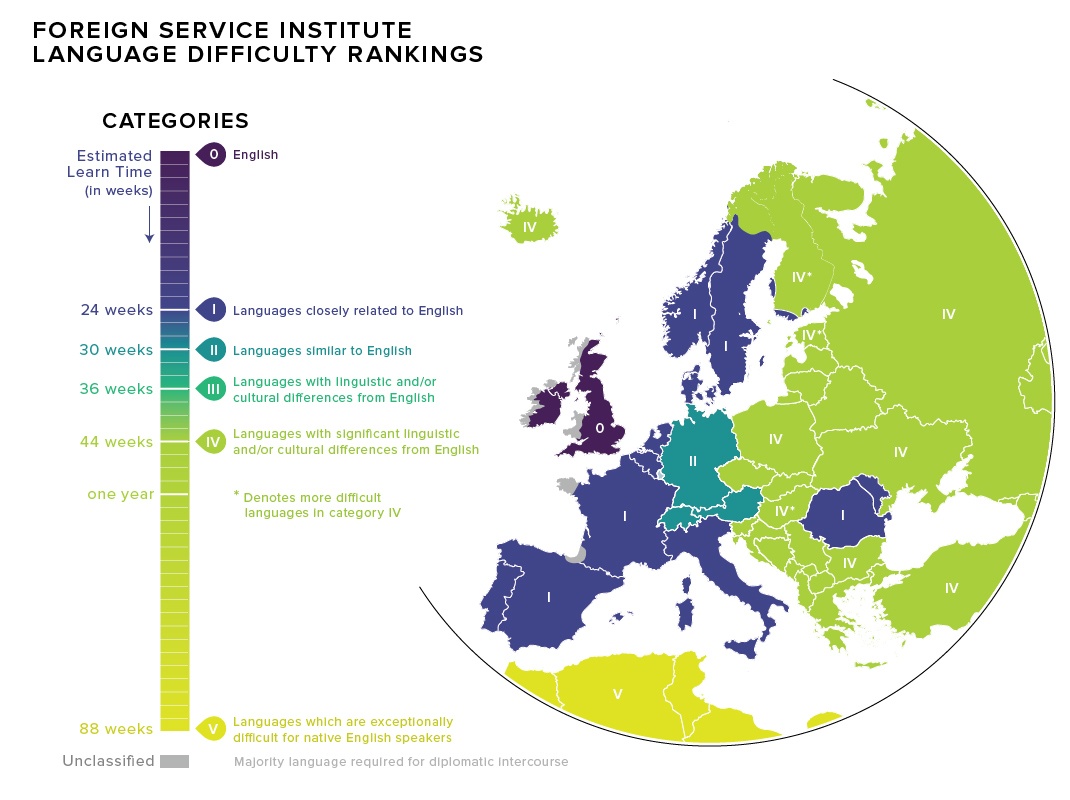
The maps below show language difficulty rankings according to the Foreign Service Institute.
Category I languages require 24-30 weeks or 600-750 class hours. These include French, Spanish, Italian, Dutch, and Swedish. All Romance and Germanic languages, they share enough grammar structure and vocabulary with English that learners can make fast initial progress.
German is the only entry in Category II, requiring around 36 weeks of intense study. It shares a lot of basic vocabulary with English, but German uses cases, which means words change their form depending on their role in the sentence, and its four-case system, combined with unusual sentence structure, earns it a category above its Germanic relatives.
Category III covers Indonesian, Malay, and Swahili at a similar time investment to German. Two of these languages are from Southeast Asia; Swahili is from East Africa. None of the Category III languages are European.
Category IV is where the difficulty increases substantially. Slavic languages (Bulgarian, Polish, Russian, Serbian), Baltic languages (Latvian, Lithuanian), Finno-Ugric languages (Estonian, Finnish, Hungarian), and also Greek, Turkish, and Icelandic all fall here. Category IV languages require 44 weeks (1,100 hours) due to significant linguistic and cultural differences from English. Hindi also belongs in this group, despite its very different script.
Category V stands apart from everything above it. Arabic, Mandarin, Japanese, Korean, and Cantonese each require approximately 2,200 hours of practice (88 weeks) to reach professional proficiency, nearly four times the investment needed for French or Spanish. Most of these languages use writing systems that take years to master on their own. Korean is an interesting exception: Korean has a writing system that’s counted among the world’s easiest, so the script is not the reason for its Category V ranking. The difficulty comes primarily from grammar that works on fundamentally different principles than English.
FSI Category
Class Hours
Study Weeks
Languages
I (Easiest)
600-750
24-30
Afrikaans, Danish, Dutch, French, Italian, Norwegian, Portuguese, Romanian, Spanish, Swedish
Keep in mind that FSI results come from highly motivated, full-time learners in small classes. For most people studying part-time, the actual calendar time will be longer.
Category I languages are the easiest for English speakers, who can reach reading and speaking proficiency within about half a year of intense study. There is a mix Romance and Germanic languages in this classification, including Dutch, Swedish, French, Spanish, and Italian.
Though German is very closely related to English, there are grammar quirks that bump it up in difficulty. FSI estimates it would take 30 weeks of intense study to become proficient in German.
Category III languages are mainly spoken in Southeast Asia, and they include Indonesian and Malay. Swahili also counts as a Category III language.
Category IV includes the most challenging European languages for English speakers to pick up. Here you’ll find Slavic and Baltic languages such as Polish, Croatian, and Latvian, as well as Greek, Turkish, and Icelandic.
This category also includes Finnish, Estonian and Hungarian. These Uralic languages have the distinction of being particularly challenging for English speakers to master as they have little in common with any other European languages. FSI estimates it would take a year of intense study to become proficient in these languages.
Languages in category V are the most challenging for English speakers because they generally have completely unfamiliar scripts and cultural assumptions. These languages are most common in Asia and the Middle East.





Category I languages are the easiest for English speakers, who can reach reading and speaking proficiency within about half a year of intense study. There is a mix Romance and Germanic languages in this classification, including Dutch, Swedish, French, Spanish, and Italian.
Though German is very closely related to English, there are grammar quirks that bump it up in difficulty. FSI estimates it would take 30 weeks of intense study to become proficient in German.
Category III languages are mainly spoken in Southeast Asia, and they include Indonesian and Malay. Swahili also counts as a Category III language.
Category IV includes the most challenging European languages for English speakers to pick up. Here you’ll find Slavic and Baltic languages such as Polish, Croatian, and Latvian, as well as Greek, Turkish, and Icelandic.
This category also includes Finnish, Estonian and Hungarian. These Uralic languages have the distinction of being particularly challenging for English speakers to master as they have little in common with any other European languages. FSI estimates it would take a year of intense study to become proficient in these languages.
Languages in category V are the most challenging for English speakers because they generally have completely unfamiliar scripts and cultural assumptions. These languages are most common in Asia and the Middle East.
Source: http://www.visualcapitalist.com/language-difficulty-map/