These letters didn’t start in England. They came from Italy. Greeks were using something similar before that. Phoenician traders had their own version before the Greeks. Your alphabet has a family tree.
Germans borrowed Latin letters. Poles and Czechs did the same. Russians got Cyrillic from scholars who were working in the Balkans centuries ago. Persian is written in a form of Arabic script.
Reddit user @Shoddy-Fan-584 wondered which countries actually write in systems invented on their own land. Not borrowed from neighbors. Not adapted from somewhere else. Actually created there.
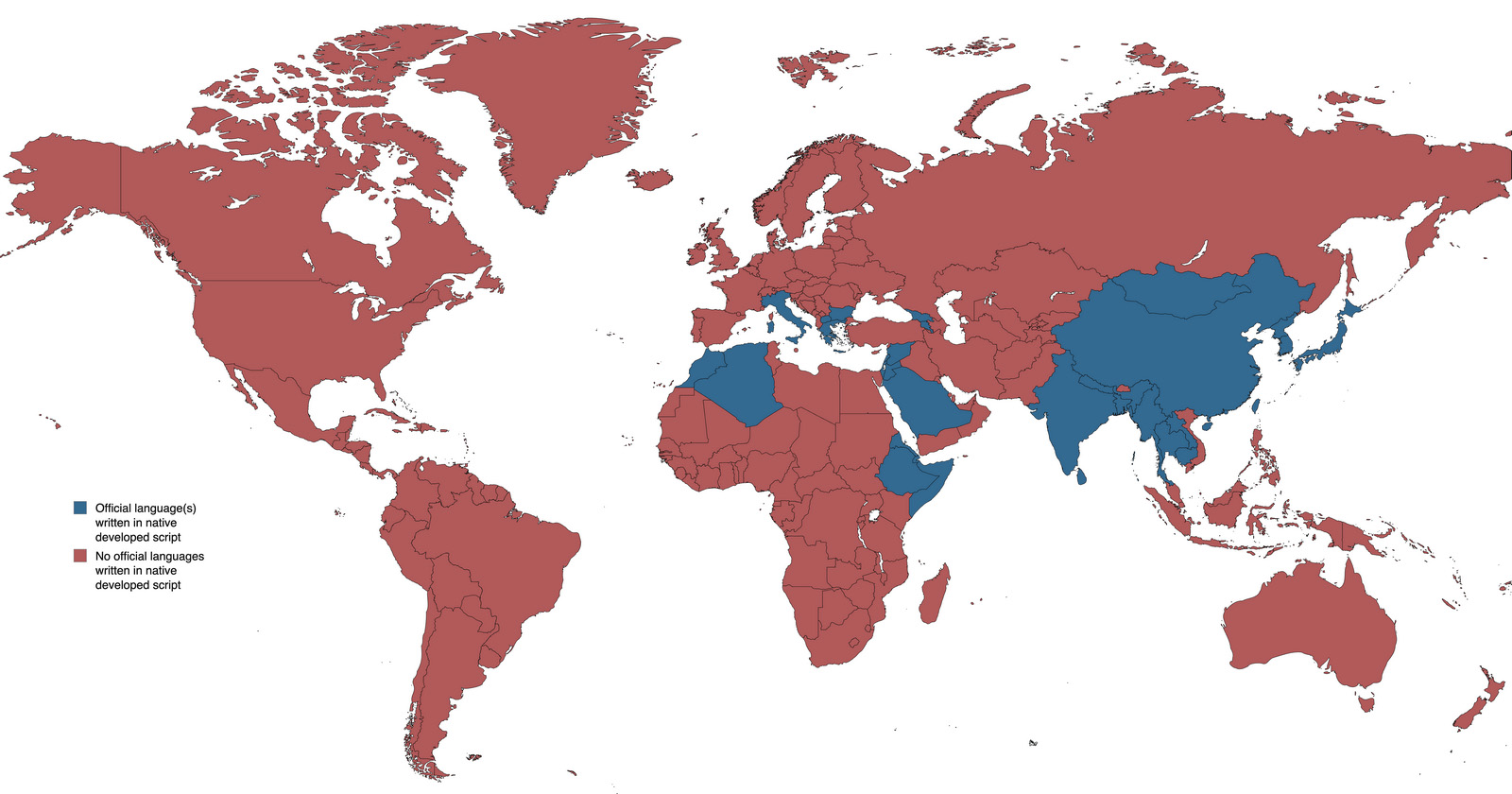
Red means borrowed. Blue means invented locally (just 27 countries show up blue).
Start with Africa. Tifinagh has been used in North Africa for thousands of years, and Morocco and Algeria still write Berber and Tamazight in it. Ge’ez is even older—Ethiopia and Eritrea both use it.
Italy is blue because Latin script started there before going global. Greece invented its letters there. The Cyrillic alphabet? That came from medieval scholars in what’s now North Macedonia and Bulgaria. Georgia has Mkhedruli. Armenia created a specific alphabet back in 405 CE.
India developed multiple scripts. Devanagari is probably the one you’ve heard of. Bangladesh has Bengali. Nepal made its own systems. Sinhala comes from Sri Lanka. Bhutan uses Tibetan script. All of these trace back to ancient Brahmi but they’re completely different from each other now.
Look at Southeast Asia—it’s almost entirely blue. Myanmar has its script. So does Thailand. Laos too. Cambodia has Khmer. Vietnam used to write in Chữ Nôm before French colonizers showed up and pushed Latin letters.
China invented its character system way back. Japan made hiragana and katakana on top of borrowing Chinese characters. In the 1440s, Korea created Hangul specifically because Chinese characters just didn’t work well for Korean. Taiwan still writes in traditional Chinese characters. Mongolia has its own traditional script, though most Mongolians use Cyrillic these days.
Twenty-seven total.
The mapmaker who made this map had to decide what counts as inventing versus borrowing. They went with this: if you just added letters to someone else’s alphabet, that’s borrowing. If you changed how the whole system works, that’s inventing.
Poles put marks on Latin letters. Still Latin. Lao came from Khmer originally, but it changed structurally enough to count as independent. Persian looks pretty different from Arabic, but it’s built on the same foundation—borrowing. Russia uses Cyrillic all the time, but Cyrillic came from the Balkans, not Russia—red.
Writing systems spread because they’re effective. Latin works for English. Also works for Polish, Turkish, Vietnamese. Completely different languages, same letters. Arabic script moved into Persian and Urdu.
Why did these 27 bother making their own? Sometimes it was practical—Chinese characters really were awkward for writing Korean sounds, which is why King Sejong had scholars design Hangul. Sometimes it was about independence. Sometimes people just wanted to try something different.