Dante Alighieri’s most famous work is the Divine Comedy, a huge poem you often hear about. But from 1302 to 1305, during his time away from home, he put together another significant book sharing his opinions on Italians from different areas and the local dialects they spoke.
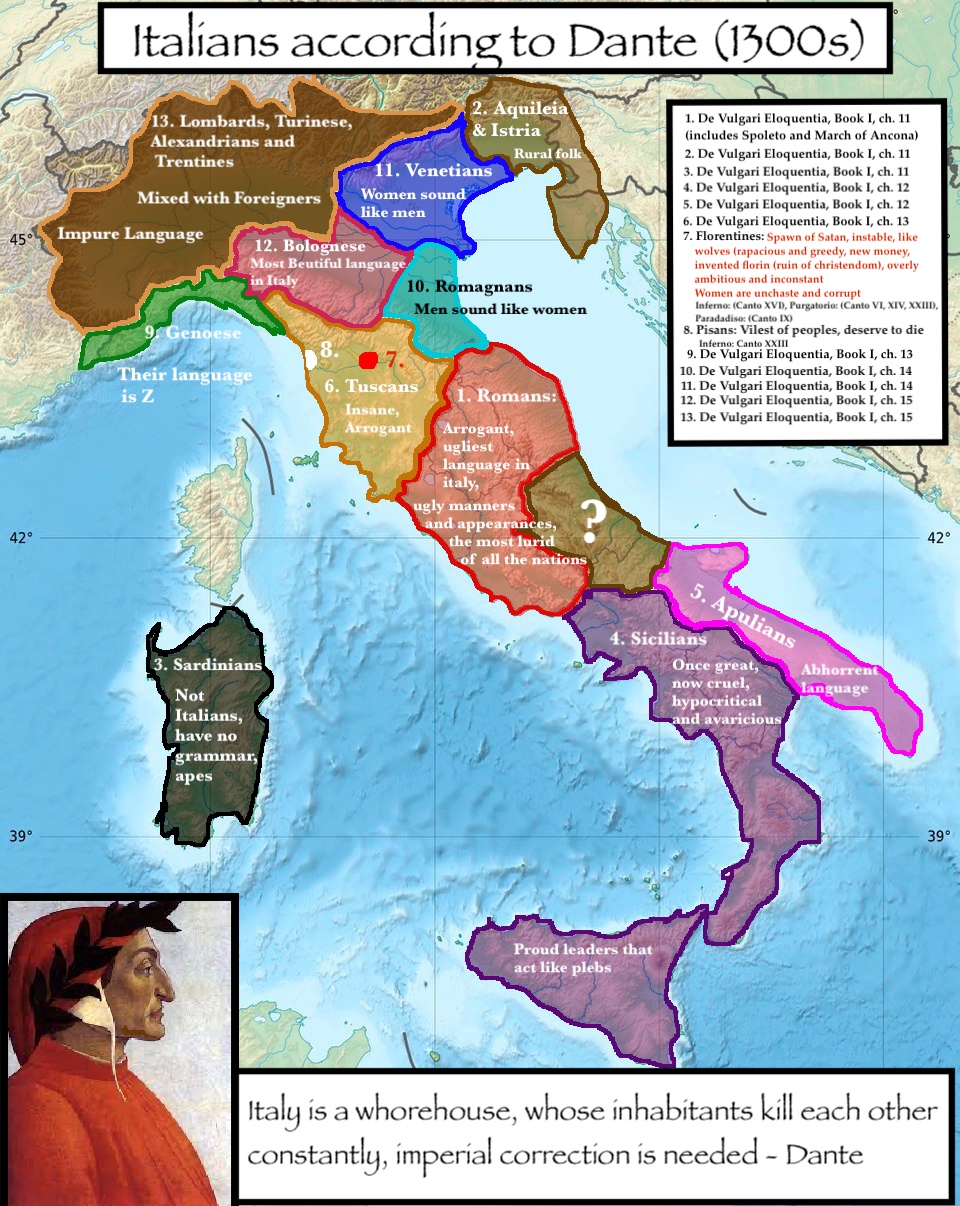
He called it De Vulgari Eloquentia, translating to On Eloquence in the Vernacular, and he wrote the whole thing in Latin, even though the book was all about promoting everyday Italian. Dante basically argued that common Italian should be viewed as equal to Latin for proper literary pieces, which went against the grain back then since Latin was the default for anything serious. He also added in some rough generalizations about people from those parts of Italy. A Reddit user named Trail_of_Tears-T_T mapped out these medieval judgments.
Romans: Ugly People, Ugly Speech
Dante was expelled from Florence in 1302. He spent years traveling in Italy after that, hearing how people spoke in different regions. Rome got his harshest opening attack. Romans should be first for “eradication or extirpation.” Their language was “not language, indeed, but rather squalid speech.”
Their appearance? “The most lurid of all other peoples” with “ugly manners and appearances.”
Sardinians: Not Even Human
Sardinia got the worst treatment. Dante excluded them entirely from being Italian, writing they “are not Italians, but are associated with Italians.” Then he compared them to animals: they “alone appear to lack a language of their own and imitate grammar like monkeys imitate humans.”
Florence: Home Full of Demonic Wolves
Now it gets personal. Dante missed Florence desperately. He wrote about his longing for home throughout his life. But in this book, he called Florentines “spawn of Satan” and compared them to “wolves (rapacious and greedy).”
The florin, Florence’s gold coin, was the “ruin of Christendom” because it “transformed the shepherd into a wolf.” Florentine women were “unchaste and corrupt.” The people were “overly ambitious and inconstant.”
Pisa: Death by Drowning
Pisans were “the vilest of peoples.” Dante got mad that nobody had destroyed them yet. Then he wrote that he wished the islands of Caprara and Gorgona would move and “build a hedge across the Arno’s mouth, so that it may flood and kill you all.”
Men Sounded Like Women, Women Sounded Like Men
Dante had odd observations about gender and speech. In Romagna, men’s voices were so soft and feminine that you’d think “a man is mistaken for a woman, even if he speaks with a manly voice.”
Venice had the reverse problem. Women there spoke so rough and masculine that their voices would “lead you to doubt, reader, that she is a man.”
Sicily: Fallen from Greatness
Sicily used to matter for Italian poetry. Frederick II’s court there had produced the Sicilian School, which influenced early Italian literature. But Dante saw only decline and corruption.
Sicilians were now “cruel, hypocritical and avaricious.” Their once-proud leaders “behave like plebeians and not like great men.” He mocked their pretensions to past glory.
Everyone Else Gets Roasted Too
Apulia had an “abhorrent language.” Tuscans were “insane, arrogant.” Genoa’s language was “Z” (nobody knows what this means). Northern areas like Lombardy, Turin, and Trent were “mixed with foreigners” with “impure language.”
Bologna alone got a compliment: “the most beautiful language in Italy.” One region out of fourteen.
So What Was the Point?
De Vulgari Eloquentia had a bigger purpose. In the 1300s, serious writers used Latin. Italian dialects were for everyday speech, not literature. Dante thought this was wrong. Italian could work just as well.
The book had ambitious plans. Dante wanted to analyze the origin and philosophy of vernacular language, which he saw as something that evolved rather than stayed static. He planned four books total but abandoned the work mid-sentence in the second book.
The first book examined the relationship between Latin and vernacular languages while searching for an “illustrious” vernacular in Italian regions. That’s where all the regional insults live. The second book analyzed the structure of the canto (song), a literary form developed by the Sicilian School of poetry.
He wrote this while traveling as an exile after getting kicked out of Florence in 1302. Hearing dialects across Italy gave him material. Being furious probably sharpened his criticism.
If you want to read the full text, English translations are available on Amazon (affiliate link to Amazon.com).