Pigs vs Camels: How Every Country Compares Per Capita
Key Takeaways
- Denmark keeps close to two pigs for every resident, the highest ratio Eurostat has recorded anywhere in the EU.
- Chad holds the largest camel population of any country on Earth, yet counts fewer than one camel per resident, well below Denmark’s pig ratio.
- Camel meat is halal and central to diets in a handful of countries, but beef, goat, mutton, and chicken replace pork far more often across the wider Muslim world.
- Peer reviewed studies consistently find camel meat lower in fat and cholesterol than beef, mutton, and chicken, and roughly on par with the leanest pork cuts available.
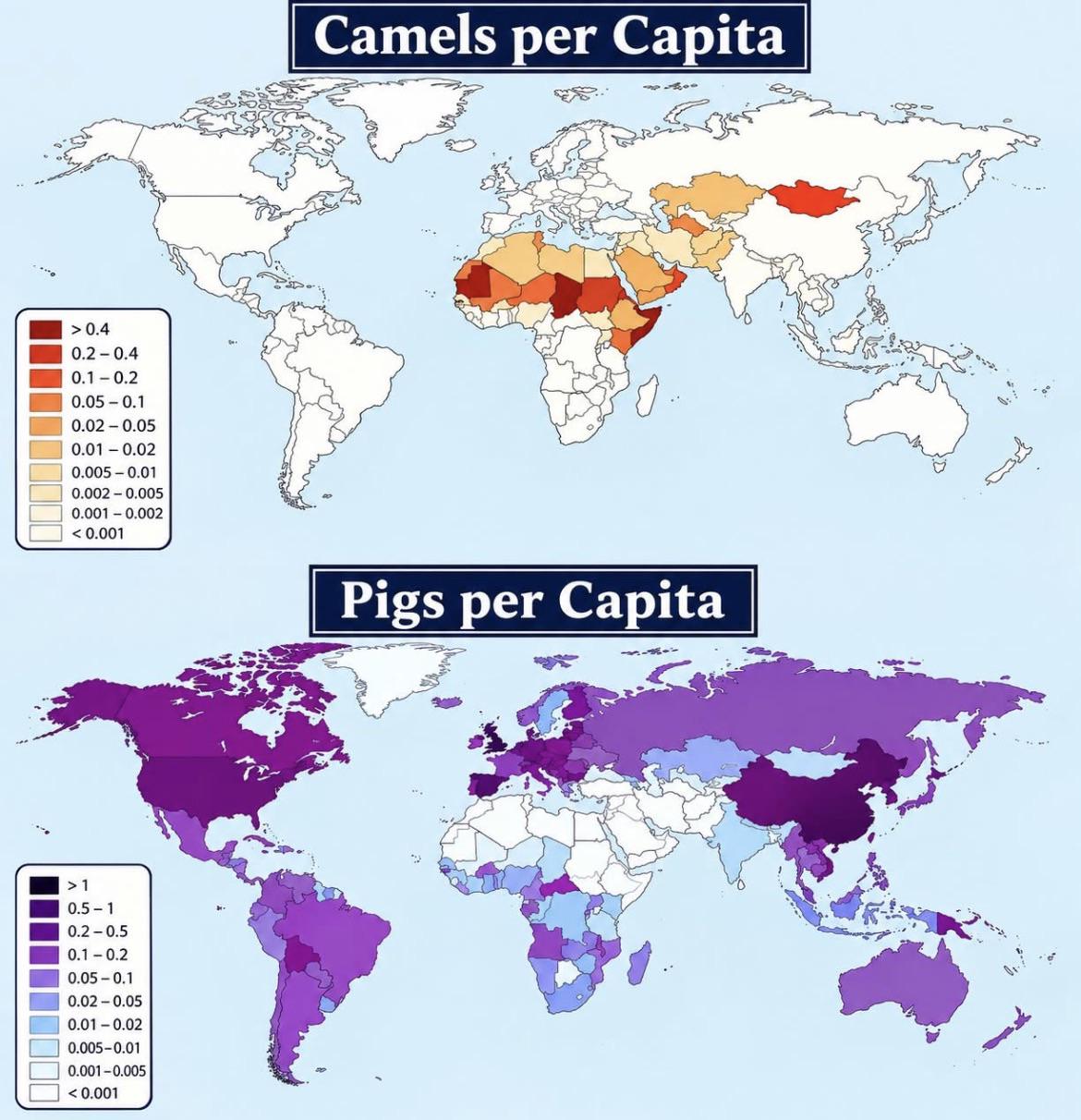
Denmark keeps close to two pigs for every person who lives there, a ratio Eurostat has tracked for years as the highest anywhere in the European Union. No country with camels comes close to matching it. Chad carries the largest camel population on the planet and comes in under one camel per resident. Somalia and Mauritania trail Chad by only a little.
The two maps of the world below show a clear split still exists across the globe. Pigs cluster through Europe and East Asia. Camels cluster across the Sahel, the Horn of Africa, and the Arabian Peninsula. The two zones barely overlap. Religion explains part of that divide. Climate explains most of the rest. Camels handle heat and long stretches without water that would put most pig breeds at serious risk.
| Country | Animal | Human population | Animal count | Animals per person |
|---|---|---|---|---|
| Denmark | Pigs | 6.0 million | 11.6 million | 1.9 |
| Chad | Camels | 21 million | 9 million | 0.4 |
| Somalia | Camels | 19.7 million | 7.4 million | 0.4 |
| Mauritania | Camels | 4.9 million | 1.5 million | 0.3 |
Camel meat instead of pork
Pork is haram under Islamic dietary law, so it barely appears in Muslim-majority countries. Camel meat fills part of that space, but only within a specific band of countries. Sudan, Saudi Arabia, Kenya, Somalia, the United Arab Emirates, Ethiopia, and Mauritania account for most of the camel meat produced worldwide. Outside that band, in Indonesia, Pakistan, Turkey, and most of the rest of the Muslim world, beef, goat, mutton, and chicken take on the role pork would otherwise play. Camel herding never took hold in those places, and the meat never became a regular habit there either.
Camel meat carries one more distinction among halal meats. Several hadith record the Prophet Muhammad instructing people to renew their ablution after eating it, something not required after eating mutton, and the Hanbali school still holds that position today. Most other schools of Islamic law treat the instruction as later relaxed and do not require it.
Camel meat versus pork nutrition
Multiple lab studies point in the same direction. Camel meat consistently comes back leaner and lower in cholesterol than beef, mutton, pork, or chicken.
| Nutrient, per 100 g (3.5 oz) raw | Camel meat | Pork tenderloin, lean |
|---|---|---|
| Protein | about 19 g | about 21 g |
| Fat | about 1 to 3 g | about 2.2 g |
| Cholesterol | about 50 to 59 mg | about 65 mg |
Lean pork holds up well on paper. Its fat and cholesterol numbers closely rival those of camel meat—at least when comparing the leanest cuts. However, that gap widens considerably with the fattier, more commonly consumed portions of the animal. For instance, a broiled pork loin cooked with its fat cap intact carries many times the fat of a tightly trimmed tenderloin.