What do we know about Pakistan? That it’s in South Asia, next to India. Both countries split from British India in 1947. Islamabad is the capital. Karachi’s the biggest city. Ask most people about languages there and you’ll get blank stares.
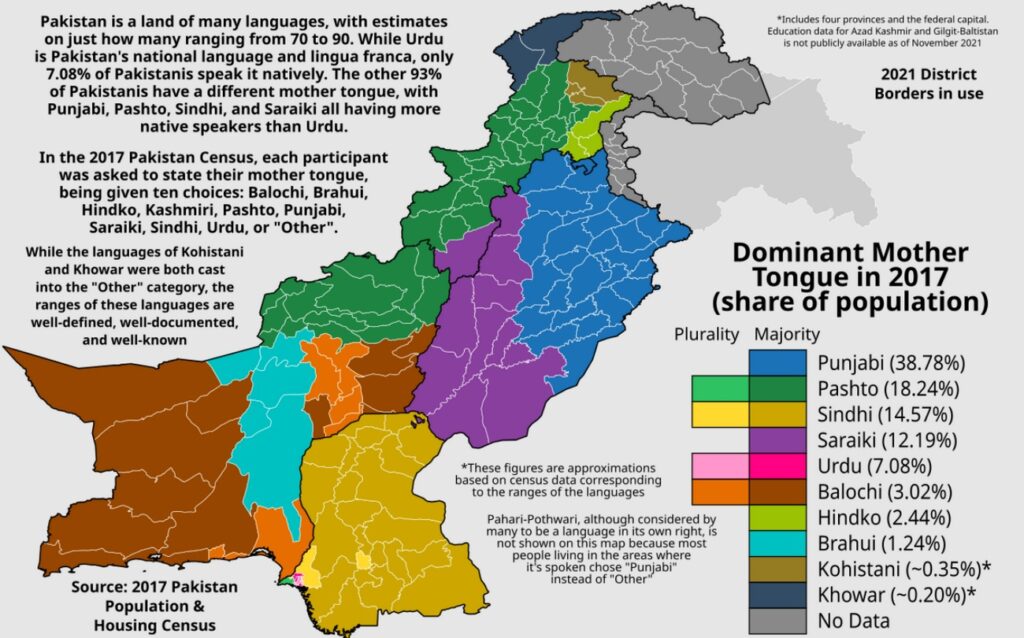
Here’s what got me. When Pakistan became independent, they chose Urdu as the official language. Only 5% of people spoke it then! Now it’s 7%.
Punjabi has five times as many speakers as Urdu. Four other languages beat it too. Why pick a language almost nobody speaks natively?
The 1947 partition left Pakistan’s founders with a dilemma. People of Pakistan would have opposed any local language as a national language leading to a controversy in the new state. Choose Punjabi and the Pashtuns, Sindhis, and Baloch get angry. Pick Sindhi and everyone else feels excluded. Urdu worked because no region owned it. Muslims throughout India spoke different languages and dialects but they could understand and speak Urdu without much effort.
There was more to it than practicality. The linguistic patriotism of Indian Muslims over Urdu played a significant role in the formation of Pakistan, and it had already served as a lingua franca among Muslims in north and northwest British India. The Mughals used it at court. The language’s ties to Islam helped too—Urdu’s link to Muslims and Islam is one of the reasons behind declaring it as the national language of Pakistan.
Urdu itself goes back to around the 12th century. It came from Persian, Arabic, Turkish, and local Indian languages mixing in the Delhi region.
What surprised me most: Urdu and Hindi are mutually intelligible regional dialects of the same language written in different scripts. The phrase “This is a book” comes out as yeh kitaab hai in both. The difference is the script—Hindi uses Devanagari (derived from Sanskrit), Urdu uses Nasta’liq (modified Arabic).
They diverge in formal vocabulary. Hindi borrows from Sanskrit, Urdu from Persian and Arabic. The Hindi word for “country” is desh, the Urdu word is mulk. Pronunciation varies too. The letter ف sounds like “F” in Urdu but “Ph” in Hindi. The guttural ق in Urdu becomes a plain “K” in Hindi.
Today about 95% of Pakistanis understand Urdu even though only 7% grew up speaking it. Kids learn it in school as a required subject through secondary level, which turned millions of people into second-language Urdu speakers.