The Great Islands Map
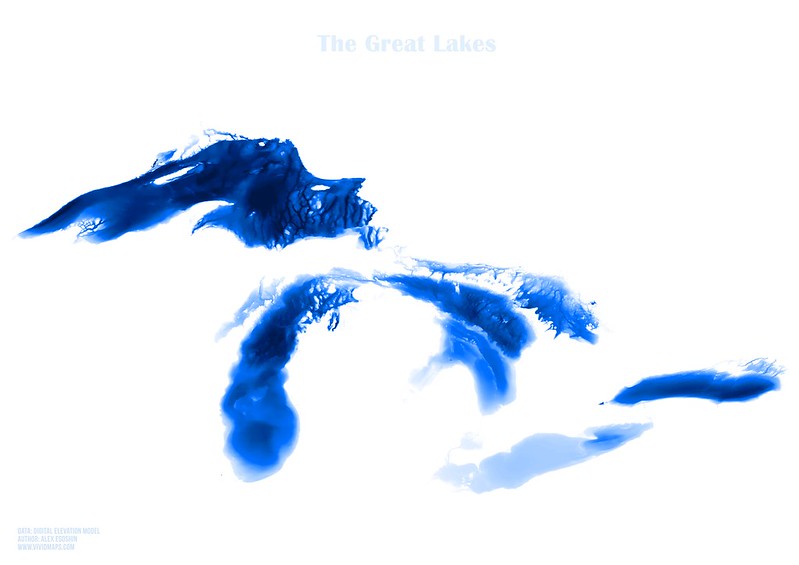
Five years ago, I made a stylized Great Islands map. Last month I found Stephen Kennedy’s The Great Islands. He took a completely different approach. He inverted bathymetry data. Superior drops to 406 meters at its deepest point (1,332 feet). On his map, those depths turn into peaks. Erie barely gets deeper than 19 meters on average (62 feet), which makes it look completely flat.
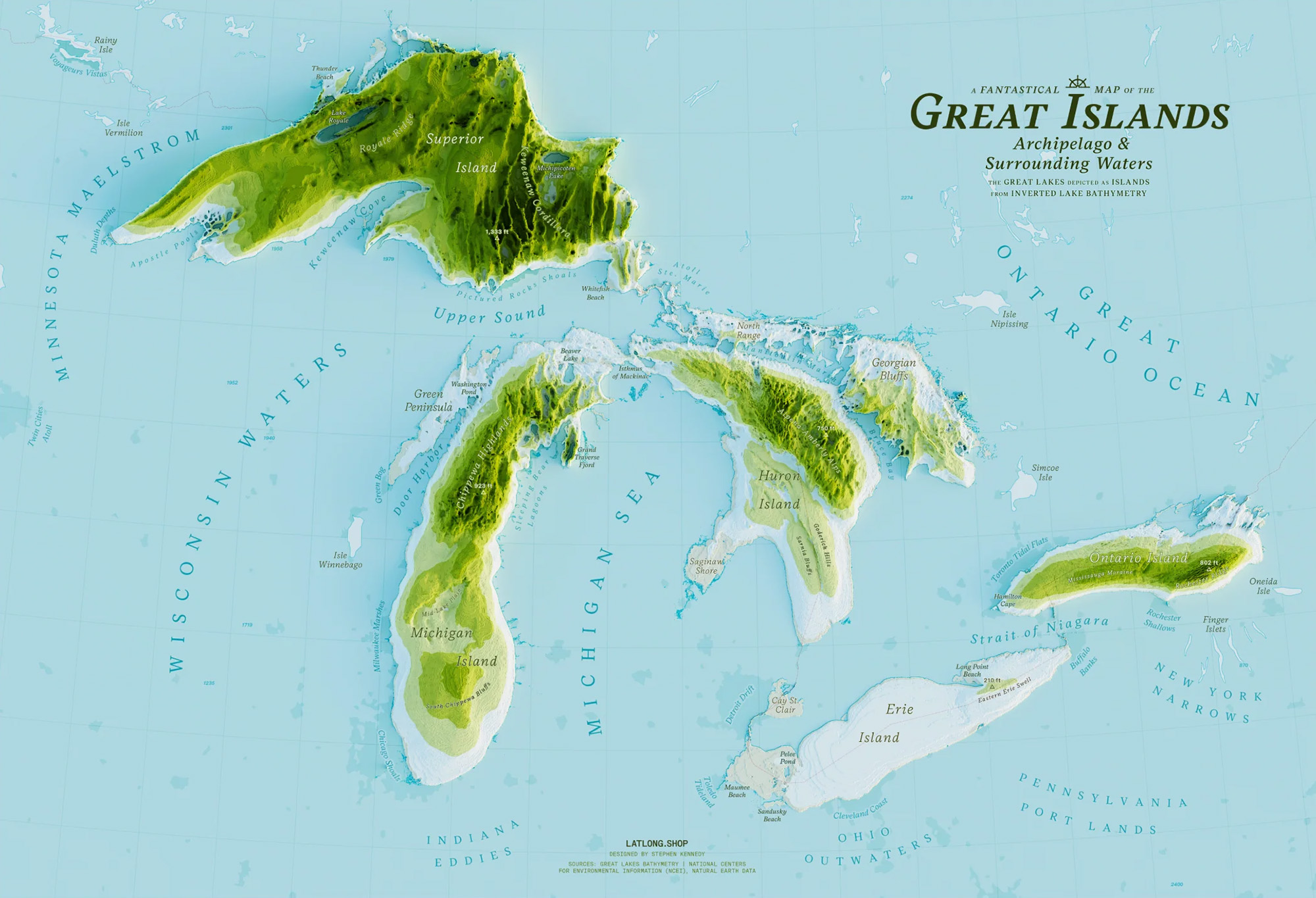
I like thinking about lakes as islands. Islands are full of life. So are these waters. Everything from microscopic algae up to wolves hunting the shores.
What actually lives here?
- Plants and algae sit at the bottom of the food web. A team of researchers sampled 102 marshes around the lakes. They found bluejoint grass in 80% of locations. Nothing else came close to being that widespread. Plant communities change depending on where you are. Superior’s acidic bedrock soils create habitat for bog species. The southern lakes have richer soils that support different plants. Diatoms dominate as the main algae. Summer brings heavy blooms of green and blue-green algae in Erie, Ontario, and Michigan.
- Fish numbers vary a lot. Erie has 107 species. Superior has about 80. The other lakes fall in between.
- Birds migrate through constantly. Roughly 380 species pass through this watershed for breeding or as stopovers. Eagles, loons, cormorants.
- Mammals include wolves, moose, beaver, lynx, bats, otters, coyotes.
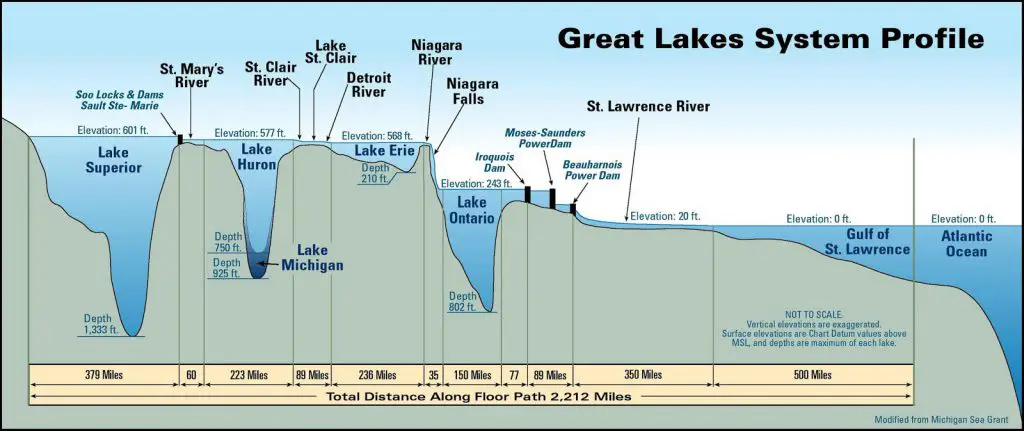
Why does Erie have so many more species? It’s warm and shallow. Depth averages just 19 meters (62 feet). Water heats up fast at that depth. Heat pushes nutrients through the system faster, which fuels more growth.
Superior is cold and deep. It averages 147 meters (483 feet). Cold water holds onto fewer nutrients. Less fuel for biological activity.
More species sounds good, but it’s not that simple. Erie’s warmth creates problems. The Great Lakes now have roughly 188 species that don’t belong here. Zebra mussels and quagga mussels do the most harm. They suck phytoplankton out of the water. Zooplankton eat phytoplankton. Fish eat zooplankton. Pull out the phytoplankton and everything else collapses. Erie takes more damage than the other lakes. Invaders love warm water with lots of nutrients and human disturbance. Those same conditions produce algal blooms. They create dead zones where oxygen drops so low that fish suffocate.
Superior stays colder. Invaders struggle there. Native fish populations hold steady.
You can get Kennedy’s map here.