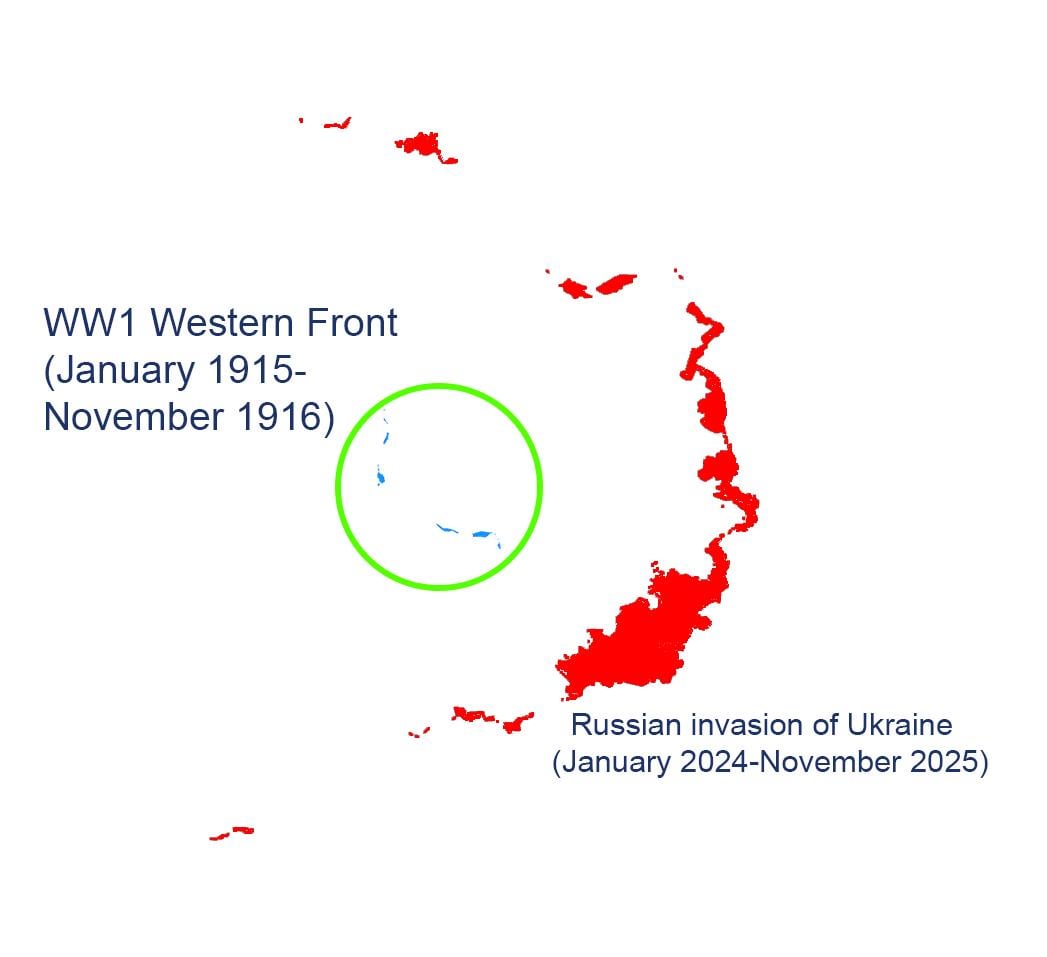
Russia invaded Ukraine on February 24, 2022. Three years have gone by. The war has stalled. Throughout 2024 and 2025, Russian forces took about4,669 km² (1,803 square miles). That’s half of Puerto Rico’s size after a full year of fighting. Most of the combat happened in eastern Donetsk. Villages there changed hands repeatedly while the line itself barely moved.
A Reddit user named 4g3nt58 overlaid Ukraine’s recent territorial changes with WWI’s Western Front from 1915-16. The scales match eerily. Both show frontlines that barely shift.
So what explains this? Modern armies have powerful weapons, yet frontlines still inch forward.
Before Gunpowder: Speed Measured in Footsteps
Medieval battles sometimes ended quickly. One army routed, the other won. But occupying territory happened at walking pace. A medieval army covered 15-25 km (9-16 miles) daily before exhaustion hit. Marching in armor was brutal. Supply wagons needed oxen. Finding food and water took constant effort. Alexander the Great’s armies were known for their speed, covering 20-30 km (12-19 miles) daily on long campaigns.
Europe got cannons in the 14th century. Siege warfare transformed. Field battles didn’t. Early cannons broke down constantly, took forever to reload, and cost a fortune. Firearms became battle-ready by the 16th century. Here’s the catch: better offensive weapons meant defenders could fortify better too. Attacking successfully meant assembling larger forces, planning more carefully, and building stronger supply chains.
1914-1918: When Firepower Outpaced Mobility
WWI pushed defensive warfare to absurd extremes. Machine guns could kill at hundreds of meters. Barbed wire stopped infantry attacks cold. Between Belgium and Switzerland, trenches stretched for 475 miles (764 km).
On July 1, 1916, the British began their Somme attack. Artillery had pounded German lines for a week. British commanders thought the bombardment had destroyed everything. German machine guns survived in deep bunkers and massacred the attacking infantry. That day produced 57,470 British casualties and nearly 20,000 deaths. Along a 24-km (15-mile) section, the advance averaged 330 meters (0.2 miles).
The Somme continued through mid-November. The ground captured came to about 12 km (7.5 miles). Casualties were staggering: Britain lost 420,000, France 200,000, Germany around 500,000. Verdun that same year went on for ten months and produced territorial changes so small you could walk across them in under an hour. About 700,000 men were killed or wounded there. In some places, German defensive lines ran back 14 miles (22 km) from the front, with concrete bunkers and multiple belts of barbed wire (Amazon link).
1943-1944: Geography Trumps Technology in Italy
WWII introduced tanks, aircraft, and motorized transport. Italy proved that terrain matters more than equipment. On September 9, 1943, Allied troops landed at Salerno. By December’s end, they’d pushed 123 km (76 miles) north and then hit a wall at Monte Cassino. The Germans had selected mountainous positions with limited roads. Valleys and fortified lines like the Volturno and Bernhardt funneled attacks into narrow corridors.
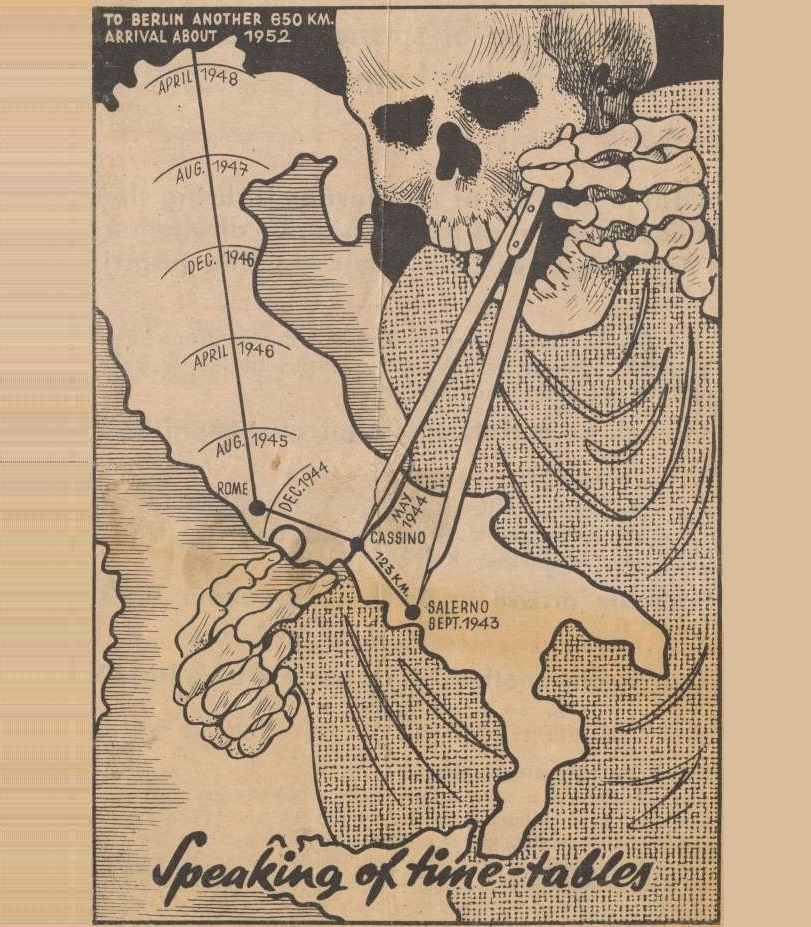
May 1944 saw German propaganda leaflets distributed to Allied soldiers. One mapped the advance from Salerno to Cassino, claiming eight months of fighting had produced “about 1,000 casualties for each kilometer.” The leaflets aimed to damage morale. What they documented was how difficult breaking fortified positions becomes, even with complete air dominance.
German propaganda leaflet mocking the progress of Allied forces in southern Italy (1944)
Four major offensives between January and May 1944 were needed to take Monte Cassino. Bombers reduced the hilltop monastery to rubble. Infantry assaulted it repeatedly. The Allies suffered 55,000 casualties. Germans lost about 20,000. All of this happened across a 30-km (20-mile) mountain section. Even destroyed structures make effective defensive positions on high terrain.
2022-2025: Modern Warfare Faces Old Constraints
Ukraine’s war has followed similar patterns. Russian advances get described as “slow, limited and highly costly.”Small groups probe for weak points instead of launching massive assaults. Drones watch areas 15-30 km (9-19 miles) from frontlines, making movement hazardous. Guided weapons strike deep targets. Defensive technology keeps evolving alongside offensive capabilities, just like machine guns did in WWI.
Weapons became dramatically more powerful from medieval swords to WWI rifles to modern drones. Some basics haven’t changed, though. Terrain dictates where attacks happen. Logistics determine how far you can push before supplies run out. Defenders with prepared positions hold advantages. That 1944 German propaganda map tried discouraging Allied troops but captured something about warfare’s constraints that persist across centuries.