Most state names are just noise. You say them without thinking. But dig into where they came from and things get weird fast.
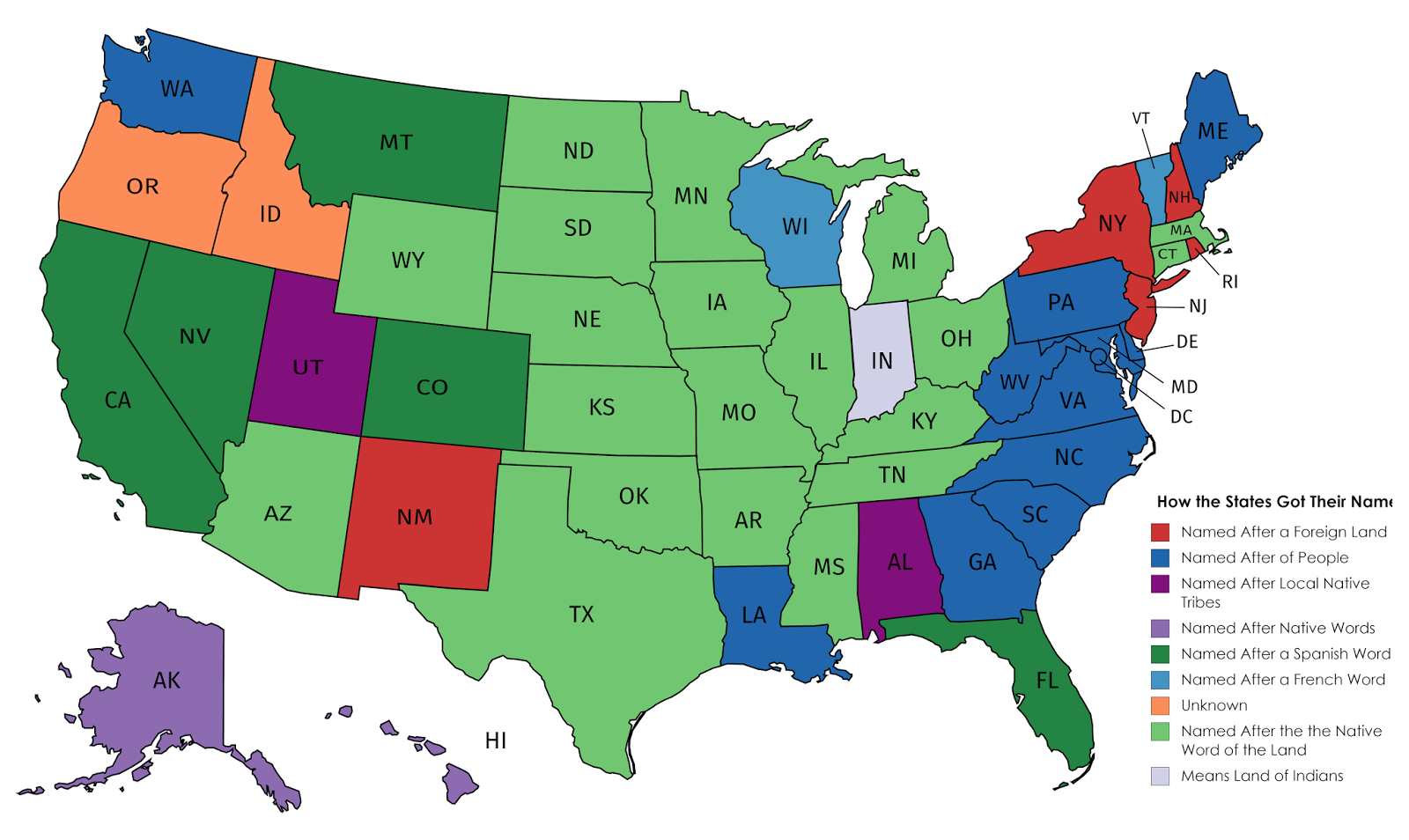
California is named after a fake island from a Spanish fantasy novel. Some lobbyist apparently invented Idaho out of thin air. Minnesota does not mean “clear blue water” no matter what anyone told you.
The East Coast is almost entirely Algonquian. Massachusetts is “at or about the great hill.” Connecticut is “beside the long tidal river.” Michigan is “large water” in Ojibwe. Simple geographic facts turned into names.
Head west and you’re in Siouan country. Both Dakotas use the same word, which means friend or ally. Minnesota is cloudy water. Nebraska is flat water. Kansas and Iowa are both named after peoples. Missouri means people with dugout canoes. Notice how many involve water.
Kentucky is Iroquoian, probably “land of tomorrow,” but people still fight about the exact translation. Ohio means “great river.” The “beautiful river” version is a myth.
Alabama is Choctaw for something like “thicket clearers.” Texas comes from Caddo meaning “friends.” Oklahoma is special because someone made it up on purpose. In 1866, Choctaw chief Allen Wright took okla (people) and humma (red) and created a brand new word for the territory.
Alaska is “the mainland” in Aleut. Hawaii goes back to Polynesian ideas about where their ancestors came from.
European Names
The other twenty-two states pulled from European languages. Spanish names track old exploration routes. French names follow the Mississippi.
Florida got its name when Ponce de León showed up during Easter 1513. “Flowery Easter” in Spanish. Colorado is “colored red” from the river. Nevada is snow-covered.
California is absurd. In 1510, some Spanish writer published an adventure novel about a magical island called California where Amazon queens ruled. Spanish explorers apparently read this book, sailed to the Pacific coast, and said “close enough.” The name stuck.
Louisiana honors King Louis XIV. Vermont is French for green mountain. Maine probably refers to a French province but the reason is lost.
Six states memorialize European royalty. Both Virginias for Queen Elizabeth I. Both Carolinas for King Charles I. Georgia for King George II. Maryland for Queen Henrietta Maria.
Washington is the only American who got a state. People tried to name states after Franklin, Jefferson, Lincoln. Never worked. Washington succeeded because he was safely dead and universally revered.
The Mysteries
Six states have origins that remain unclear or disputed.
Idaho is probably a hoax. In the 1860s, George Willing (mining lobbyist) proposed this name. Claimed it was Shoshone for “gem of the mountains.” That word doesn’t exist in Shoshone. Doesn’t exist in any documented Native language. Willing seems to have fabricated it.
Arizona might be Basque for “good oak.” Might be O’odham for “small spring.” Spanish explorers wrote “Arizonac” but the source is murky.
Oregon is just lost. Could be French for hurricane. Could be Indigenous. Multiple theories, no answers.
Rhode Island references either the Greek island Rhodes or comes from Dutch for “red island.” Pick one.
Wisconsin is Ojibwe but means either “red stone place” or “gathering of waters” depending on which scholar you ask.
Arkansas derives from the Quapaw people via French. Not disputed. What’s disputed is pronunciation. The state passed a law telling people how to say it so they’d stop confusing it with Kansas.
State
Language Origin
Original Word/Form
Meaning/Translation
Notes
Alabama
Choctaw (Muskogean)
alba ayamule / albah amo
“thicket clearers” or “plant gatherers”
Multiple interpretations exist; refers to tribal group
Alaska
Aleut (Eskimo-Aleut)
aláxsxaq / alaxsxix
“mainland” or “great land”
Borrowed through Russian
Arizona
Spanish (possibly O’odham or Basque)
Arizonac / alĭ ṣonak
“small spring” OR “good oak”
Etymology disputed; Spanish recorded from Indigenous or Basque sources
Arkansas
Algonquian via French
Akansa (Quapaw tribal name)
“people of the south wind” or “downstream people”
French pronunciation preserved by state law
California
Spanish (literary fiction)
California (from novel)
Fictional paradise island
From “Las sergas de Esplandián” by Garci Rodríguez de Montalvo (1510)
Colorado
Spanish
colorado
“colored red” or “reddish”
Refers to Colorado River’s sediment
Connecticut
Algonquian (Mohegan)
Quinnehtukqut
“beside the long tidal river”
Refers to Connecticut River
Delaware
English (via French title)
Named for Lord De La Warr
Named after Thomas West, 3rd Baron De La Warr
Title derives from Norman French “de la guerre”
Florida
Spanish
Pascua Florida
“Flowery Easter” or “Feast of Flowers”
Named by Ponce de León in 1513 during Easter season
Georgia
English (Latin form)
Named for King George II
Honors King George II of Great Britain
Colony chartered in 1732
Hawaii
Hawaiian (Polynesian)
Hawaiʻi (from Hawaiki)
Likely “homeland” or “place of the gods”
From Proto-Polynesian ancestral homeland concept
Idaho
Uncertain/Possibly fabricated
Claimed to be Shoshone
“gem of the mountains” (unverified)
Likely invented by George M. Willing; no Indigenous source confirmed
Illinois
Algonquian (Miami-Illinois)
Inoca or irenwe·wa
“ordinary speaker” or “the people”
French rendering: Ilinois; popular “tribe of superior men” is folk etymology
Indiana
English
Indiana
“Land of the Indians”
Coined by English speakers in reference to Native inhabitants
Iowa
Siouan (Chiwere)
Ayuxba / Ayuhwa
“sleepy ones” or tribal name
Refers to Ioway people; exact meaning debated
Kansas
Siouan (Kansa)
Kká:ze
“people of the south wind”
Refers to Kansa (Kaw) people
Kentucky
Iroquoian (possibly Wyandot)
Ken-tah-ten
“land of tomorrow” or “meadow land”
Multiple competing etymologies; “dark and bloody ground” is folk etymology
Louisiana
French
Named for King Louis XIV
“Land of Louis”
French territory named by La Salle in 1682
Maine
Uncertain (possibly French)
Maine (French province)
Possibly “mainland”
May distinguish mainland from islands; etymology unclear
Maryland
English (Latin form)
Named for Queen Henrietta Maria
“Mary’s Land”
Honors wife of King Charles I
Massachusetts
Algonquian (Massachusett)
Massachusett
“at or about the great hill”
Refers to Great Blue Hill near Milton
Michigan
Algonquian (Ojibwe)
mishi-gami
“large water” or “large lake”
Refers to Lake Michigan
Minnesota
Siouan (Dakota)
mni sotá
“cloudy water” or “sky-tinted water”
Refers to Minnesota River; “clear blue water” is less accurate
Mississippi
Algonquian (Ojibwe)
misi-ziibi
“great river”
Borrowed by French from Ojibwe
Missouri
Algonquian (Miami-Illinois)
Wimihsoorita
“those who have dugout canoes”
Refers to Missouri people; exact meaning debated
Montana
Spanish (from Latin)
montaña
“mountain” or “mountainous region”
From Latin montanea
Nebraska
Siouan (Otoe)
Ñí Brásge
“flat water”
Refers to Platte River
Nevada
Spanish
nevada
“snow-covered” or “snow-capped”
Refers to Sierra Nevada mountains
New Hampshire
English
Named for Hampshire, England
Named after English county
Granted to John Mason in 1629
New Jersey
English
Named for Jersey (Channel Island)
Named after island of Jersey
Granted to Sir George Carteret from Jersey
New Mexico
Spanish (via Nahuatl)
Nuevo México
“New Mexico”
References Mexico (from Nahuatl Mēxihco)
New York
English
Named for Duke of York
Honors future King James II
Previously New Netherland under Dutch rule
North Carolina
English (Latin form)
Named for King Charles I
“Land of Charles” (Carolus in Latin)
Split from Carolina in 1712
North Dakota
Siouan (Dakota)
Dakhóta
“friend” or “ally”
Dakota people’s self-designation; split from Dakota Territory 1889
Ohio
Iroquoian (Seneca)
ohi:yo’
“great river” or “beautiful river”
Refers to Ohio River; “beautiful” less linguistically supported
Oklahoma
Choctaw
okla humma
“red people”
Coined by Choctaw chief Allen Wright in 1866
Oregon
Uncertain
Multiple theories
Unknown
Theories include French ouragan (hurricane), Indigenous terms; no consensus
Pennsylvania
English + Latin
Named for William Penn
“Penn’s Woods” (sylvania = woods in Latin)
Charles II named it for Admiral William Penn
Rhode Island
Uncertain (Greek or Dutch)
Rhode (Greek island) OR Roodt Eylandt
“Island of Rhodes” OR “Red Island”
Official name: Rhode Island and Providence Plantations
South Carolina
English (Latin form)
Named for King Charles I
“Land of Charles” (Carolus in Latin)
Split from Carolina in 1712
South Dakota
Siouan (Dakota)
Dakhóta
“friend” or “ally”
Dakota people’s self-designation; split from Dakota Territory 1889
Tennessee
Cherokee
Tanasi
Unknown (village name)
Cherokee village name; exact meaning lost
Texas
Caddoan (Hasinai Caddo)
táyshaʔ
“friends” or “allies”
Spanish recorded as Tejas; applied to Caddo peoples
Utah
Uto-Aztecan (Ute)
Yuttahih
“people of the mountains”
Spanish borrowed from Apache term for Ute people
Vermont
French
vert mont
“green mountain”
Named by Samuel de Champlain or later French speakers
Virginia
English (Latin form)
Named for Elizabeth I
“Virgin Queen’s Land”
Honors Elizabeth I, the “Virgin Queen”
Washington
English
Named for George Washington
Honors first U.S. President
Only state named for U.S. president; became state 1889
West Virginia
English
Named for Virginia
“Western Virginia”
Split from Virginia in 1863 during Civil War
Wisconsin
Algonquian (Ojibwe/Miami)
Meskonsing / Ouisconsin
“red stone place” or “gathering of waters”
French rendering of Indigenous name; exact meaning debated
Wyoming
Algonquian (Munsee Delaware)
xwé:wamənk
“at the big river flat” or “large plains”
Borrowed from Wyoming Valley, Pennsylvania
Many popular stories are fiction. Kentucky is not “dark and bloody ground.” Minnesota is not “clear blue water.” European explorers heard Native words, wrote down their phonetic interpretation, and meanings got scrambled. What looks authoritative might be a guess from centuries ago.
The Dems are arguing that social media conglomerates need to be broken up because they have too much influence on the populace. But have they said anything about the BIG PHARMA getting too big, having a huge influence on us? Of course not, they like us drugged up, paying exorbitant drug costs, they like the huge kickbacks they receive.
Exactly, that is why it is the Democrats and the Biden administration who are currently in the process of implementing restrictions on the prices Big Pharma can charge Medicare recipients for the ten most popular (and relatively expensive) drugs prescribed for those patients. Meanwhile, Trumpty Dumpty and the Republicans have no plan at all to reduce prescription drug prices because their primary concern is to shift more of the tax burden from the absurdly wealthy 1%-ers to the middle class and poorest Americans AND to control women and their personal healthcare decisions. But, like the fool you are, go on believing in the falsehood that if you only work hard enough at your fast food job that someday you will also be in the 1%.
The Dems are arguing that social media conglomerates need to be broken up because they have too much influence on the populace. But have they said anything about the BIG PHARMA getting too big, having a huge influence on us? Of course not, they like us drugged up, paying exorbitant drug costs, they like the huge kickbacks they receive.





The Dems are arguing that social media conglomerates need to be broken up because they have too much influence on the populace. But have they said anything about the BIG PHARMA getting too big, having a huge influence on us? Of course not, they like us drugged up, paying exorbitant drug costs, they like the huge kickbacks they receive.
Lol Idaho, isnt that a kind of potato ?
Exactly, that is why it is the Democrats and the Biden administration who are currently in the process of implementing restrictions on the prices Big Pharma can charge Medicare recipients for the ten most popular (and relatively expensive) drugs prescribed for those patients. Meanwhile, Trumpty Dumpty and the Republicans have no plan at all to reduce prescription drug prices because their primary concern is to shift more of the tax burden from the absurdly wealthy 1%-ers to the middle class and poorest Americans AND to control women and their personal healthcare decisions. But, like the fool you are, go on believing in the falsehood that if you only work hard enough at your fast food job that someday you will also be in the 1%.
Oklahoma is not an English word.
Lol Idaho, isnt that a kind of potato ?
Idaho unknown?
I-doan-no
The Dems are arguing that social media conglomerates need to be broken up because they have too much influence on the populace. But have they said anything about the BIG PHARMA getting too big, having a huge influence on us? Of course not, they like us drugged up, paying exorbitant drug costs, they like the huge kickbacks they receive.