Africa appears solid and permanent on any map. It seems that the world’s second-largest continent hasn’t changed shape in recorded history — and might remain so forever. Yet beneath the surface, geological forces are slowly tearing it apart.
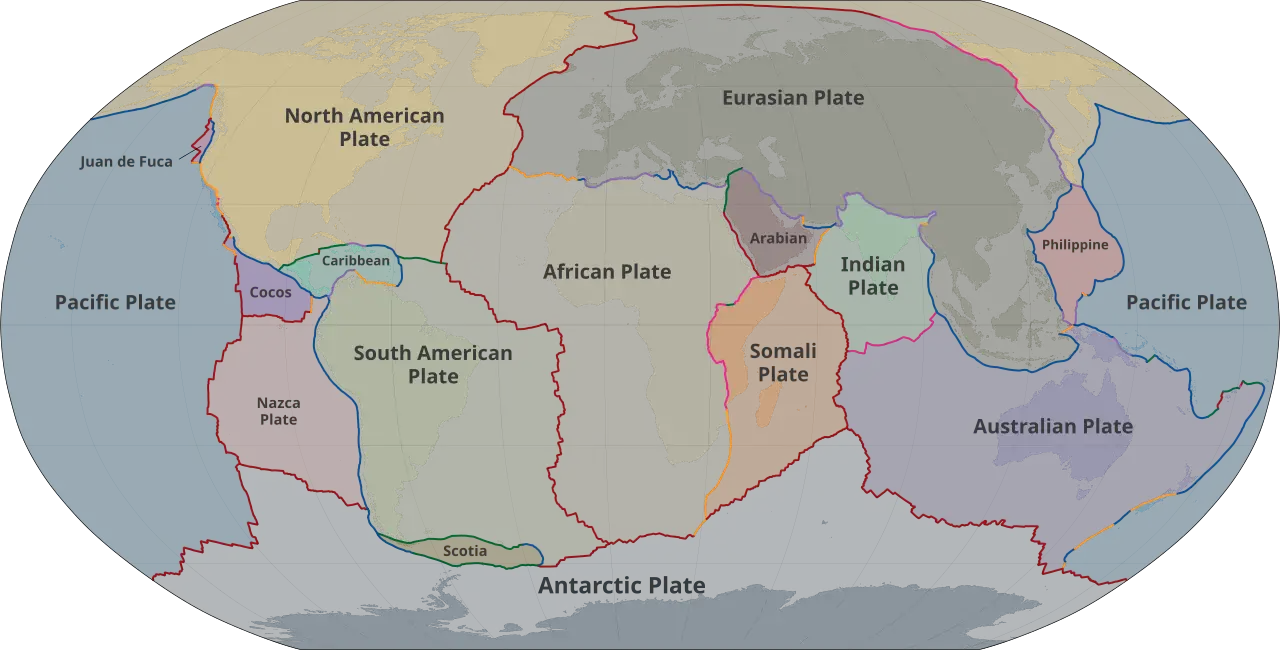
The East African Rift System runs 3,000 km (1,864 miles) from Ethiopia to Mozambique. Two tectonic plates (the Somali and Nubian) move apart at 6-7 mm per year, or 0.24-0.28 inches. That’s roughly fingernail growth speed. You can’t see it happening without satellites and GPS tracking the motion.
Look at the Red Sea for comparison. It widens 10 mm (0.4 inches) annually as Arabia drifts from Africa. That rift became an ocean. The East African Rift could do the same.
What Future Africa Might Look Like
Reddit user u/TheAssConsumer created this projection using plate movement data, showing Africa 10 million years ahead.
Today’s landlocked cities (Nairobi, Addis Ababa, Kampala) sit on coastlines in this scenario. Ethiopia, Somalia, and Eritrea break off as an island.
Will it happen? Geologists debate this. Ken Macdonald at UC Santa Barbara points out that rifts stall. The Atlantic stopped spreading for millions of years before resuming. Even at steady rates, matching the Red Sea’s size needs 20-30 million years. The rift might just stop.
If seawater floods in, East African weather changes substantially. Ocean basins control temperature and moisture patterns regionally. Ethiopia and Kenya’s dry areas might get more rain, but stormier rain. Adding large water bodies destabilizes local climate.
The East African Rift is the world’s largest active rift. Earthquakes can hit magnitude 7.0. Mount Nyiragongo in the DRC sends lava through nearby communities when it erupts. Rivers change course as terrain shifts. The Congo Basin will rise or drop depending on how continental mass moves, stressing the rainforest.
Further north, Morocco, Algeria, and Tunisia face potential earthquake increases as pressure transfers through the Tell-Rif range.
The Afar region and Iceland are unique because mid-ocean ridge spreading is visible above water there. Elsewhere this happens kilometers deep, invisible to direct study.
The rift might become an ocean. It might stop and form rift valley lakes instead. Either way, East Africa occupies a tectonically active zone. This splitting has continued for millions of years and won’t stop on human timescales.