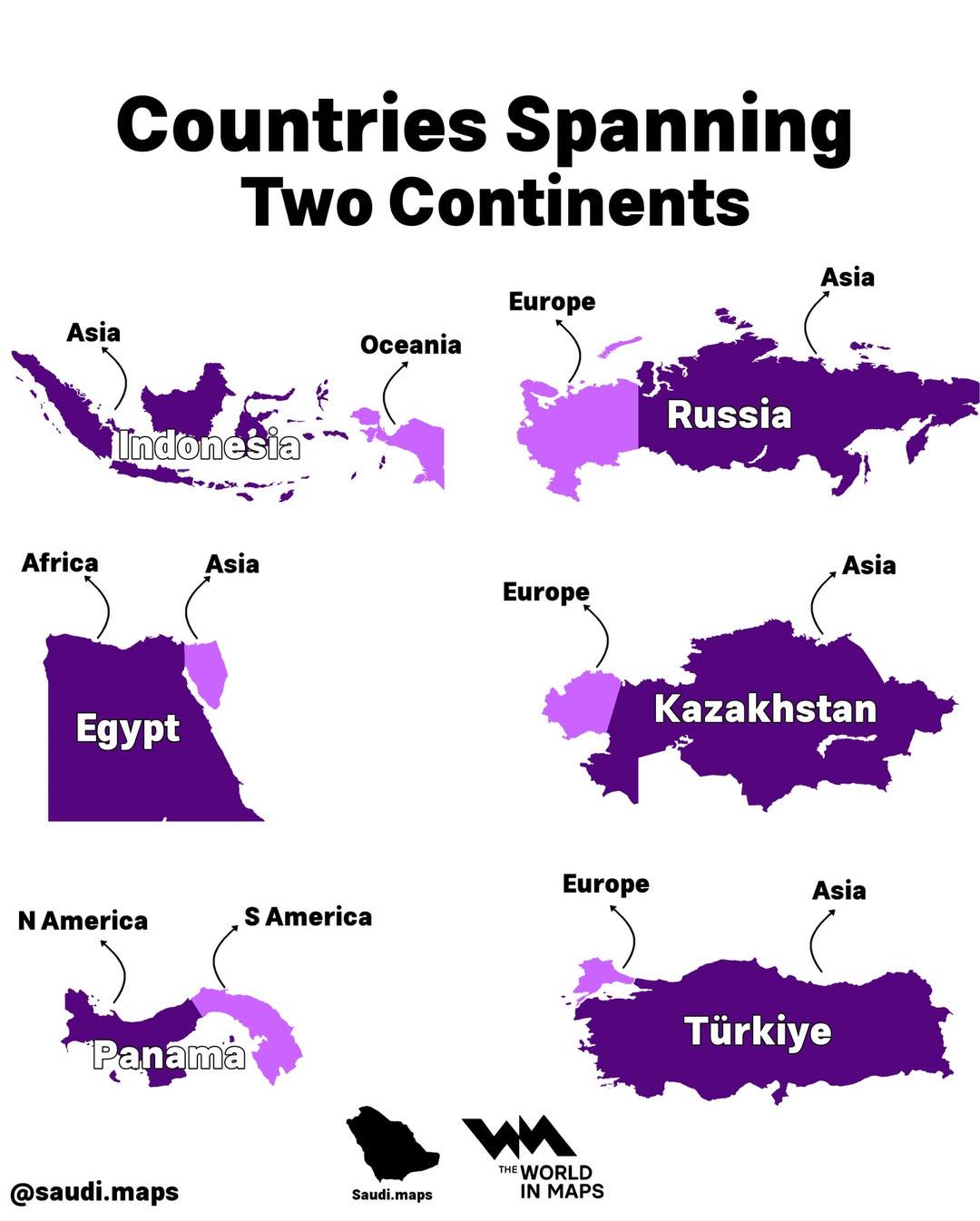
Most people know Russia spans Europe and Asia. Turkey too. But there are actually six countries with land on two continents: Russia, Turkey, Indonesia, Egypt, Kazakhstan, and Panama. The last two on that list surprise most people.
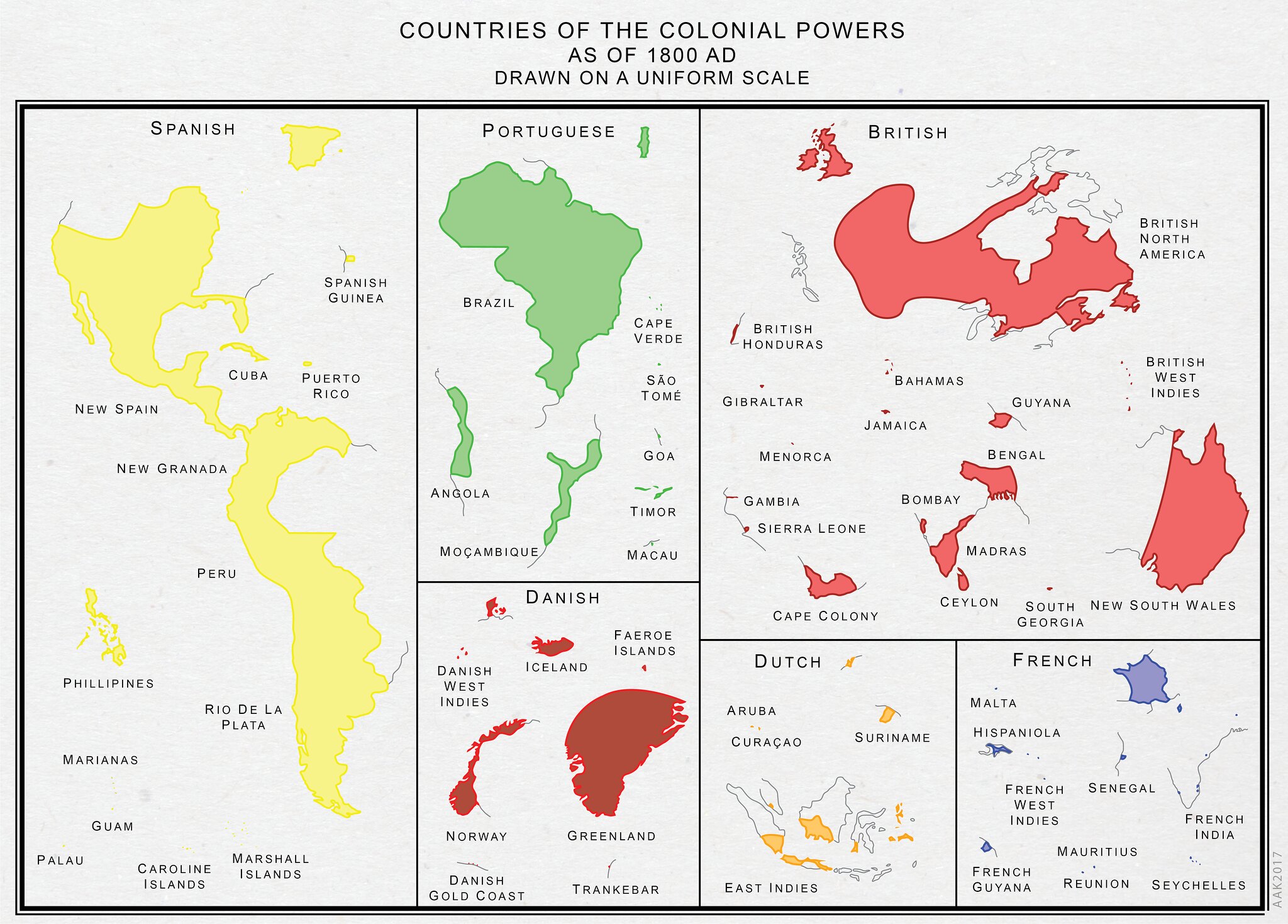
You won’t find France on this map even though French Guiana sits in South America and Réunion is in Africa. Same goes for the UK with its Caribbean territories, or the Netherlands and Denmark with their scattered islands. Those are overseas possessions from the colonial era. This map shows countries where contiguous land crosses continental boundaries.
Russia
Russia stretches from the Baltic Sea to the Pacific Ocean. Most of the country (77%) lies in Asia. But most Russians (also 77%) live west of the Urals in Europe. Cities like Moscow and Saint Petersburg are in the European part. So are most other major population centers. Siberia is huge but doesn’t have many people.
The boundary between Europe and Asia has been debated for a long time. Some geographers prefer the Ural Mountains, others the Ural River, and some use the Caucasus range instead. The same debate applies to Kazakhstan.
Total Area
Total Population
European Part
European %
Asian Part
Asian %
17,098,242 km² 6,601,668 sq mi
~145 million
3,960,000 km² 1,528,560 sq mi ~110 million people
23% land 77% population
13,138,242 km² 5,073,108 sq mi ~35 million people
77% land 23% population
Indonesia
Indonesia catches most people off guard. The country has more than 17,000 islands spread across the Indian and Pacific Oceans. Java, Bali, Sumatra, Sulawesi—all in Asia. But Papua, the Indonesian half of New Guinea, sits on the Australian continental shelf. Geographers classify it as Oceanian rather than Asian.
Papua makes up 16.7% of Indonesia. About 5 million people live there. The remaining 270 million Indonesians live on the Asian islands. Java alone, despite being much smaller than Papua, has over 150 million people. The difference comes down to terrain. Java has volcanic soil good for farming and cities built up over centuries. Papua has dense rainforest and rugged mountains.
Total Area
Total Population
Asian Part
Asian %
Oceanian Part (Papua)
Oceanian %
1,904,569 km² 735,358 sq mi
~285 million
1,585,569 km² 612,192 sq mi ~280 million people
83.3% land 98.2% population
~319,000 km² 123,166 sq mi ~5 million people
16.7% land 1.8% population
Turkey
Just 3% of Turkey is in Europe. Around 15 million people live there, mostly in and around Istanbul. The city sits on both sides of the Bosphorus Strait—Europe on one bank, Asia on the other. Istanbul has been a major city for over 2,000 years under different names (Byzantium, then Constantinople). That history keeps drawing people there.
Total Area
Total Population
Asian Part
Asian %
European Part
European %
783,562 km² 302,535 sq mi
~85 million
759,798 km² 293,360 sq mi ~70.4 million people
97% land 83% population
23,764 km² 9,175 sq mi ~15 million people
3% land 17% population
Egypt
Egypt is transcontinental because of the Sinai Peninsula. The Sinai sits east of the Suez Canal in Asia and takes up about 6% of Egypt’s territory. Around 1.5 million people live there. The other 103 million Egyptians live along the Nile Valley and Delta in Africa. The Nile makes Egypt livable. Without it, the country would be uninhabitable desert from the Mediterranean to Sudan. The Sinai has a few towns but it’s mostly desert.
Total Area
Total Population
African Part
African %
Asian Part (Sinai)
Asian %
1,002,450 km² 387,050 sq mi
~104.5 million
~941,450 km² 363,498 sq mi ~103 million people
93.9% land 98.6% population
~61,000 km² 23,552 sq mi ~1.5 million people
6.1% land 1.4% population
Kazakhstan
Kazakhstan straddles the Ural River. Many geographers use that river as the Europe-Asia boundary (though as with Russia, not everyone agrees). The European section west of the river is 5.5% of Kazakhstan. About one million people live there—roughly 5% of the population.
Total Area
Total Population
Asian Part
Asian %
European Part
European %
2,724,900 km² 1,052,090 sq mi
~20 million
2,576,900 km² 994,950 sq mi ~16.8 million people
94.5% land 95% population
148,000 km² 57,140 sq mi ~1.0 million people
5.5% land 5% population
Panama
Panama connects North and South America at their narrowest point. The Panama Canal runs through the country and marks where the two continents meet. Panama City and most other major cities are north of the canal in North America. The southern part near Colombia is less populated. Panama covers 75,417 km² (29,119 sq mi) with around 4.5 million people. The boundary between North and South America isn’t universally agreed upon. Some geographers draw it at the Panama Canal. Others use the Colombian border or place it in the Darién Gap.
Did any of these countries surprise you? Which other nations do you think should be considered transcontinental?