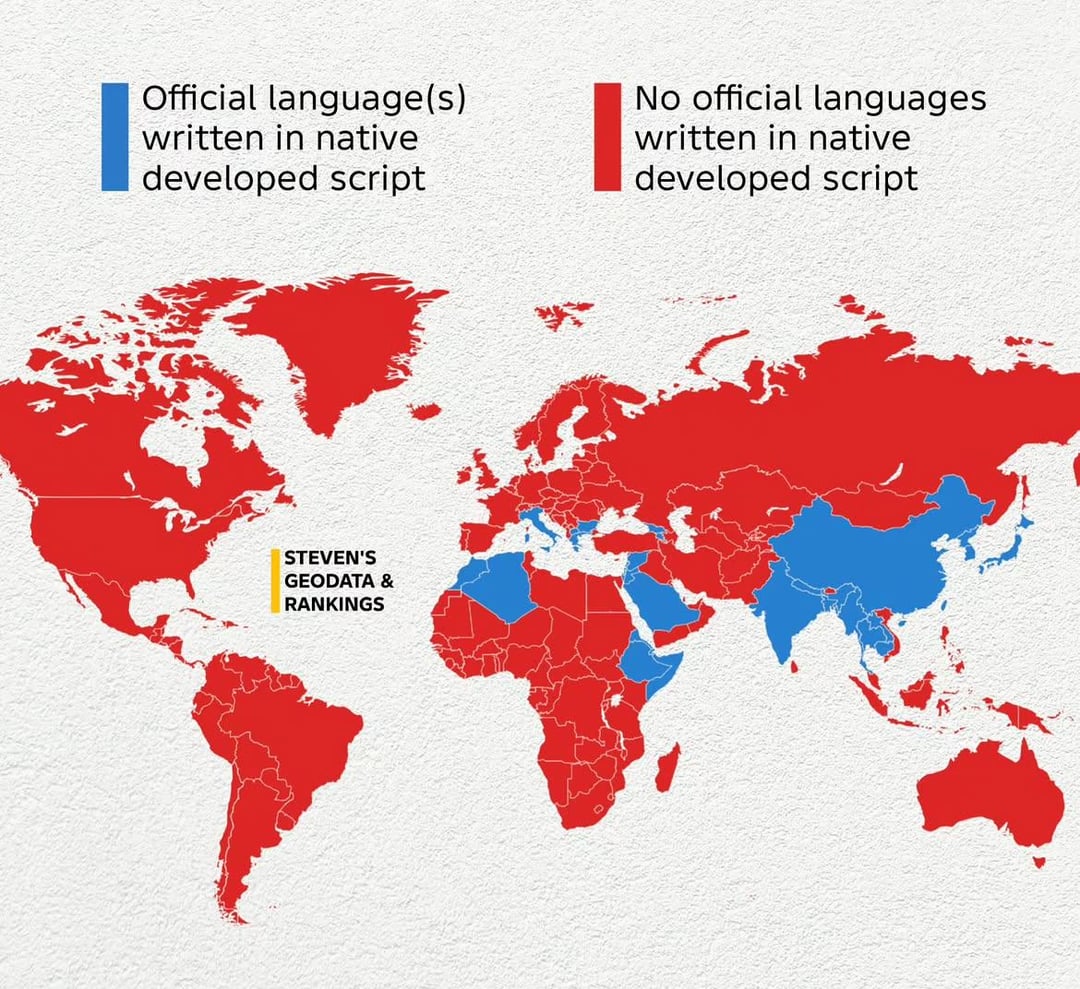
Every country in the Americas writes its official language in Latin script. So do most of Europe and nearly all of sub-Saharan Africa. One alphabet, spread across more than half the planet through empire and colonialism. This map below from Steven’s Geodata & Rankings shows where that held and where it didn’t. Blue countries have at least one official language in a natively developed script. Red ones don’t.
In Russia and Central Asia, writing uses the Cyrillic script. While based on the work of Saints Cyril and Methodius in the 9th century CE, Cyrillic was actually developed by their students in Bulgaria for Slavic languages—it did not originate in Russia or Central Asia. Sub-Saharan Africa is mostly red for the same colonial reasons as the Americas. Even most of Europe is red; Latin was already spreading through the Roman Empire long before the modern concept of colonialism existed.
In the Caucasus, Georgia and Armenia stand out in blue. Georgian Mkhedruli developed in the 5th century CE. In Armenia, Mesrop Mashtots published the alphabet in 405 CE to translate the Bible into Armenian.
The first blue in Africa is Morocco and Algeria. Morocco made Tamazight, the Amazigh-Berber language, co-official in 2011. Algeria followed in 2016. Both use the Tifinagh script, an ancient native North African writing system. Then a gap. Egypt, Libya, Tunisia, and Sudan are red. Arabic is their official language too, but Arabic arrived through conquest. Their pre-Islamic languages lost official standing centuries ago.
The Arabic script likely originated around the 4th century CE, developing natively in the region stretching from the northern Arabian Peninsula into the Levant. On the map, blue highlights Saudi Arabia, Yemen, Jordan, Syria, Lebanon, and the Gulf States. Israel also stands out in blue because it uses the Hebrew script, which developed natively in the region. Iraq is shown in red. While Arabic is its official language, the script did not develop natively within Iraq’s borders—an area historically associated with cuneiform and other ancient Mesopotamian writing systems. Similarly, Iran, Afghanistan, and Pakistan are red because they adapted the Arabic script for their own non-Arabic languages following historical Islamic conquests.
Ethiopia and Eritrea utilize the Ge’ez (Ethiopic) script to write Amharic and Tigrinya, a system that has been in use for over 1,500 years. Djibouti and Somalia are also shaded in blue; although Arabic serves as a co-official language in both nations, their primary native languages, Somali and Afar, are written using modified Latin scripts. Furthermore, Somalia is linguistically distinct for having invented its own entirely native writing systems in the 20th century, such as the Osmanya script, even though the Latin alphabet remains the national standard today.
The largest blue landmass lies further east, encompassing India, Bangladesh, Nepal, Bhutan, and Sri Lanka. All of these nations use scripts derived from the ancient Brahmi tradition. India alone recognizes 22 official languages in its constitution, most of which utilize distinct, native scripts. Myanmar, Thailand, Cambodia, and Laos extend this blue block into Southeast Asia, while China, both Koreas, and Japan make up the eastern end.
Chinese writing traces back to oracle bone inscriptions from roughly 1300 BCE, while Korean Hangul is at the other end of that span. Finished by King Sejong in 1443 CE, Hangul is unique; no other major writing system has a known creator on an exact date. His goal was widespread literacy, aiming to replace complex Chinese characters with a phonetic system ordinary people could easily master. Japan, by contrast, kept Kanji but integrated Hiragana and Katakana during the 9th century CE. Meanwhile, Thailand’s alphabet has been in continuous use since 1283 CE, and Cambodia’s Khmer script dates even further back to the 7th century.
Europe, The Americas, Sub-Saharan Africa, Djibouti, Somalia
~7th century BCE
Tifinagh
Tamazight (Amazigh-Berber)
Morocco, Algeria
~600 BCE
Hebrew
Hebrew
Israel
~3rd century BCE
Tamil
Tamil
India, Sri Lanka
~3rd century BCE
Sinhala
Sinhala
Sri Lanka
~3rd century BCE
Arabic
Arabic
Arabian Peninsula, Levant, North Africa, Sudan, Djibouti, Somalia
4th century CE
Ge’ez (Ethiopic)
Amharic, Tigrinya
Ethiopia, Eritrea
~4th century CE
Armenian
Armenian
Armenia
405 CE
Georgian (Mkhedruli)
Georgian
Georgia
~5th century CE
Tibetan (Uchen)
Dzongkha
Bhutan
7th century CE
Khmer
Khmer
Cambodia
~7th century CE
Cyrillic
Russian, Kazakh, Uzbek, Kyrgyz
Russia, Central Asian nations, Eastern Europe
9th century CE
Hiragana / Katakana
Japanese
Japan
9th century CE
Bengali
Bangla
Bangladesh, India
~10th century CE
Perso-Arabic (Nastaliq)
Urdu, Farsi, Pashto, Dari
Pakistan, Iran, Afghanistan
10th–11th century CE
Devanagari
Hindi, Nepali, Marathi
India, Nepal, Bhutan
~11th century CE
Burmese
Burmese
Myanmar
11th century CE
Thai
Thai
Thailand
1283 CE
Lao
Lao
Laos
~14th century CE
Hangul
Korean
South Korea, North Korea
1443 CE
Osmanya
Somali
Somalia
1920–1922 CE
In total, roughly 44 of 195 countries write at least one official language in a natively developed script. The Americas account for none of them. Every country from Canada to Argentina uses Latin script. Mesoamerica had produced writing long before European contact. The Maya logosyllabic script was in use for over a millennium before Spanish ships arrived. None of those systems survived as official national scripts.