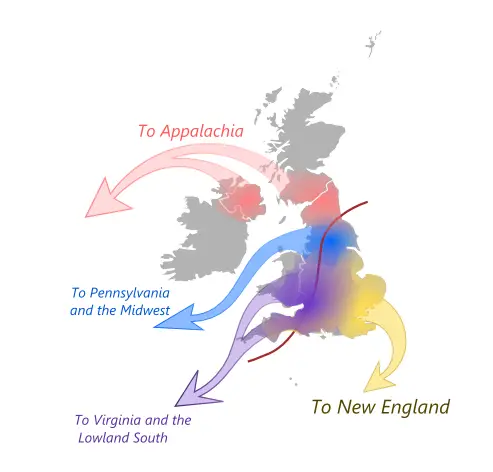
Various waves of migration from Britain played a significant role in shaping the modern United States, not only in terms of language. Why does Massachusetts feel nothing like Virginia? Why does Pennsylvania vote so differently from its neighbors? The answer sits in four migration streams from Britain between the 1620s and 1770s.
Around 20,000 Puritans left East Anglia for Massachusetts between 1629 and 1640. They came as families, which was rare—most colonies attracted young single men chasing money. These were comfortable middle-class people leaving stable lives because they wanted to worship without the Church of England looking over their shoulders. They set up town meetings, passed a law requiring public schools in 1647, and built communities where everyone had opinions about everyone else’s business.
Pennsylvania got Quakers from England’s North Midlands after William Penn received his charter in 1681. Quakers threw out the whole idea of hierarchy. No priests. No aristocrats. Everyone stood equal before God. Penn advertised his “Holy Experiment” across Europe and welcomed Germans, Welsh, Scots, whoever showed up. That’s why Pennsylvania remains moderate while states around it swing hard left or right.
Virginia drew from southern English counties like Dorset and Somerset. Wealthy gentry families transplanted their entire social system. The estates, the obsession with proper bloodlines, the assumption that some people were born to lead. Their concept of liberty applied mainly to gentlemen who owned land.
The fourth group came from Britain’s bloodiest frontier. For centuries, the Scottish-English border was a combat zone. Families survived through tight clan bonds, constant vigilance, and willingness to use violence. Many went to Ulster first, then crossed to America and pushed into the Appalachian backcountry. Their suspicion of distant authority made perfect sense coming from where they did.
David Hackett Fischer wrote Albion’s Seed (Amazon link) in 1989 documenting these patterns. His research showed these four groups created cultural frameworks that later arrivals adapted to more than replaced. Germans in Pennsylvania adopted Quaker ways. Irish in Boston navigated existing Puritan structures.
Native peoples shaped these lands first. Africans forced here built the South’s wealth. Waves of later immigrants added countless layers. But these four British migrations laid down the original templates.
Massachusetts puts more money into public schools than nearly anywhere else. Pennsylvania splits its votes. The South keeps sharper class lines. Appalachia elects politicians who promise minimal government interference. Same country, same language, same basic laws for 250 years. But scratch the surface and you find four different Britains that crossed the Atlantic and never really merged.