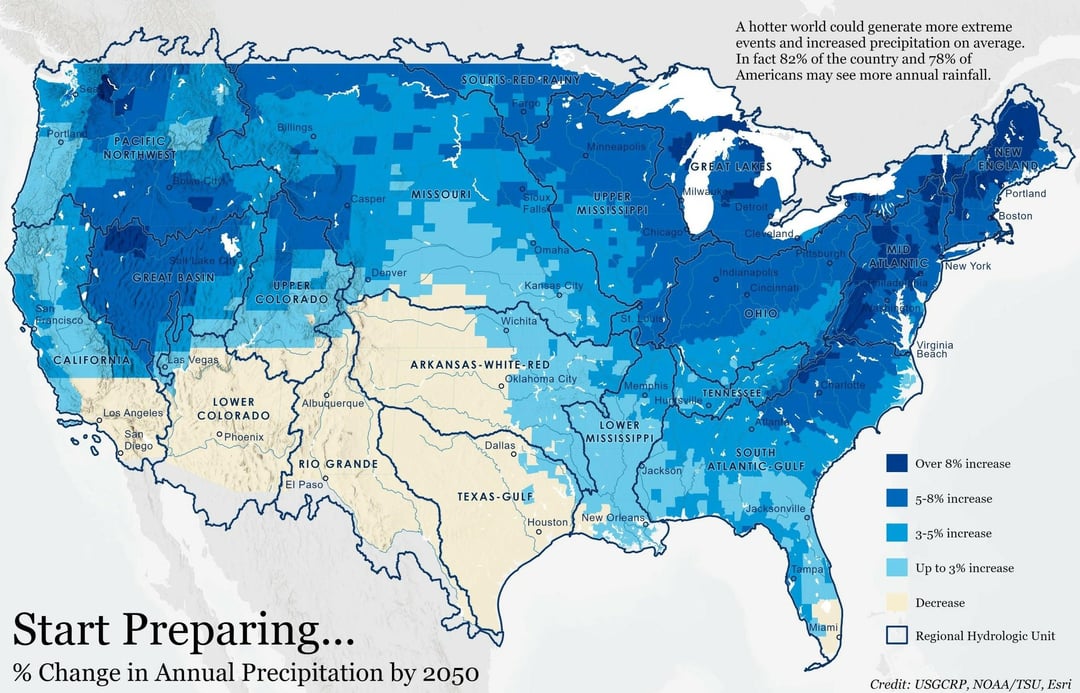
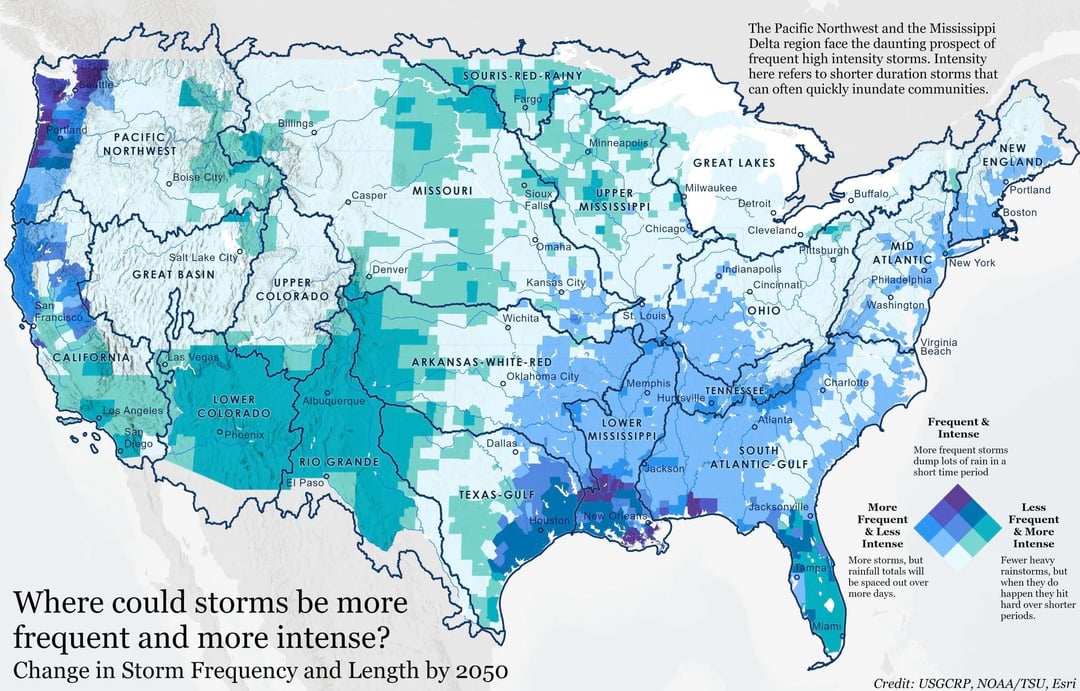
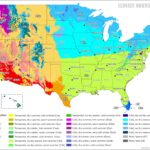
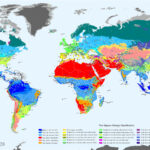
Precipitation across the United States has never been evenly distributed. The Pacific Northwest gets drenched while the Southwest stays parched. The Gulf Coast sees summer deluges while the interior West counts every drop. But these familiar patterns are shifting, and two maps created by Reddit user nohup_me based on USGCRP and NOAA data show exactly how those changes will play out by 2050.
The projections show 82% of the country getting wetter by mid-century. These come from CMIP6 climate models that researchers have scaled down to work regionally. Look at the eastern states, the Great Lakes, or the northern plains—rainfall is going up across the board. This isn’t just theoretical either. The Midwest’s biggest storms already deliver 42% more precipitation now than they did in 1958, while the Northeast has seen 55% increases.
Several regions go the opposite direction, though. The map shows less rainfall coming for western Arkansas-White-Red basin, Texas Gulf Coast, Rio Grande basin, Lower Colorado, and Southern California stretching from LA to San Diego. Southern Florida gets drier too. Not great news for places already watching their water supplies.
The second map zooms in on storm frequency and intensity. Two regions really stand out here—the Pacific Northwest and Mississippi Delta. Both will see what climate scientists call frequent high-intensity storms.
Projections show the Pacific Northwest getting 13% more days with over an inch of rain (comparing 2041-2070 to 1971-2000).
The Mississippi Delta has multiple problems piling up at once. Storm intensity is increasing, sure, but sea level also keeps rising faster there (about one inch every seven years) because the land is sinking. Then you add more frequent and stronger tropical cyclones. Mississippi’s 100-year floodplain currently spans 200 square miles (518 sq km), but projections put that at 300 square miles (777 sq km) by 2050.
Atmospheric rivers are already causing severe disruptions in the Pacific Northwest. These massive bands of tropical moisture travel northward and unleash astonishing amounts of rain when they reach the coast. Disturbingly, they are not only becoming more powerful but also occurring with increasing frequency.
The year 2050 is not some far-off science fiction scenario; it is just 25 years away. Anyone under 50 today will undoubtedly witness these dramatic changes firsthand.