There’s a temple prostitute named Shamhat in the Epic of Gilgamesh, written somewhere around 2100 BCE, with proper scenes built around her. Mesopotamian clay tablets from even earlier, around 2400 BCE, document prostitution as part of ordinary daily life. Rome had a whole bureaucratic setup for it: a government-issued license called a licentia, regular taxation, the works. Whatever your personal views on the subject, the historical record on this is fairly unambiguous: people have been trying to figure out how to handle prostitution for about as long as they’ve been writing things down.
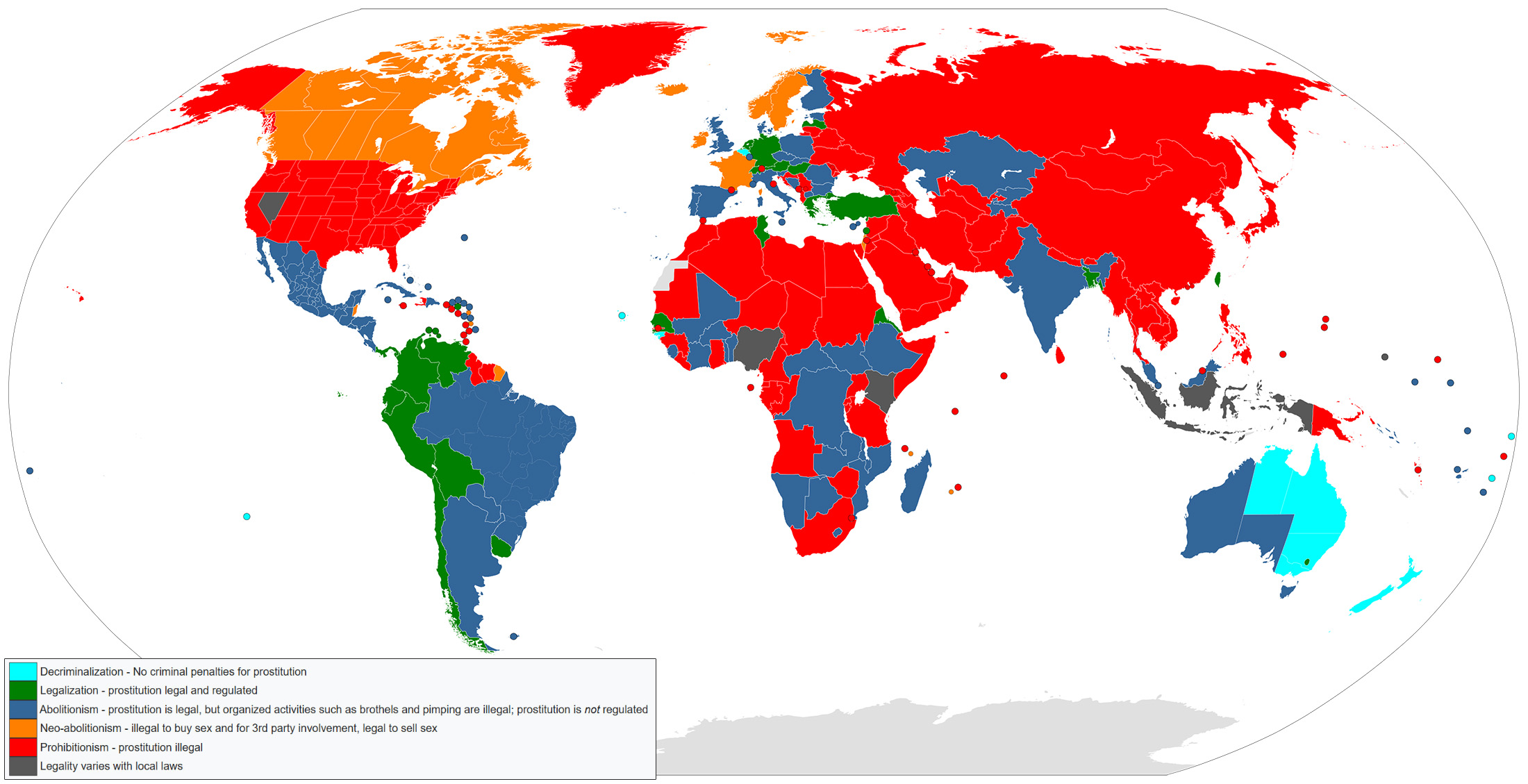
What this map shows is that in 2025, we’re still figuring it out — and doing so in six different ways at once. Germany and the Netherlands tax and license sex work the same way they would any other profession, with health checks built into the regulatory framework. New Zealand went further in 2003, scrapping criminal penalties altogether under the Prostitution Reform Act and giving sex workers access to the same labor protections as anyone else employed legally. Sweden went the other direction entirely in 1999, deciding the problem wasn’t the seller but the buyer, and made purchasing sex a criminal offense while leaving the selling of it legal. France, Canada, Ireland, and Israel have since followed that same logic.
Then there’s Russia, Iran, Saudi Arabia, and most of the Middle East, where all of it is illegal — in some places, severely so.
Legal Model
Example Countries
Prohibitionism (all aspects illegal)
Russia, China, Iran, Saudi Arabia, UAE, Egypt, Myanmar, Philippines, South Korea
Neo-abolitionism (selling legal, buying illegal)
Sweden, Norway, Iceland, France, Canada, Ireland, Israel, Northern Ireland (UK)
Here’s where it gets complicated for anyone expecting the stricter the law, the better the outcome. Dutch researchers tracked what happened after cities introduced licensed legal zones and found reported sexual violence fell by 30 to 40 percent in the first two years. A San Francisco study put that number at 82 percent of sex workers physically assaulted on the job — and San Francisco is a city where prostitution is illegal. Banning something doesn’t make it disappear. It mostly means the people doing it have no legal protection when something goes wrong.
The debate around all of this has been running for centuries and isn’t close to settled.