New York forced the issue first. On April 25, 1901, Governor Benjamin Odell signed a law ordering every vehicle owner in the state to register their car and mount the owner’s initials on the back, in letters at least 3 inches (about 7.6 centimeters) tall. Nobody issued the plate itself. Owners nailed together whatever was on hand. Leather scraps. House numbers. Hand-painted wood. Massachusetts closed that gap in 1903, becoming the first state to manufacture and issue its own numbered plates. States, Canadian provinces, and automakers didn’t agree on a single physical size for every plate in North America until 1956, settling on 12 by 6 inches, about 30.5 by 15.2 centimeters, with mounting holes drilled in the same spot no matter who printed the metal. That agreement never touched a separate question. Whether a car needs one plate or two.
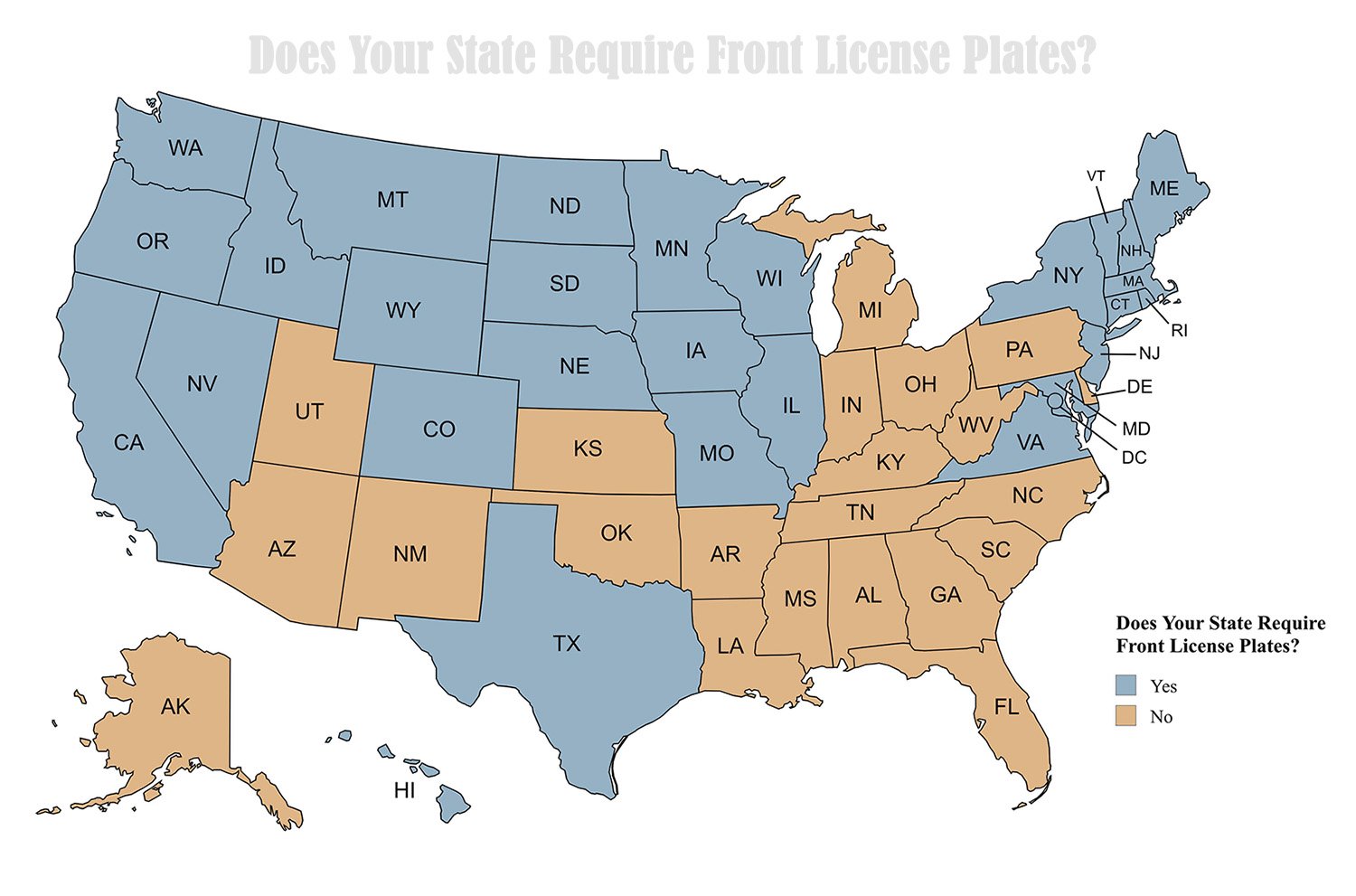
27 states plus Washington DC currently require both plates. The other 23 only check the back. Every state in the country requires at least a rear plate. The real divide on the map above is the front bumper. Texas requires both. Every other state touching the Gulf of Mexico skips it. Louisiana. Mississippi. Alabama. Florida. Michigan doesn’t require one either, and Michigan spent most of the twentieth century as the center of the US auto industry. Neither does Ohio or Indiana, its neighbors on the assembly line. Wisconsin and Illinois, one state over, both still require it. Nevada technically requires a front plate too, but only if the car came from the factory with a mounting bracket, which is how Nevada picked up the nickname the 1.5 plate state. Law enforcement groups tend to push for keeping the front plate for exactly that reason. A hit-and-run witness usually only sees the front end of a fleeing car, and toll gantries read plates coming and going in both directions on many of the country’s toll roads.
The rule follows the car’s registration, not the road underneath it. A driver registered in a state that skips the front plate isn’t violating the law by driving through a state that requires one. Enforcement of the rule itself also tends to be light for a first offense, usually a warning, or a fix-it ticket instead of a fine.
The map keeps shifting in one direction. Ohio dropped its front plate in 2020 under House Bill 62, a change state officials pinned at roughly $1.4 million a year in production savings. Alaska followed in 2022. Utah went next. The state ended its front plate requirement on January 1, 2025, under a bill from state senator Dan McCay. The projected savings total close to $3 million a year for the state, plus another $1.75 million a year in lower fees for Utah drivers (Utah News Dispatch). No state has moved the opposite way and added the requirement back. Virginia came close to being next. A bill to drop its own front plate rule was introduced for the 2026 legislative session. It died in March. For now, Virginia stays in the 28.