Europe still has big predators. Brown bears, grey wolves, wolverines, Eurasian lynx, and Iberian lynx all live here. Humans nearly killed them off through centuries of hunting and habitat destruction. Most of Europe had lost these animals by the early 1900s.
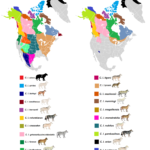
The maps show what’s returned.
Wolverines, lynx, bears, and wolves in Europe.
Wolves
Wolves bounced back fastest. Around 19,000 now live across 31 countries. Spain’s mountains have them. Italy’s Apennines too. You’ll find wolves throughout the Balkans, across Eastern Europe, and in Scandinavia. They persist by using forests and mountains where human populations stay lower. Some packs den within 50 kilometers of major cities.
Bears
Brown bears total about 17,000. Thousands live in Scandinavia. The Carpathians crossing Romania, Ukraine, and Slovakia hold huge numbers. Romania is exceptional – it has over 6,000 bears, more than a third of Europe’s total in one country. Spain’s Cantabrian range has roughly 400 bears in two separate groups that don’t interbreed. The Alps got bears back after reintroduction programs. Because these populations separated centuries ago, they’re now genetically distinct.
Wolverines
Wolverines barely survive with about 1,250 individuals, nearly all in northern Norway, Sweden, and Finland. They need vast wilderness Europe mostly doesn’t have. One wolverine roams maybe more than 600 square kilometers. They’re built for extreme cold and heavy snow, for places where winter dominates and reindeer herds migrate across tundra.
lynx
Eurasian lynx are probably the hardest predator to observe in Europe. Approximately 9,000live in forests from Scandinavia through the Baltics and Carpathians, with scattered populations in Central Europe. They need more space than wolves plus dense forest cover. That explains the broken-up range on the map. Switzerland, Germany, and Austria reintroduced lynx where they’d been extinct over a century.
Iberian lynx exist only in southwestern Spain and Portugal, preferring scrubby Mediterranean habitat over forests. In 2002 just 94 remained– among the world’s rarest cats. Captive breeding, habitat work, and farmer cooperation pushed numbers past 1,600. They stay confined to protected areas without much room to expand, but the recovery is substantial.
The two lynx species are separated by more than 2,000 kilometers and inhabit completely different landscapes. They never meet.
Looking at the maps shows patterns. Romania, Finland, and Sweden have space and tolerance for predators. Western Europe is too densely populated and farmed. Mountains serve as corridors between isolated groups.
The situation keeps changing. Bears occasionally appear in Romanian suburbs. Italian suburbs too. Wolves returned to the Netherlands and Denmark after 140-year absences. Every expansion sparks arguments about livestock, hunting rules, and whether contemporary Europe can accommodate big predators.