Regional Development Across Europe Mapped
Europe is one continent, but in development terms it behaves more like several. The contrast between a Scandinavian country where people live past 83 on average, university access is near-universal, and incomes are among the highest in the world, and a post-Soviet state where wages are a fraction of that and infrastructure investment has lagged for decades, is not subtle.
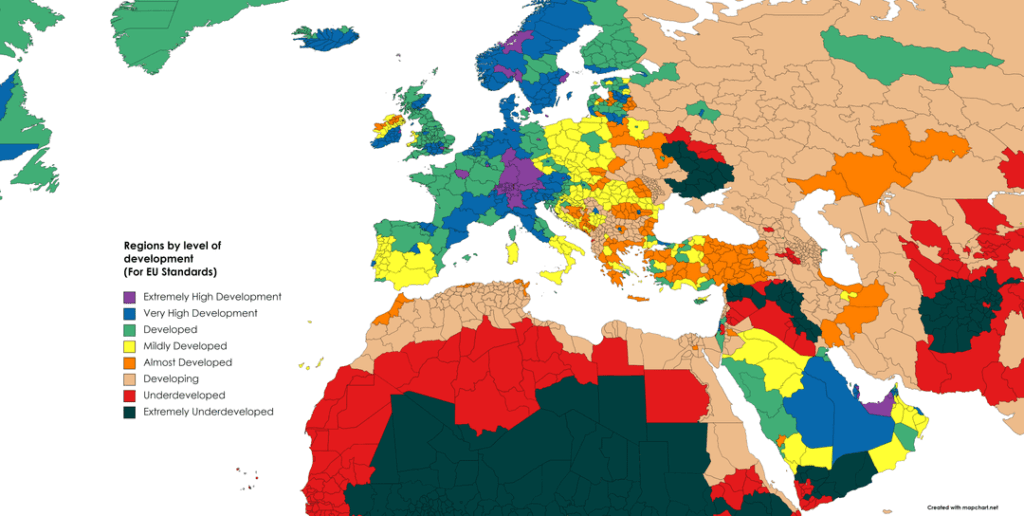
On a map of European regions classified by EU development standards, the deepest purple, the “extremely high” tier, covers inner London, the Paris metropolitan area, the economic cores of Germany and Switzerland, northern Italy’s industrial belt, and large parts of Norway, Sweden, and Austria. Further east, the colors shift toward orange. Russia, Belarus, and most of Ukraine land in the “developing” range, though Moscow, Saint Petersburg, and their surrounding oblasts are considerably better off than those national averages suggest. Eastern Ukraine ends up at the very bottom of the scale. The war that started in 2022 is the reason.
UNDP’s Human Development Report puts Iceland at the top globally, with an HDI of 0.972 for 2023. Norway and Switzerland are right there too, both at 0.970. Down at the other end of the European rankings, Ukraine is at 0.779, Moldova 0.785, Belarus 0.824.
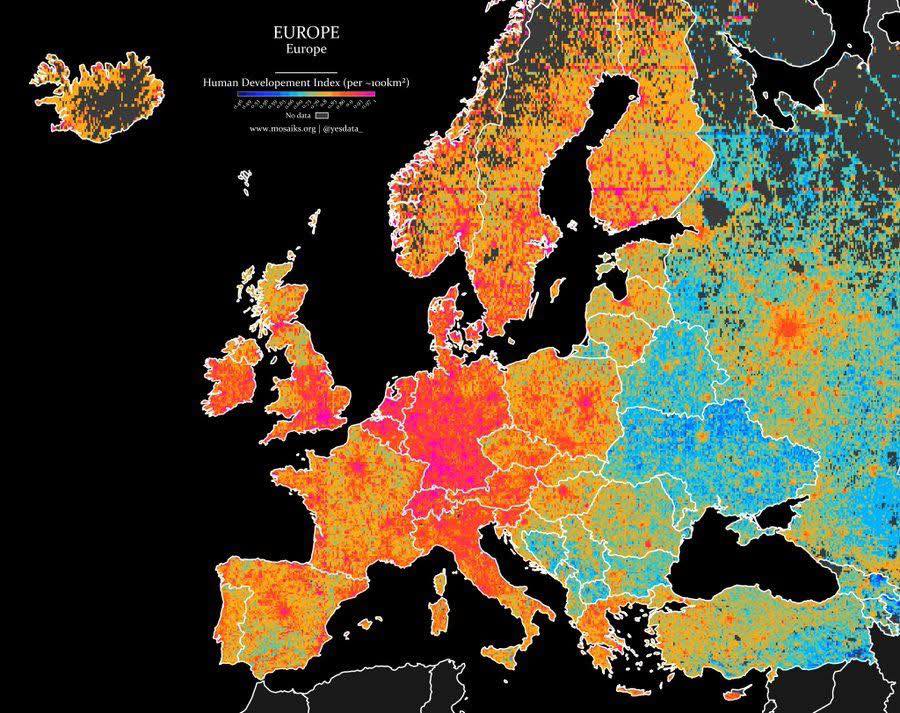
Most of that distance has historical roots. The Iron Curtain kept Eastern European countries inside centrally planned economies for about forty years. Foreign investment barely reached them. Market competition didn’t exist. The institutional development reshaping the West over the same period was simply off the table. After 1989, countries like Poland had to basically invent market economies from scratch. That kind of starting point doesn’t disappear in a generation.
Getting into the EU changed things considerably. Since 2004, Central and Eastern EU members have been growing at roughly double the pace of the older Western states. Poland grew fast enough that by the 2010s it had become the standard reference for successful post-communist transition. Romania was another country that moved faster than most expected.
As a result, central and Eastern EU members have cut nearly 30 percentage points off their gap with the West since 2004. In the Western Balkans, progress has been slower. Their average GDP per capita went from 27% of the EU’s in 2003 to 41% in 2024. At that pace, closing the gap fully will take many more decades. Moldova and Belarus have moved far less even than that. And for Ukraine, the full-scale invasion that began in 2022 has pushed development numbers in the wrong direction.
Capital cities consistently outperform national figures, and that is visible here too. Moscow and Saint Petersburg both land in the “very high development” category on the regional map, even though Russia’s national HDI of 0.832 places it well behind the European leaders.
Top 10 Most Developed European Countries by HDI (2023)
| European Rank | Country | Global HDI Rank | HDI Score (2023) | Life Expectancy (yrs) | GNI per Capita (PPP $) |
|---|---|---|---|---|---|
| 1 | Iceland | 1 | 0.972 | 82.7 | 69,117 |
| 2 | Norway | 2 | 0.970 | 83.3 | 112,710 |
| 3 | Switzerland | 2 | 0.970 | 84.0 | 81,949 |
| 4 | Denmark | 4 | 0.962 | 81.9 | 76,008 |
| 5 | Germany | 5 | 0.959 | 81.4 | 64,053 |
| 6 | Sweden | 5 | 0.959 | 83.3 | 66,102 |
| 7 | Netherlands | 8 | 0.955 | 82.2 | 68,344 |
| 8 | Belgium | 10 | 0.951 | 82.1 | 63,582 |
| 9 | Ireland | 11 | 0.949 | 82.4 | 90,885 |
| 10 | Finland | 12 | 0.948 | 81.9 | 57,150 |
From Iceland to Finland is just 0.024 HDI points across ten countries. They share something beyond raw income: broad access to education and long life expectancy alongside high wages, not separately from them. Ireland is an unusual case in the table. Its GNI per capita of $90,885 is the second highest, more than Norway in income alone, yet it ranks ninth overall. Ireland spent most of the twentieth century as one of Western Europe’s poorer economies before a significant economic shift in the 1990s and 2000s. The income gains since then have been real, but HDI accounts for more than a paycheck, and Ireland’s life expectancy and education indicators keep it below the countries ranked above it.
Where you are born in Europe still shapes your life in measurable ways. For EU members in the east, that has genuinely been changing. For those outside the EU, the distance remains largely where it was.