As you drive through Ohio, you might spot a horse-drawn buggy on the highway alongside big trucks. The man guiding it doesn’t use a smartphone. His home is lit by kerosene lamps instead of electricity, and he works his fields with real horses.
There are 410,955 peopleliving this way right now in North America. They’re called Amish. No cars. No power from the grid. They wear simple clothes and speak Pennsylvania Dutch at home.
Their roots go back to 1693 when Jakob Ammann, a Swiss religious leader, broke away from the Mennonites. His followers came to Pennsylvania in the 1700s looking for religious freedom. The name “Amish” comes from him.
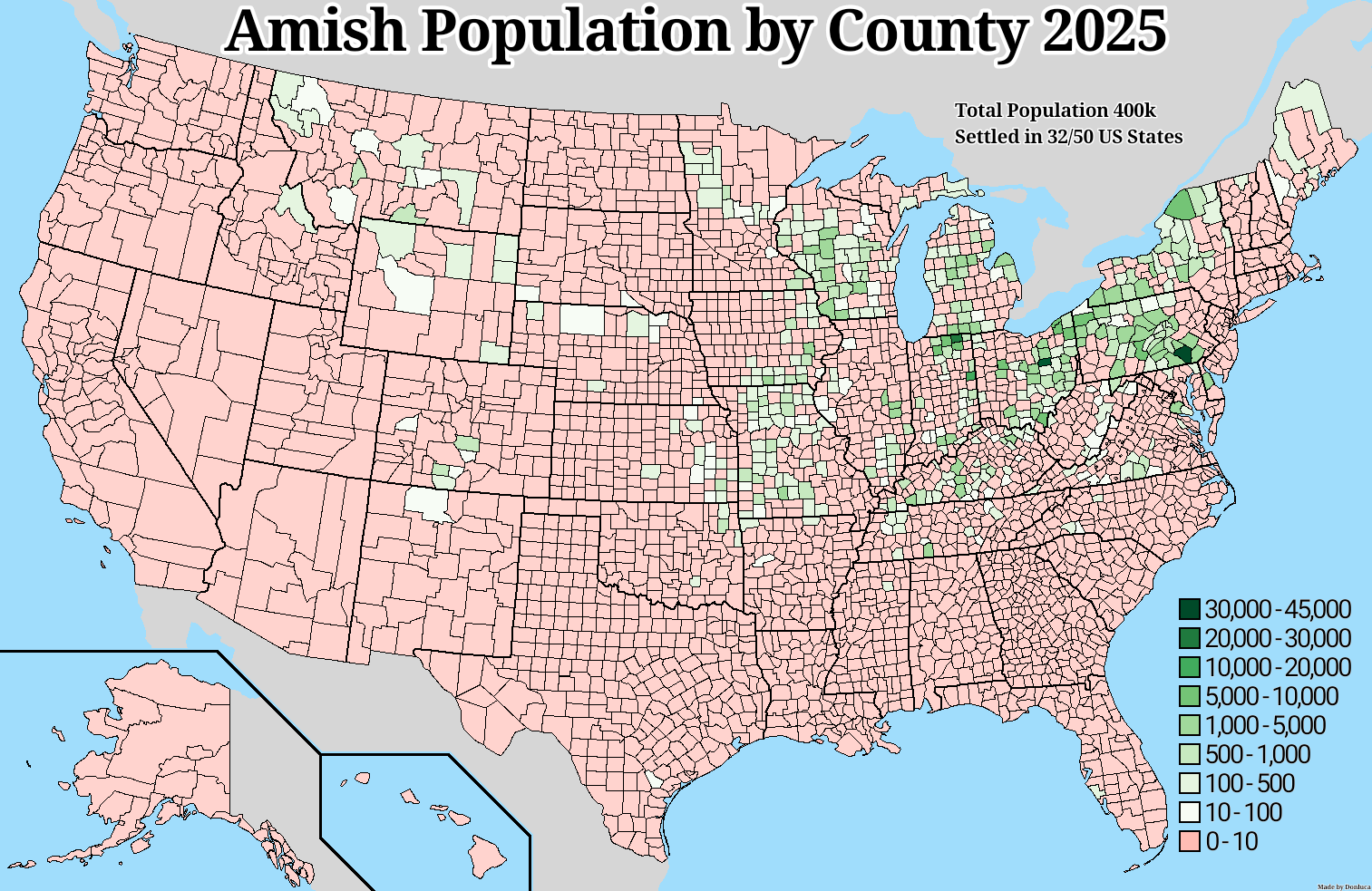
The map below created by Reddit user Crafty-Company-2906 shows the Amish population by U.S. county.
Back in 2000, about 177,910 Amish lived in North America. Today? 410,955. That’s 131% growth in 25 years. Every 20 years or so, their population doubles.
How? Big families. We’re talking 5-7 kids per household. In Lancaster County, one in ten Amish families has 10 or more children. Compare that to 1.9 kids for the average American family.
Plus, around 85-90% of Amish teenagers decide to stay Amish after they grow up. Most religions would be thrilled with half that rate.
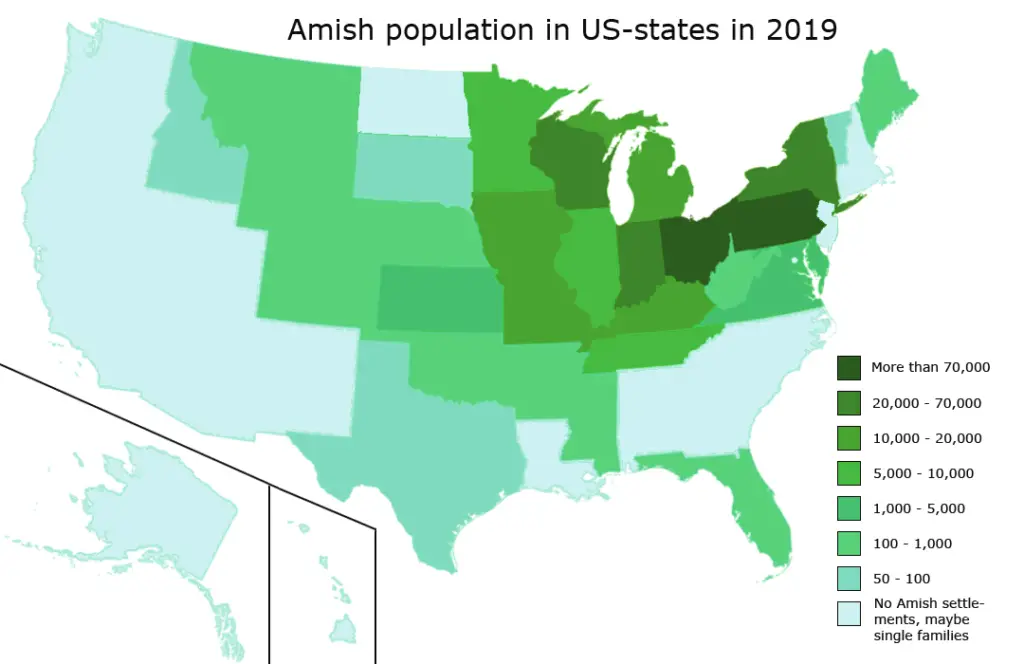
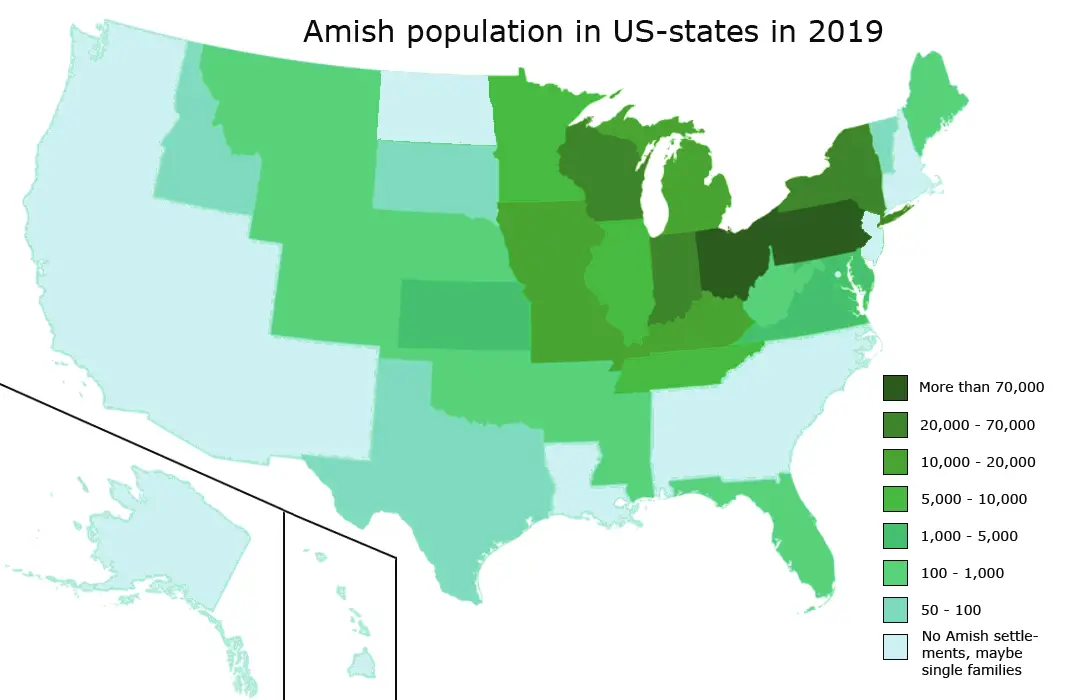
Pennsylvania has 95,400 Amish. Ohio’s got 86,300. Indiana has 67,300. Those three states account for 61% of all Amish in North America.
Lancaster County in Pennsylvania is the biggest single settlement—44,700 people. Holmes County, Ohio comes second with 39,000. In Holmes County, nearly half of everyone you meet is Amish.
But here’s what’s changed. They’re not just in Pennsylvania and Ohio anymore. Amish settlements now exist in 32 states and three Canadian provinces. Nine new ones started just last year.
Since 2000, Amish families have moved to Colorado, Nebraska, New Mexico, South Dakota, Vermont, and Wyoming. Why? Land in Pennsylvania costs too much now. Same with parts of Ohio. So families pack up and head west looking for affordable farms.
Minnesota’s Amish population shot up 230% over 20 years. New York went from 4,505 Amish residents to over 21,000. Wisconsin, Missouri, and Kentucky all have booming Amish communities now.
Not all Amish are the same. They’re divided into groups based on how strict they are. Beachy Amish (around 10,000 people) are the most relaxed. They might drive cars and use basic phones. Old Order Amish (380,000 or so) are more traditional. Swartzentruber Amish (about 25,000) are the strictest. They refuse almost all modern tools and plow exclusively with horses.
Family size varies by group. Swartzentruber families average 9 kids. Old Order families average 6.5. Keep that up for a few generations and the math gets crazy. Some projections suggest 10 million Swartzentruber Amish plus 10 million Old Order Amish by 2125. Will there be enough cheap farmland? Nobody knows.
Amish kids go to school through eighth grade, then stop. After that, boys learn trades like construction or furniture making. Girls help at home and with family businesses. At home, everyone speaks Pennsylvania Dutch—a German dialect that’s stuck around for 300 years. They learn English too, mostly for dealing with non-Amish neighbors.
Then at 16, Rumspringa starts. Teenagers get more freedom before baptism. Some experiment with cars, phones, even parties. The media loves making this sound wild. Yes, some kids party. But most just hang out at volleyball games and group singings. Over 90% end up getting baptized and staying Amish anyway.
During Rumspringa, young people date. A guy offers a girl a ride home from a singing in his courting buggy. They see each other for a year or more. If it’s serious, he asks her parents for permission to marry. No arranged marriages—that’s a myth.
Each settlement has its own “Ordnung“—basically a list of rules about what technology is allowed and how people should behave. The rules change from place to place. Some communities allow battery-powered tools for work. Others won’t touch them.
Amish are serious pacifists. During World War I and II, some went to jail rather than serve in the military. Eventually, the government gave them conscientious objector status.
In 2006, a man walked into an Amish school in Lancaster County and shot 10 girls, killing five. What happened next shocked everyone. The Amish families went to comfort the shooter’s widow. They showed up at his funeral. They forgave him right away. Not easily—they’re human—but their faith requires it.
Farming used to define Amish life. But farmland keeps getting pricier. Now lots of Amish work in manufacturing, construction, furniture shops, and retail. Some run successful businesses selling furniture, baked goods, or quilts to non-Amish customers. Over a lifetime, an Amish household might bring in $1-2 million in revenue, though that number bounces around depending on what they do and where they live .
Usually, one child inherits the farm (often the oldest son) so it stays workable. Other kids get different assets.
The Amish don’t evangelize. They won’t knock on your door with pamphlets. Their approach? Live well and let people notice. Converting is technically possible but super rare. You’d need to learn Pennsylvania Dutch, adopt their whole lifestyle, and convince a community to accept you. Maybe a few dozen converts exist total.
They don’t pay Social Security and don’t collect it either. No health insurance. When someone faces big medical bills, the community fundraises. Their retirement plan? Their kids and neighbors.
Books About Amish Life
Want to read more? Check these out (Amazon links):