What Would the World’s Religious Map Look Like Without Islam?
In 610 CE, a new faith emerged in Arabia and permanently altered the religious map of three continents.
Read more: What Would the World’s Religious Map Look Like Without Islam?
Religion maps displaying different religions predominating in the world.
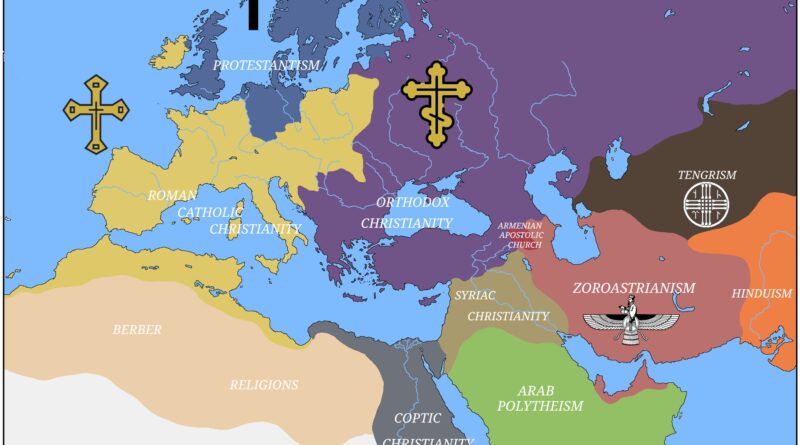
In 610 CE, a new faith emerged in Arabia and permanently altered the religious map of three continents.
Read more: What Would the World’s Religious Map Look Like Without Islam?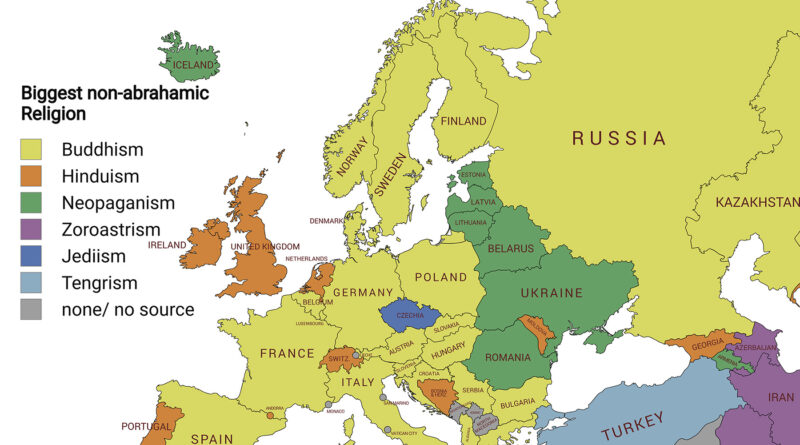
Europe’s religious map is mostly Abrahamic. Christianity, Islam, and Judaism between them account for the vast majority of believers across the continent. Filter those three out and what’s left includes Tibetan Buddhism in Russia, reconstructed Norse paganism in Iceland, ancient fire worship in Azerbaijan, and 21,539 registered Jediists in Czechia.
Read more: Europe’s Non-Abrahamic Religions Mapped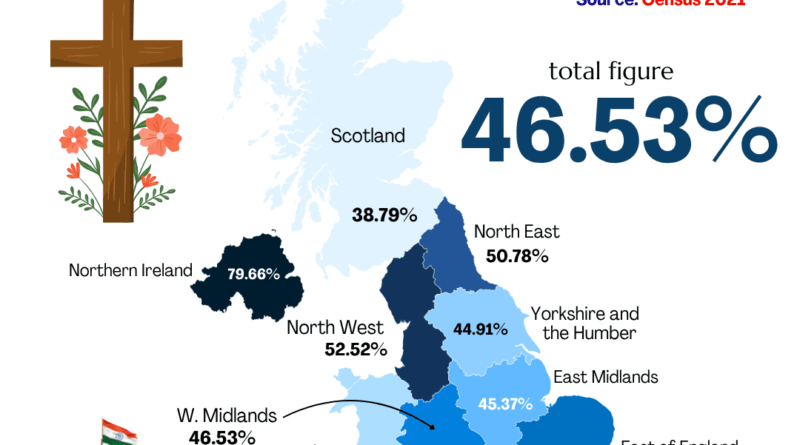
Christianity fell below half the UK population in 2021. But that national number hides enormous regional differences. Northern Ireland is 80% Christian. Scotland is 51% non-religious. London contains a third of all British Muslims, 42% of Hindus, and over half of Jews.
Read more: Mapping Religious Identity Across the UK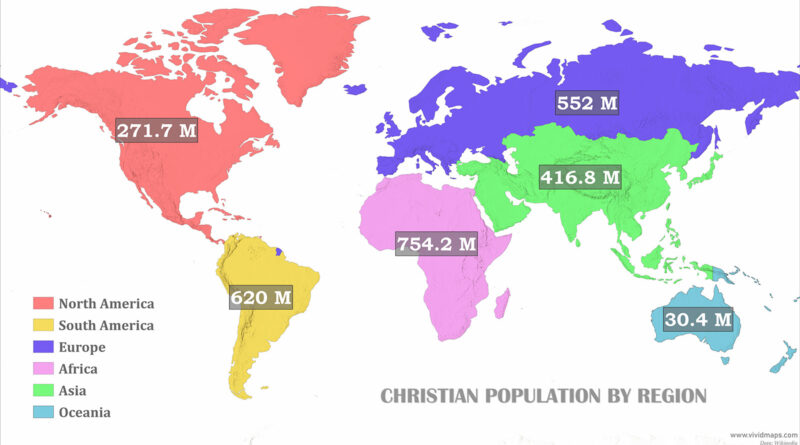
Christianity’s journey from the Middle East to every corner of Earth has created an unexpected distribution. While many assume Europe or North America dominate, the data shows a different reality. Africa now hosts more Christians than any other continent.
Read more: Christianity Across Continents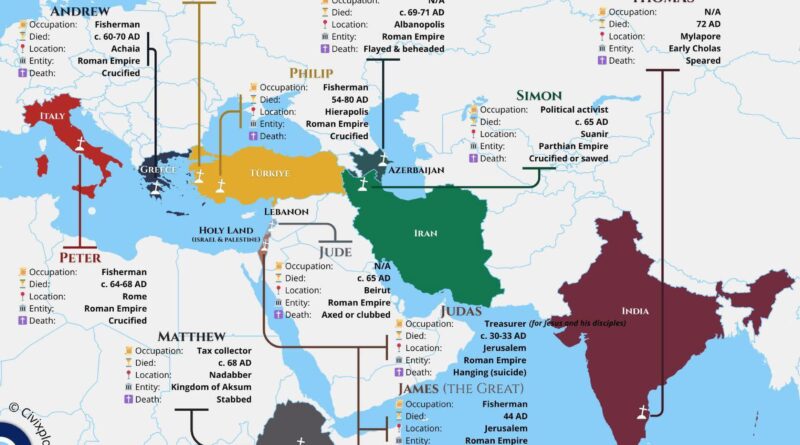
After Jesus’s death around 30 AD, his twelve closest followers scattered across continents. Peter died in Rome, Thomas traveled to India, Andrew reached Greece, and Matthew went to Ethiopia. This map traces their journeys along Roman roads and trade routes, showing how Christianity expanded from Jerusalem to three continents within seven decades.
Read more: What happened to the 12 Apostles?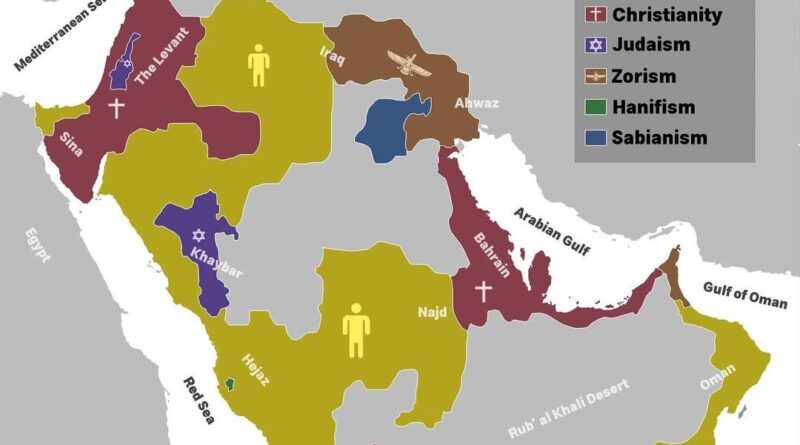
In the early 5th century, different beliefs shared the Arabian Peninsula. Jewish and Christian families lived in busy caravan towns, while many desert tribes still honored local gods or searched for a single creator.
Zoroastrian customs from Persia reached Arabia’s northeast, blending with local traditions. A few generations later, Islam appeared and began to reshape life across the peninsula.
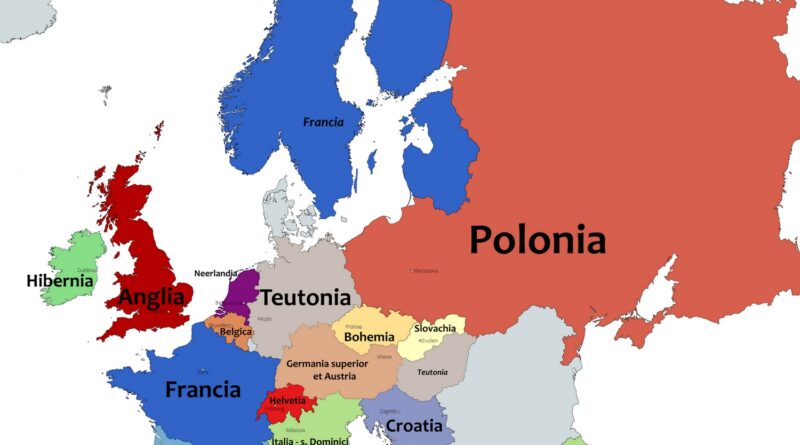
A map of Dominican provinces reveals how religious boundaries established centuries ago still organize communities across Europe, often ignoring today’s political borders.
Read more: Dominican Order Provinces in Modern Europe
Most Popes throughout history were born in Italy—but a closer look reveals an interesting geographic distribution across continents. Discover where Popes were born and how shifts in the scope of the Catholic Church have impacted its leadership.
Read more: Where Were the Popes Born? A Map of Papal Origins Through Time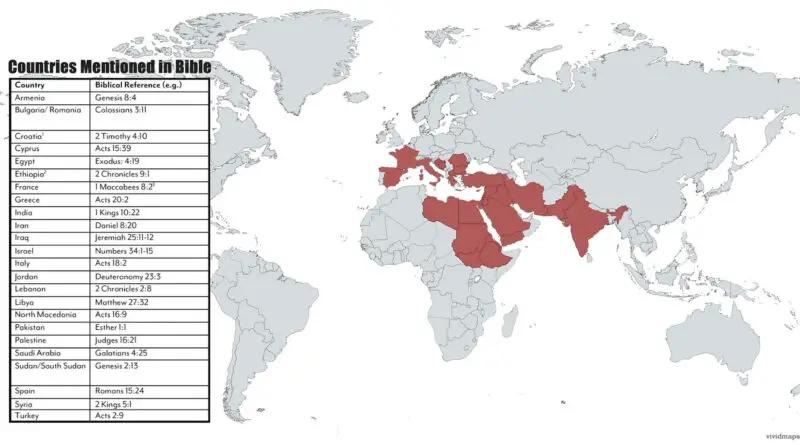
Beyond mere lines on a map, biblical lands tell a complex story of human civilization, where each location represents centuries of migration, conflict, and connection.
Read more: A World Map of All the Countries Mentioned in the BibleDemographic maps project major shifts in Amish and Mormon populations through 2100. Both groups are expanding, but heading in opposite directions.
Read more: Amish and Mormon Populations by 2100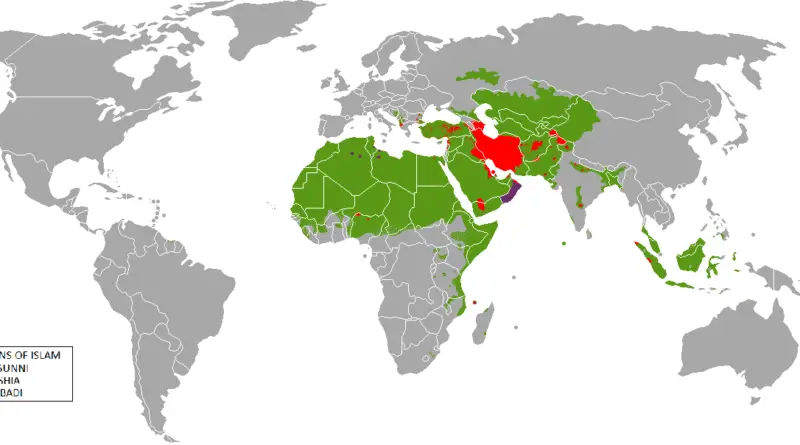
The divisions within Islam have historically emerged due to theological, political, and jurisprudential differences among its followers, leading to the formation of distinct branches or sects. The two primary branches of Islam are Sunni and Shia, each representing a significant portion of the Muslim population worldwide. These divisions originated in the early years of Islam, rooted in disagreements over leadership succession following the death of Prophet Muhammad in the 7th century.
Read more: Divisions of Islam in the world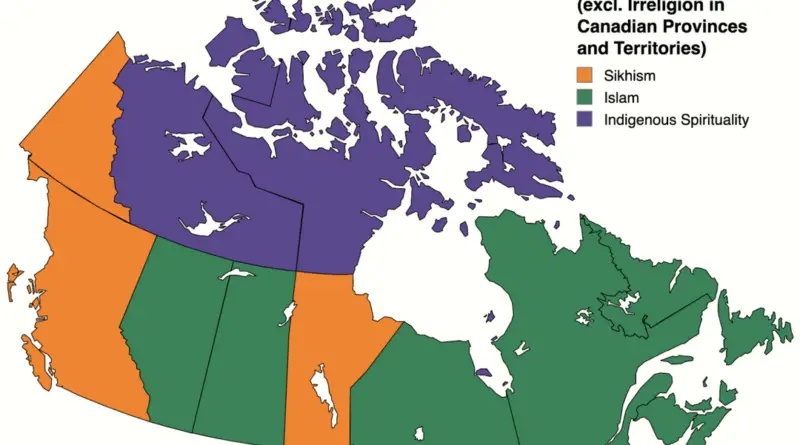
From Sikhism in British Columbia to Buddhism in Nova Scotia, explore how different faiths create unique religious patterns across Canada’s regions, based on latest Census data.
Read more: Second and Third Most Practiced Religions Across Canada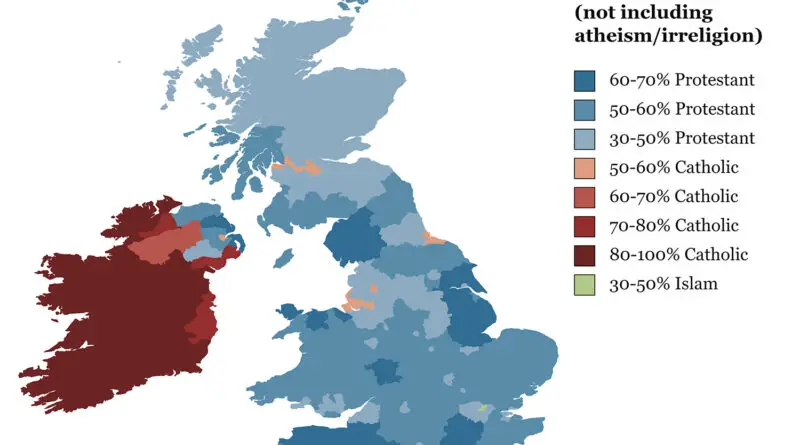
Religion in the United Kingdom and Ireland is characterized by a historically dominant presence of Christianity. In the UK, the Church of England (Anglicanism) has been the established church, while the Church of Scotland is significant in Scotland. Ireland has a strong Catholic tradition. However, both regions have experienced growing religious diversity and secularization in recent years, with a rising number of non-religious and atheist individuals. Other faiths, including Islam, Hinduism, and Sikhism, have also become more prominent due to immigration and globalization, shaping the religious landscape in the UK and Ireland.
Read more: Religion in the United Kingdom and Ireland