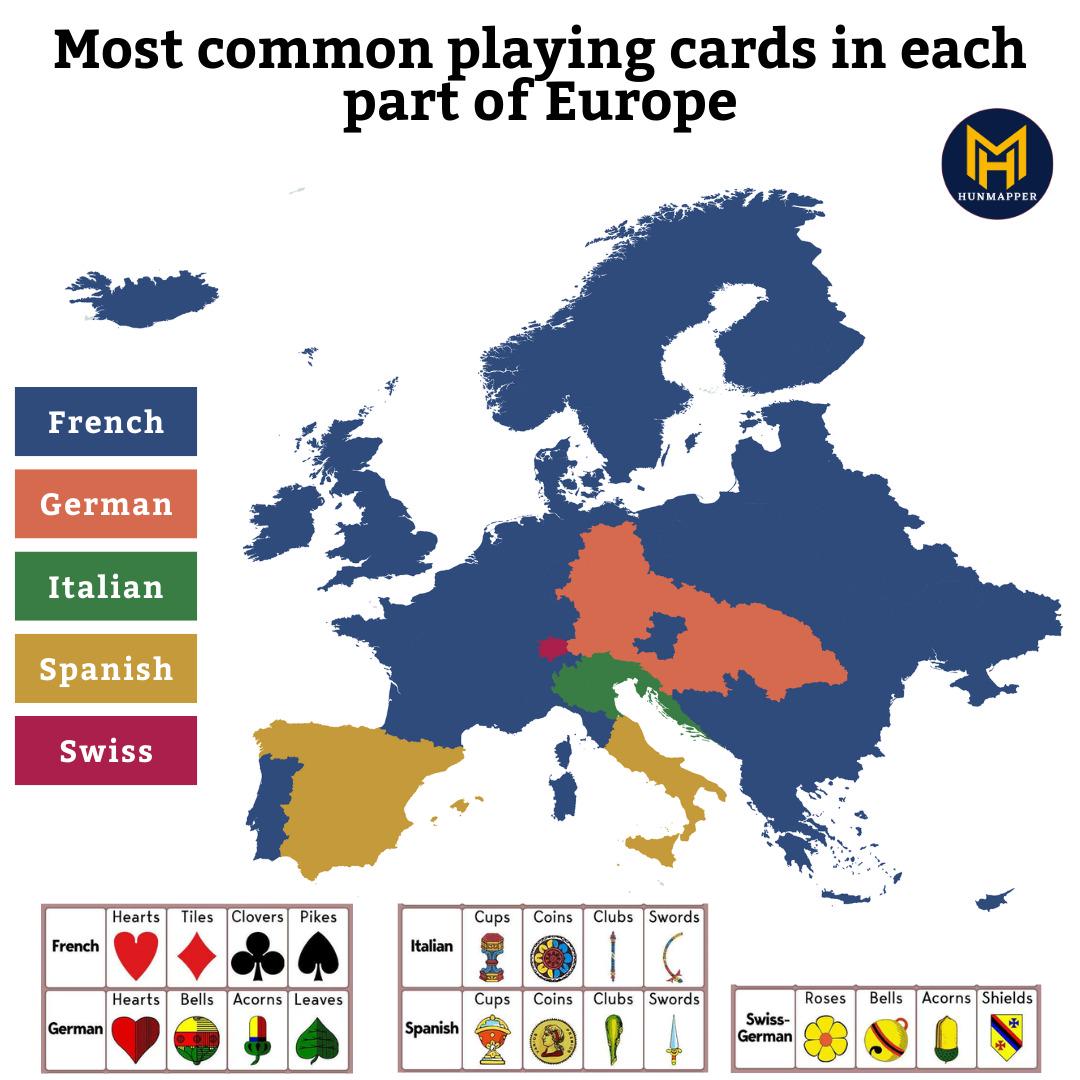
Sometime in the late 14th century, playing cards started turning up across the Mediterranean coast of Europe. The earliest recorded decks, from around 1370, appeared in Italy and Spain, and their four suits — cups, swords, coins, and batons — came almost directly from Mamluk Egyptian cards. This is where European card playing begins, and those Italian and Spanish Latin suits are still the oldest card tradition on the continent. What makes all of this geographically interesting is that things didn’t stay unified for long, and hunmapper mapped exactly what happened next.
German-speaking regions had settled on their own system by the mid-15th century: acorns, bells, leaves, and hearts. It’s a visually different world from the Italian suits, more central European in feel, less Mediterranean. Swiss card makers of the same era took acorns and bells from the German system but used roses and shields for the rest, and that particular combination stuck around long enough to still be in use today. Around 1480, French makers took the German system as their starting point and cut it down to the simplest possible format: two colors, four clean shapes. Cards became considerably cheaper to print that way, which had obvious consequences for how widely the format traveled.
Deck structures diverge even more sharply than the suit symbols suggest. Neither the German, Swiss, Italian, nor Spanish traditions include a Queen — that’s a French contribution, and a relatively recent one in the long history of card playing. German and Swiss packs typically run to 32 or 36 cards, with the court made up of a King, Ober, and Unter. Italian and Spanish decks are a different shape altogether: usually 40 cards, three court figures, but with a Knight rather than any kind of knave pair. The French 52-card structure with its King, Queen, and Jack is the youngest of these formats by some distance.
Suit System
Suits
Deck Size
Court Cards
Primary Region
Italian
Cups, Coins, Clubs, Swords
40 or 52
King, Knight, Knave
Northern Italy, Adriatic region
Spanish
Cups, Coins, Clubs, Swords
40 or 48
King, Knight, Jack
Spain, Latin America, parts of S. Italy
German
Hearts, Bells, Leaves, Acorns
32 or 36
King, Ober, Unter
Germany, Austria, Central Europe
Swiss-German
Roses, Bells, Acorns, Shields
36
King, Ober, Unter
German-speaking Switzerland
French
Hearts, Diamonds, Clubs, Spades
52
King, Queen, Jack
Most of Europe and worldwide
Schafkopf in Bavaria runs on a 36-card German deck, and the game grew around that format over generations in a way that makes the two basically inseparable. Playing it with a standard poker deck runs into problems almost immediately — cards the game depends on simply don’t exist in a French format. Jass in German-speaking Switzerland has that same dependency on Swiss-German cards, and Italian games like Scopa and Briscola grew up around 40-card Latin decks over centuries of play. Regional card formats survived largely because regional games needed them to.
The ranking surprises go beyond court cards. In Briscola and Scopa, the 1 (Ace) outranks the King, which feels completely wrong to anyone whose only reference point is poker or Bridge. German decks have their own history with the Ace: older German packs dropped it entirely by around the 1470s, with the Deuce taking its place as the highest card instead.
The French deck’s global spread had a lot to do with ink costs. Multiple colors were needed to print German, Italian, and Spanish decks properly, while the French system worked fine in just red and black. French and English manufacturers had a real commercial advantage because of this from the 17th century onward. The worldwide reach of Whist, Bridge, and eventually Poker through British and American cultural influence then carried the format into virtually every corner of the world, and the Napoleonic Wars physically moved French-pattern cards into regions where local formats had been the standard for generations.