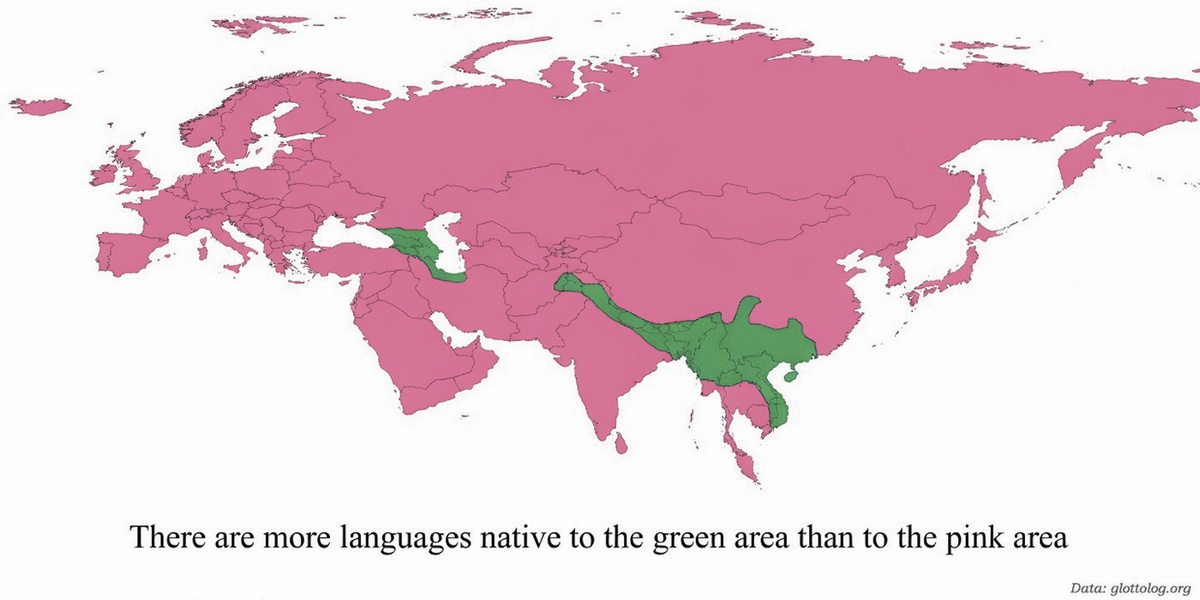
There are roughly 7,000 languages spoken on Earth today. But they don’t spread evenly across the planet — some regions have accumulated dozens of completely unrelated ones within a small area. The map below, created using Glottolog data, shows exactly where that happens in Asia — and the answer is almost always mountains.
The green on this map follows the mountain belt from the Caucasus through to Southeast Asia.
Isolated mountain communities develop their own speech over time. This isn’t anything exotic — it’s just what prolonged separation does to language. Mountains keep producing that separation in a way that other terrain doesn’t. Even communities that have technically lived within reach of each other for centuries can end up linguistically unconnected because ridges and valleys interrupt the regular contact that blends languages together. Researchers who study this have a name for places where it happens reliably — “accretion zones,” where geographic fragmentation keeps any single language from spreading and dominating. The Caucasus is a good illustration of how far this can go — a region between the Black and Caspian Seas small enough to cross in a single day of driving, containing between 35 and 40 indigenous languages across three completely unrelated families. These families share no common ancestors and look nothing like each other — or like anything else spoken outside the region.
The same dynamic plays out further along the mountain chain. Nepal’s 2011 census came back with 123 officially recognized languages — for a country roughly the size of Iowa, that’s a genuinely unusual figure. Quite a few of those languages are in trouble, kept alive by a few hundred speakers in places that are hard to reach and even harder to study. The numbers in the table below come from Ethnologue and Wikipedia, and they should be read loosely — survey dates and methodologies differ enough that the real figures are probably somewhat different in most cases.
Kurdish (5+ million in Iran); Luri (~2 million); Bakhtiari (~1 million); Gorani (~200,000)
Hindu Kush
Pashto (~40 million total); Dari (~12 million in Afghanistan); Pashai (~500,000); Khowar (~240,000); Nuristani languages (~130,000 combined); Kalasha (~5,000)
Karakoram
Shina (~500,000); Balti (~300,000); Burushaski (~120,000); Wakhi (~60,000); Khowar (~240,000)
Vietnamese (~97 million); Tay (~1.6 million); Muong (~1.2 million); Hmong (~1 million in the region)
One thing raw speaker counts don’t communicate well is how genuinely unrelated some of these languages are to anything around them. Burushaski is probably the most extreme case — around 120,000 people speak it in the Karakoram, and despite decades of research, nobody has found a connection to any other language family. Not a distant one, not a tentative one. Most languages carry traces of contact somewhere in their history — borrowed vocabulary, shared grammatical patterns, common roots with something nearby. Burushaski has none of that.