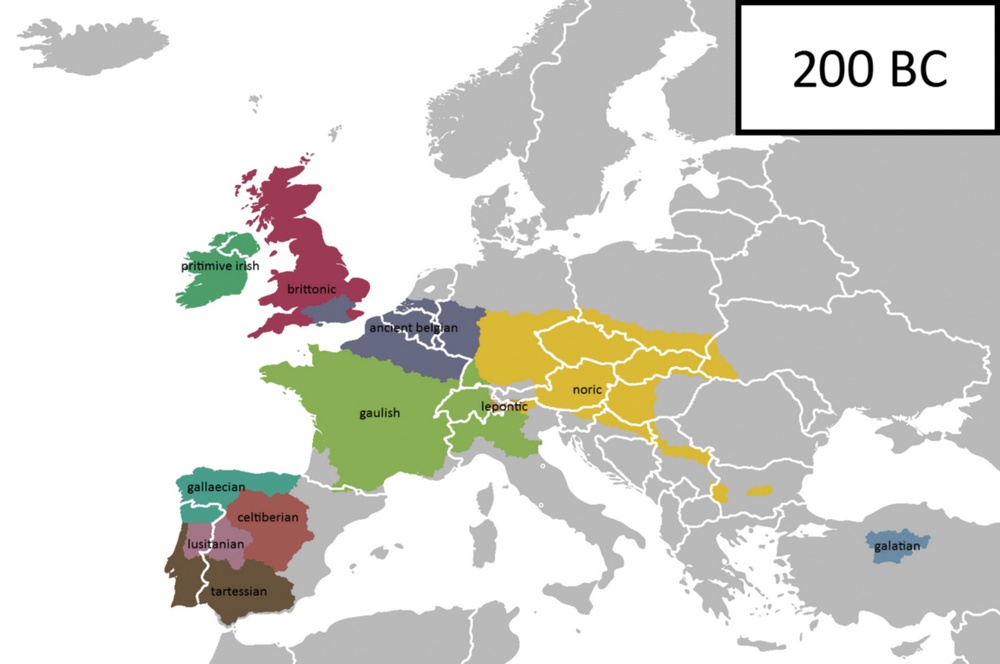
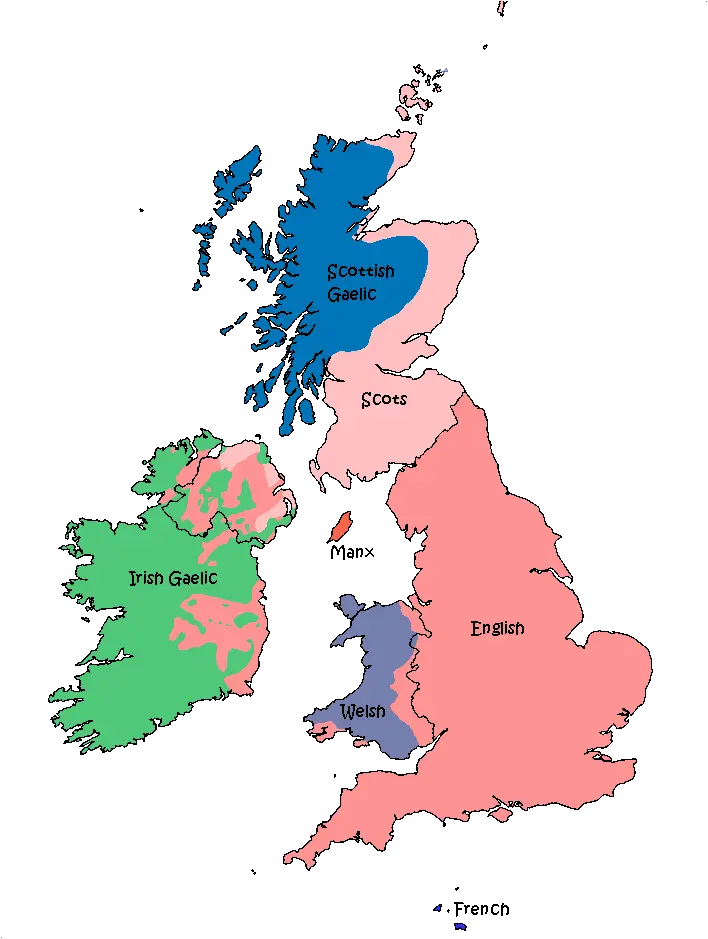
Two thousand years ago Celtic was spoken from the Atlantic coast of Portugal east across Gaul and the British Isles, south through northern Italy, across the Balkans, and into the highlands of what is now central Turkey, where a community of Gaulish settlers had been speaking it in complete isolation for close to 700 years.
Where this language family comes from
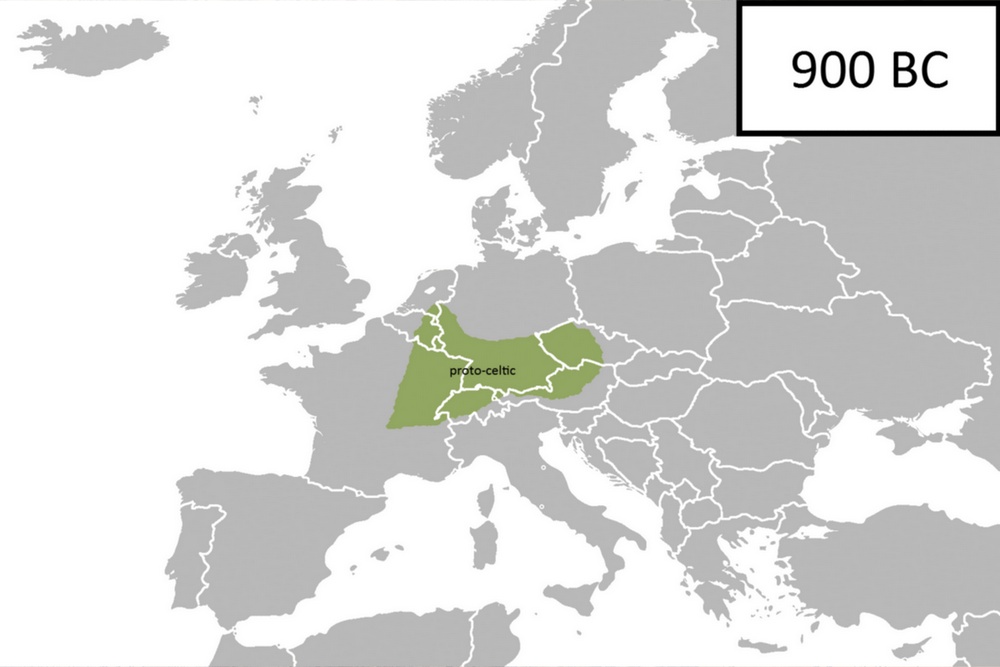
Celtic belongs to the Indo-European family, the group that also gave the world Latin, Greek, Sanskrit, Persian, Russian, and English. Proto-Celtic separated from Proto-Indo-European around 1300 BCE and left no written record. What linguists know about it was pieced together by comparing the surviving daughter languages and working backward toward whatever they must have shared.
Those daughter languages eventually divided in two. The ones that developed on the European mainland are collectively called Continental Celtic: Gaulish, Lepontic, Celtiberian, Gallaecian, Noric, and Galatian. All of them disappeared. The ones that developed in the British Isles and Ireland, called Insular Celtic, are where the six surviving languages came from: Irish, Scottish Gaelic, Manx, Welsh, Cornish, and Breton.
How Celtic reached so much of the continent
Celtic-speaking peoples spread through most of the European continent from around the 5th century BC, eventually reaching the Black Sea, the Anatolian Peninsula, Spain, Italy, and the British Isles. There was no Celtic empire behind any of this. The spread followed trade routes and migration, propelled by the cultural prestige of the La Tène metalworking tradition, which from roughly 450 BC became a status marker across much of Europe. Skilled ironwork, warrior aristocracy, and language traveled together as an interconnected package. By 300 BC that package had reached from the Atlantic coast of Iberia all the way to central Turkey.
Why the continental languages eventually disappeared
After Caesar conquered Gaul between 58 and 50 BC, Latin was adopted quickly by the Gaulish aristocracy, since speaking it meant access to Roman political networks and patronage, and trilingualism was already noted in southern Gaul by the 1st century BC. Farmers and rural communities took a very different path. A language woven into daily life and local custom can outlast political conquest by centuries. Gaulish is thought to have gone extinct around the late 6th century, some 600 years after Caesar’s campaigns.
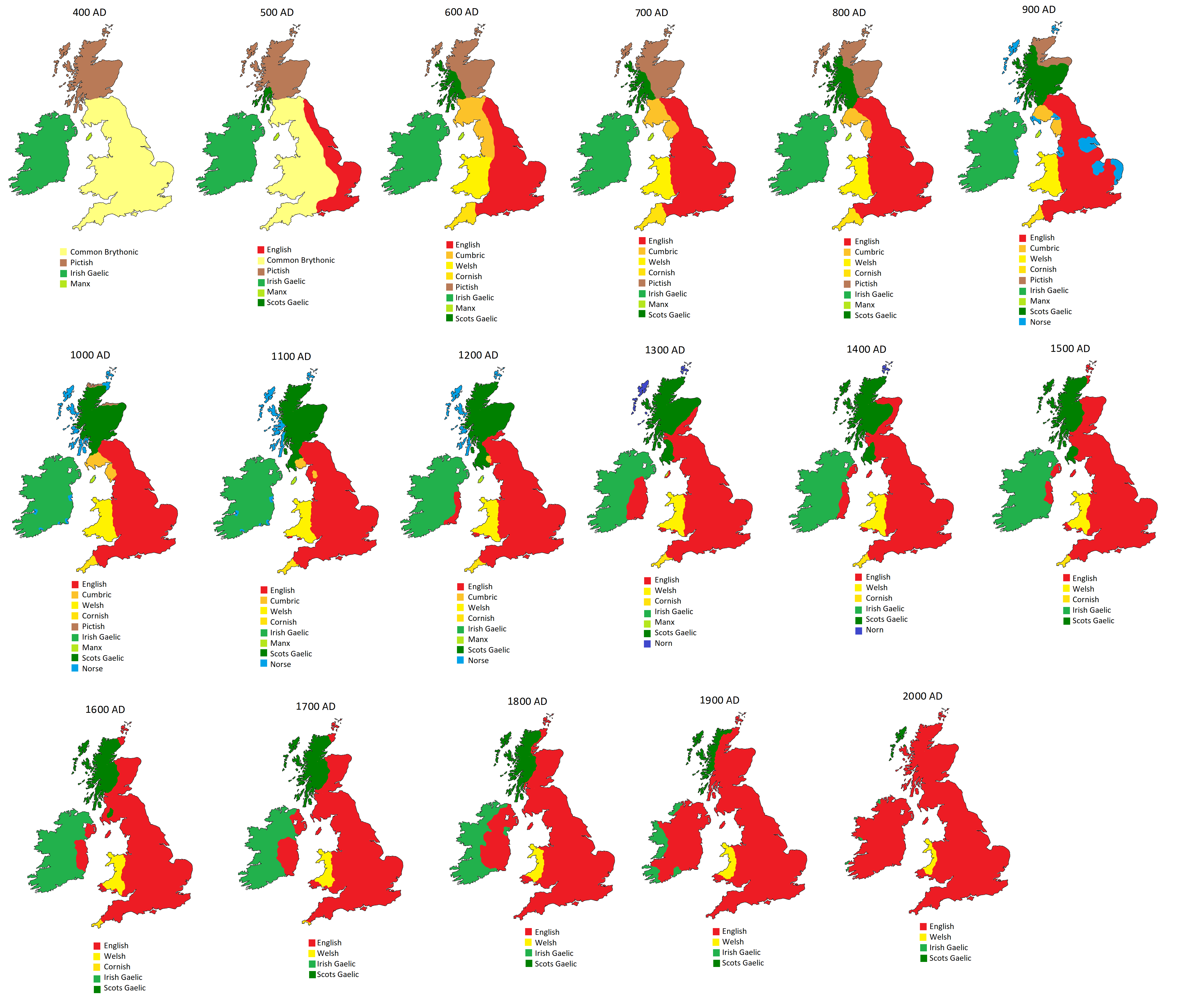
Ireland, which Rome never reached, stayed monolingual Celtic until the Norman incursions of the 13th century. Irish settlers moving into Scotland in the 3rd and 4th centuries eventually extinguished Pictish, permanently replaced by Gaelic by the 12th century. Anglo-Saxon settlers pushing into Britain from the 5th century forced Brittonic steadily westward. Welsh survived in Wales. Cornish lasted in Cornwall right through to the 18th century. Breton survived in Brittany because people from southwestern Britain had carried it there in the 5th and 6th centuries.
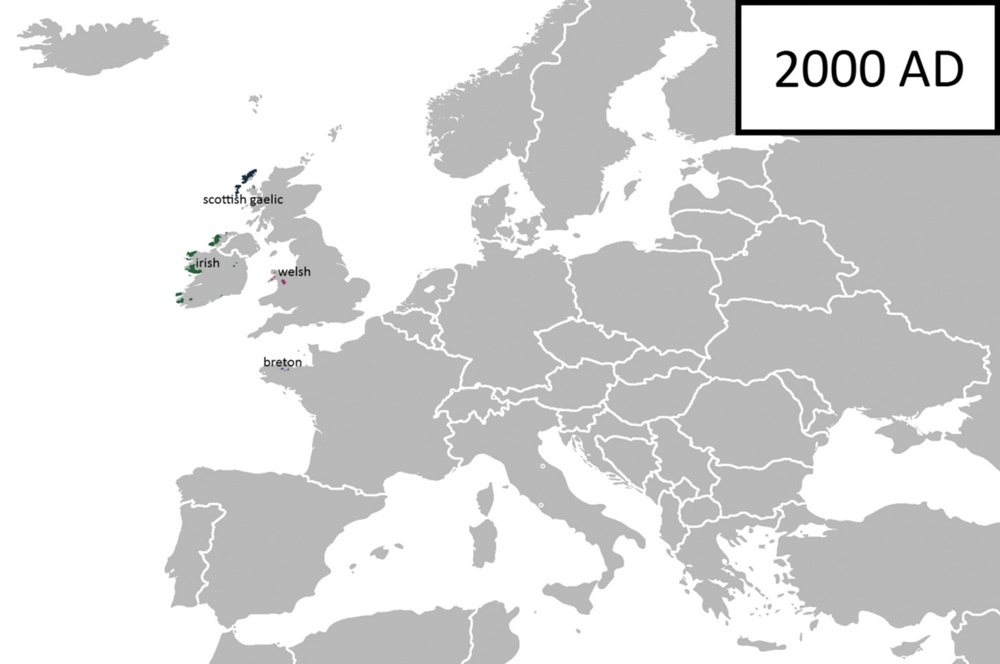
Irish, Scottish Gaelic, Manx, Welsh, Breton (Cornish effectively extinct by around 1800)
2000 AD
Irish, Scottish Gaelic, Welsh, Breton (Manx and Cornish revived)
Six survivors
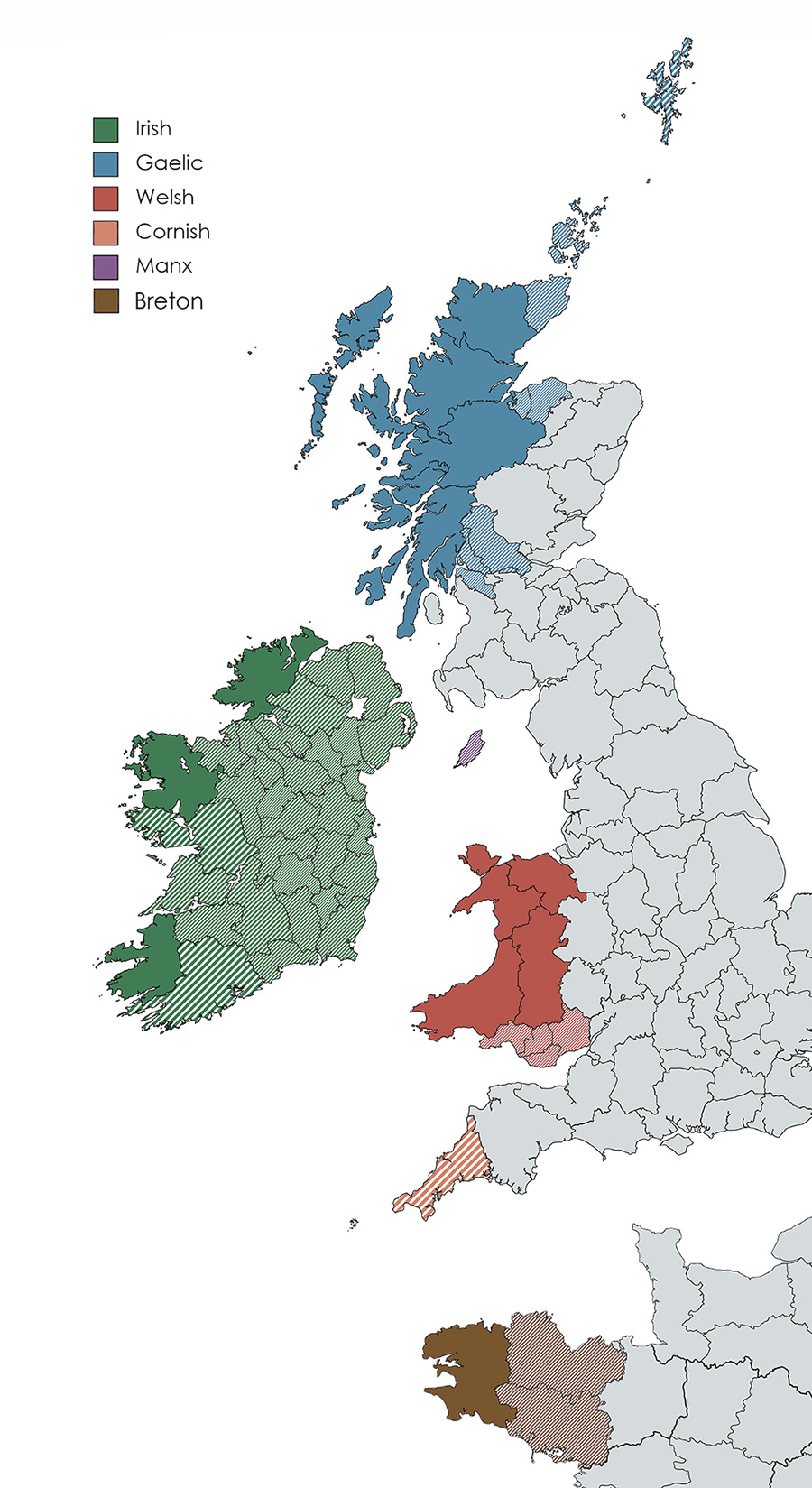
Welsh, Irish, Scottish Gaelic, and Breton have been spoken without interruption. Cornish and Manx each broke that chain: Cornish in the late 18th century and Manx in 1974. Both were brought back through years of determined community work, and today, a new generation is growing up with them as first languages.
The six divide into two branches. Irish, Scottish Gaelic, and Manx share a common descent from Old Irish and form the Goidelic group. Welsh, Cornish, and Breton came from ancient Brittonic and form the Brittonic group. Some mutual intelligibility exists within the Goidelic group, particularly between the Scottish Gaelic of Islay and Argyll, Ulster Irish, and Manx. Welsh and Irish speakers find nothing mutually intelligible. The two branches have been developing independently for well over a thousand years.
Long before the Latin script arrived, Celtic languages were written using Ogham, a system of 25 characters cut as notches along a stem line. Around 500 of those inscriptions survive on stone, the oldest from the 4th century AD, found across Ireland, Scotland, Wales, and England.
How many speakers remain
In Ireland, Irish is compulsory in schools from early childhood right through to the final state exams, which means virtually every adult has spent years studying it. Using it daily is a different question. Most daily speakers live in rural Gaeltacht areas on the western coast, and only around 72,000 to 94,000 people actually use Irish on a daily basis, despite its status as a national language and an official EU language. Welsh occupies a noticeably different position. You hear Welsh on the streets of Cardiff and Swansea, not just in remote coastal villages. Welsh-medium school enrollment has grown steadily since the 1980s, and the total number of speakers has been rising rather than falling.
Language
Branch
Alphabet
Main Territory
Estimated Speakers
Daily/Active Speakers
UNESCO Status
Welsh
Brittonic
29 letters
Wales, UK
~720,000
~538,300 (2021 Census)
Vulnerable
Irish
Goidelic
18 traditional / 24 modern
Ireland
~1.77 million (some ability)
~72,000–94,000 daily
Definitely endangered
Scottish Gaelic
Goidelic
18 letters
Highlands and Outer Hebrides
~87,056–130,156
~57,000 (2011 Census)
Definitely endangered
Breton
Brittonic
Latin (~25 letters)
Brittany, France
~206,000–356,000
~206,000
Severely endangered
Cornish
Brittonic
Latin (~22 letters)
Cornwall, UK
2,000
563
Critically endangered (Revived, [extinct c.1777])
Manx
Goidelic
Latin (standard)
Isle of Man
~2,200
100
Definitely endangered (Revived [extinct 1974])
Before World War II, Breton was spoken by well over a million people across Brittany. Decades of active suppression in French schools brought that figure down to under a quarter of what it once was. Welsh is the only Celtic language UNESCO does not classify as endangered.
About 2 million people speak a Celtic language today, native and non-native speakers combined. Set against the 300 BC maps, that is a dramatic contraction of geographic ground. But Welsh gains speakers year on year. Cornish and Manx crossed from complete extinction to genuine first-language communities within a single human generation.