Slice a palm trunk in half, and there is nothing to count. There are no rings—no buildup year after year like the way an oak keeps its history. Yet, despite lacking this wooden core, Colombia’s wax palm (Ceroxylon quindiuense) can tower up to 60 meters (200 ft) in the Andes. Nothing classified as a true tree gets that tall without growth rings, because this giant is not a true tree at all. It is a monocot, the tallest one alive, more akin to a massive blade of grass than anything with bark. Every palm grows from a single point at its crown, a meristem that powers the plant’s entire life. Damage that point, and the palm dies; there is no second bud and no stump regrowth. The genus Hyphaene stands as the lone exception in the entire family. Its trunk regularly forks in two—a natural branching trick no other palm genus possesses.
Around 2,600 palm species exist worldwide, spread across 181 genera. A third of those genera have just one species each. Calamus, the rattan genus, has well over 400 species on its own.
Where palms grow without our help
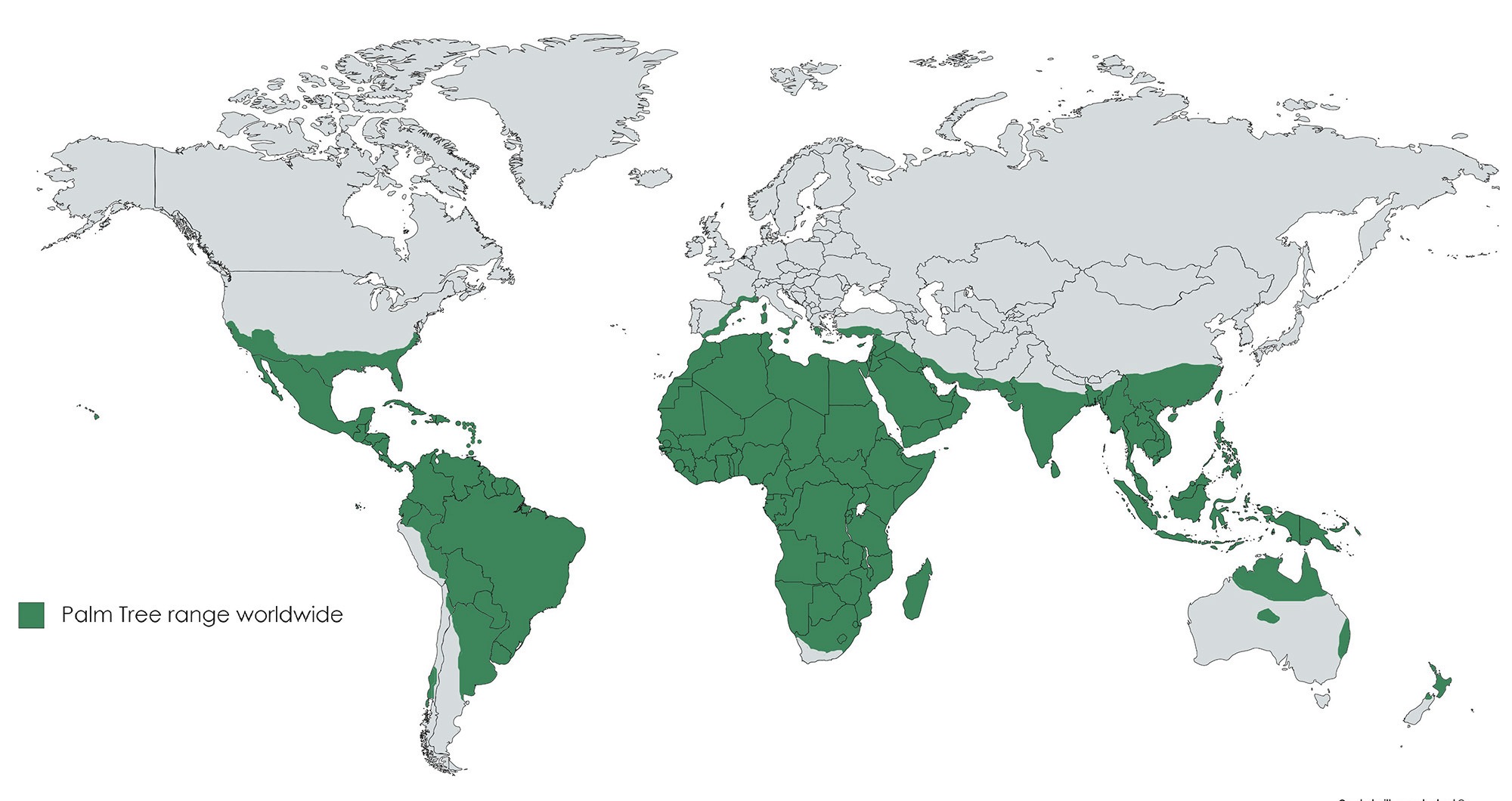
Rhopalostylis sapida grows wild on New Zealand’s Chatham Islands. Most people have never heard of this palm. It lies roughly 44 degrees south of the equator, about as far as any wild palm gets without help. Run that same line north and it lands near the Mediterranean. Chamaerops humilis holds that record on the northern side. Most palms never get anywhere close to either extreme. The bulk of the family stays within about 30 degrees of the equator.
Below you can find native palm species by world biogeographic region:
Region
Geographic extent
Native palm species
Indo-Malayan
South and Southeast Asia (India to Indonesia and the Philippines)
898
Neotropical
Central and South America, the Caribbean
741
Australasian
Australia, New Guinea, New Zealand, and neighboring islands
390
Afrotropical
Sub-Saharan Africa and Madagascar
259
Oceanian
Remote Pacific islands (such as Hawaii, Fiji, and Samoa)
165
Nearctic
North America north of the tropics
33
Palearctic
Europe, North Africa, and temperate Asia
17
The Palearctic row in that table covers 17 species in total, spread across Europe, North Africa and temperate Asia. Continental Europe itself accounts for just two of them. Chamaerops humilis accounts for almost all of it. The species grows wild along Mediterranean coasts in Portugal, Spain, southern France, Italy and Malta. It does not stop there either. Phoenix theophrasti is the second species, and almost nobody has heard of it. It survives in a scatter of gorges and beaches on Crete, a few nearby Greek islands, and a handful of spots on the Turkish coast.
Pushing into the subtropics
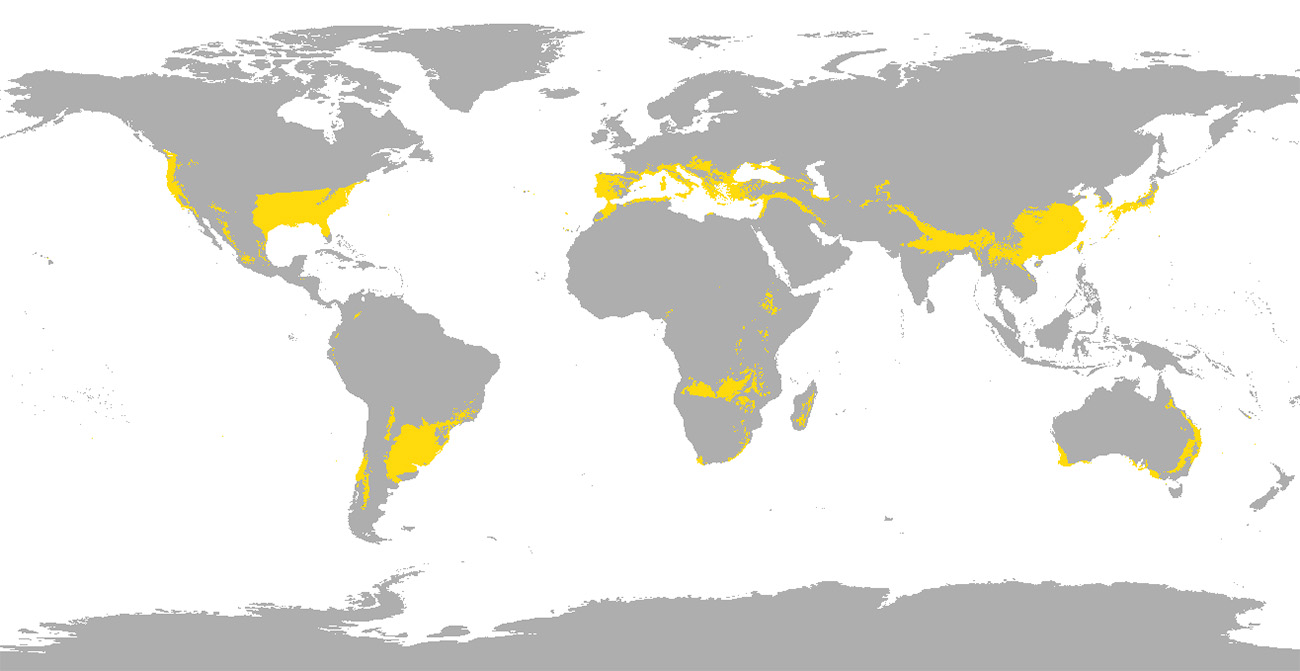
Frost usually kills a palm outright. That keeps most of the family out of anywhere genuinely cold. A few genera ignore the rule. Trachycarpus handles snow in parts of China and the Himalayas. Chamaerops shrugs off the dry, cool winters of the Mediterranean. Washingtonia and Butia do something similar across drier parts of the Americas. None of them need constant humidity. That single trait pushes all four well past the tropics, into subtropical and even warm temperate ground.
That same frost tolerance explains the rest. Palms now grow almost anywhere people plant them, far outside where they evolved. A palm on a Los Angeles boulevard usually has no connection to that place at all. Its wild ancestors came from somewhere else, often a different hemisphere entirely. The cultivated map looks nothing like the native one above.
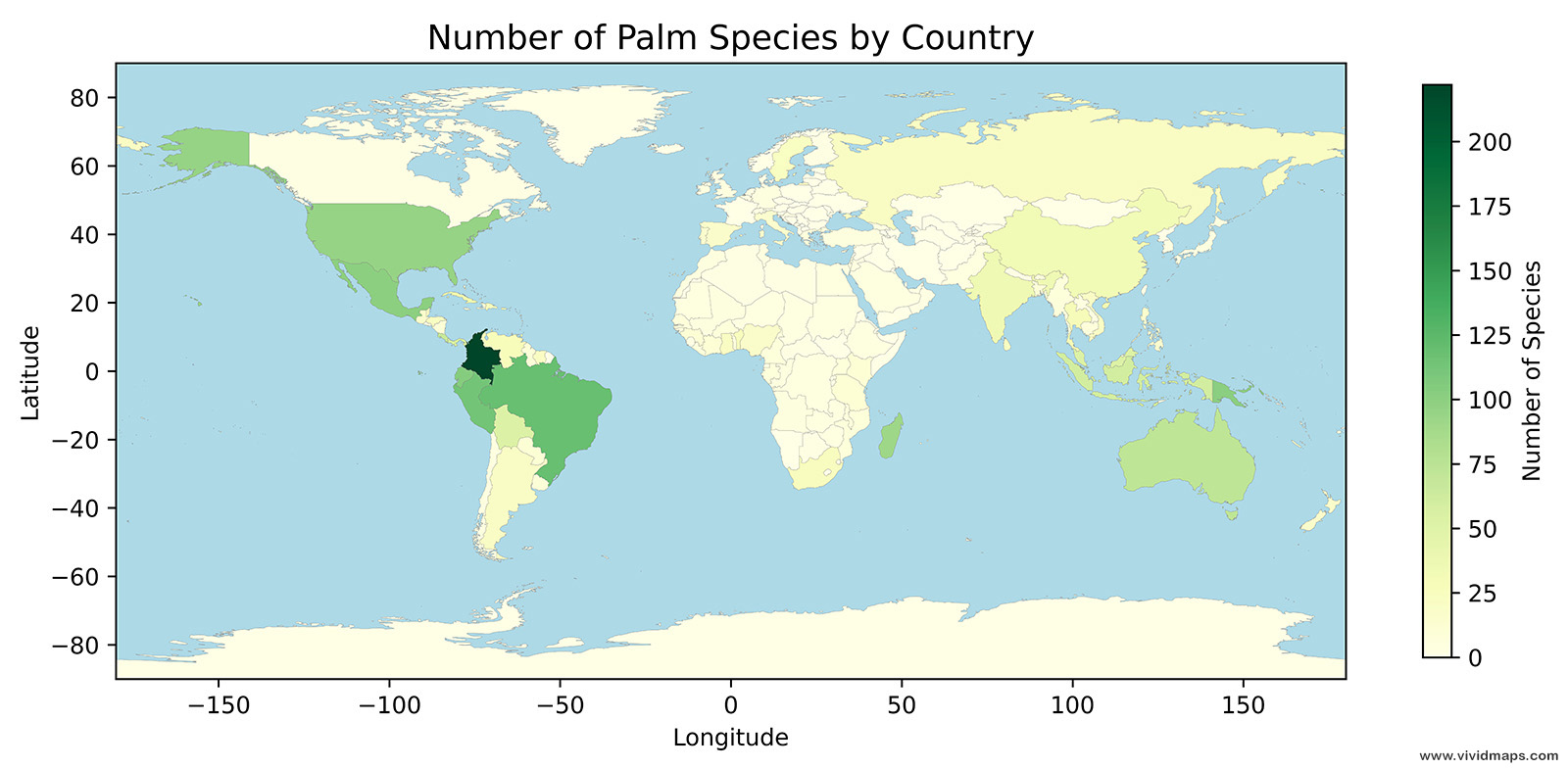
Earlier, I created a map using GBIF occurrence records to count native and introduced species together for every country. On this map, Colombia emerges as a global palm superpower, registering 222 species in total. Geography explains a good part of that richness. The country touches the Caribbean, climbs into the Andes, and reaches into the Amazon. It holds three different worlds for palms, all inside one border.
Garden escapees
Trachycarpus fortunei is the European example, and adaptability is not always a good thing. Ticino is the Italian-speaking corner of southern Switzerland. There, ornamental windmill palms planted in local gardens have escaped, spreading into the surrounding chestnut and oak forests. Some lakeside towns now look faintly subtropical, with the snow-capped Alps rising right behind them.
Switzerland is not alone in dealing with this species either. It also shows up on invasive watchlists in Australia, France, Japan, and New Zealand.
California has the same problem with different species. Phoenix canariensis escaped from gardens decades ago. It now crowds the San Diego River and similar waterways, enough to land on the state’s invasive plant inventory. Washingtonia robusta does much the same nearby. It forms dense, single species stands that block light from anything beneath them. Florida and Hawaii list it as invasive too.