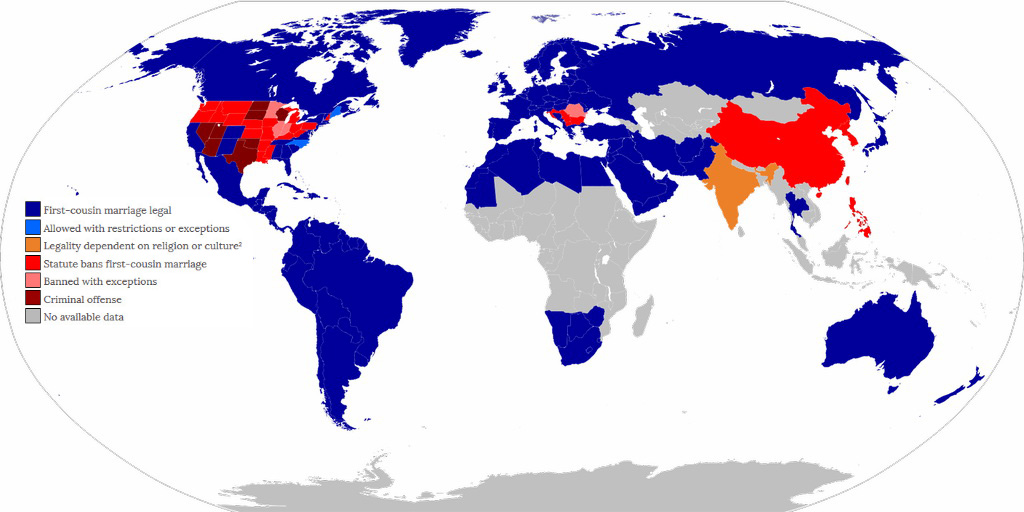
Cousin marriage — the union between people who share grandparents or great-grandparents — hasn’t disappeared into the past. It remains common practice across much of the world, though different societies have wildly different takes on it. Some see it as strengthening family ties, while others have made it illegal. China bans it. The Philippines ban it. Both Koreas ban it. And if you’re planning a cousin wedding in the U.S., you’d better check which state you’re in — about half won’t allow it.
Some facts may especially surprise: roughly one in ten marriages worldwide happens between first or second cousins. That’s not a tiny fringe practice. The highest concentrations appear across the Middle East, North Africa, and South Asia, regions where extended families aren’t just important — they’re often the cornerstone of social and economic life.
The table below lists estimated rates of cousin marriage by country, based on data from World Population Review.
Country
Cousin Marriages (%)
Pakistan
61.2%
Kuwait
54.3%
Qatar
54.0%
United Arab Emirates
50.5%
Sudan
50.0%
South Sudan
50.0%
Afghanistan
49.0%
Mauritania
47.2%
Iraq
46.4%
Yemen
44.7%
Iran
39.5%
Saudi Arabia
38.9%
Libya
37.6%
Oman
35.9%
Syria
35.0%
Bahrain
31.8%
Palestine
31.6%
Egypt
29.0%
Jordan
28.0%
Guinea
25.9%
Lebanon
25.0%
Sri Lanka
23.0%
Algeria
22.6%
Turkey
21.1%
Tunisia
21.1%
Nigeria
19.9%
Morocco
19.9%
Bangladesh
17.0%
Israel
10.4%
India
7.5%
Malaysia
6.0%
Cambodia
6.0%
El Salvador
4.9%
Japan
3.9%
Honduras
3.4%
Costa Rica
3.4%
Puerto Rico
3.3%
Colombia
3.0%
France
2.6%
China
2.0%
Brazil
2.0%
Germany
2.0%
Spain
2.0%
Ecuador
2.0%
Uruguay
2.0%
Canada
1.5%
Portugal
1.5%
Mexico
1.3%
Venezuela
1.3%
Chile
1.3%
United Kingdom
1.1%
Italy
1.1%
Belgium
1.0%
Norway
0.7%
Hungary
0.5%
Argentina
0.4%
Australia
0.2%
Bolivia
0.2%
United States
0.1%
Russia
0.1%
Philippines
0.1%
Ukraine
0.1%
Peru
0.1%
Netherlands
0.1%
Cuba
0.1%
Sweden
0.1%
Czech Republic
0.1%
Belarus
0.1%
Slovakia
0.1%
Ireland
0.1%
Panama
0.1%
Croatia
0.1%
Belize
0.1%
The map reveals a clear geographical pattern. The Greater Middle East, North Africa, and parts of South Asia (especially in Pakistan) dominate the higher percentages — a concentration confirmed by multiple demographic studies.
What explains these rates? Economics and tradition go hand in hand. If your family owns farmland or a business, marrying within the extended family keeps those assets under one roof. You’re not handing over your inheritance to strangers. Then there’s trust — you’ve known your cousin’s parents your whole life because they’re your aunts and uncles. Wedding arrangements become less complicated when both families already understand each other. In smaller communities where everyone’s interconnected through multiple family lines, cousins may make up much of the available marriage pool. Add centuries of religious acceptance and established custom, and the pattern continues generation after generation.
Pakistan leads with over 61%, followed by Kuwait and Qatar at around 54%. Afghanistan sits at 49%, Iraq at 46%, and Saudi Arabia at nearly 39%.
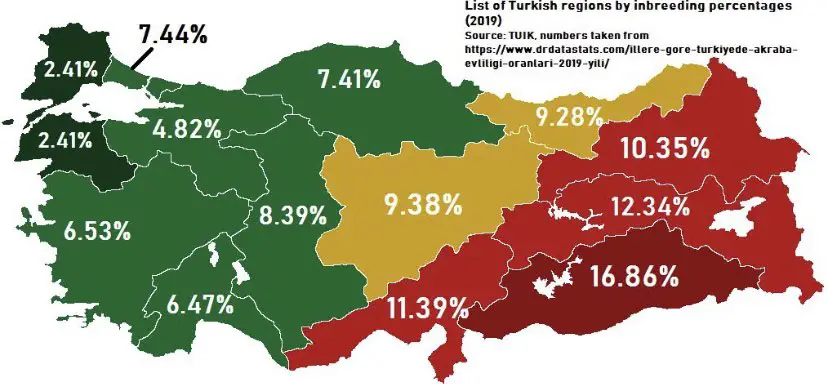
But in some countries, the rate of cousin marriage differs greatly by region. For instance, in Turkey, it averages around 21%, but zoom in and the regional differences become obvious. Some provinces have much higher rates, others much lower. The map below breaks down first-cousin marriages by Turkish region.
Now let’s talk genetics. Children of closely related parents inherit DNA from a smaller pool of ancestors. If both parents carry the same recessive gene variant – say, one that causes a metabolic disorder — their child has a higher chance of inheriting it from both sides. The actual risk depends on how closely the parents are related and what genes are common in their population. Research in medical journals has documented higher rates of certain congenital and metabolic disorders in populations with high consanguinity, though the degree of risk varies considerably from one community to another.







Saudi Arabia isn’t 70%
You’re thinking of Pakistan which is 70%
no