Trains are still a big part of life in Europe—millions of people hop on them daily, and they carry huge loads of freight from one end of the continent to the other. But back before cars and trucks really took off around the mid-1900s, trains were everything for getting around. Pretty much any long-distance journey—whether for passengers or freight—relied on the trains back then.
Jordi Martí-Henneberg, a geographer from the University of Lleida in Spain, poured a ton of time into creating this big database that tracks Europe’s rail networks from 1840 up until 2010.
Mapping it all wasn’t straightforward at all, what with borders in Europe getting reshuffled so often—especially in that rough patch from 1914 to 1950. He broke down his approach in a 2013 paper from the Journal of Transport Geography.
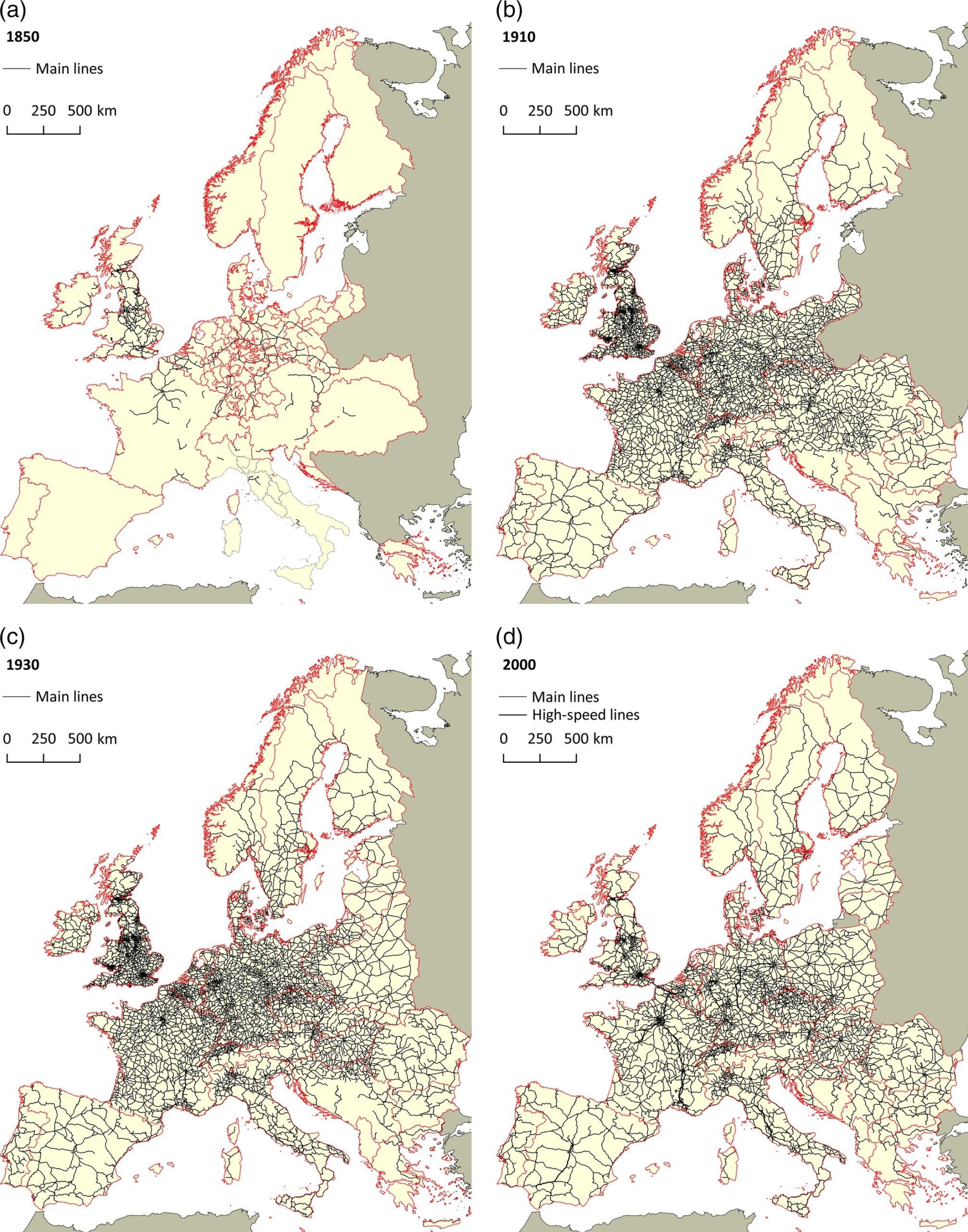
A few years later, he followed up with a 2021 article in Social Science History, where he featured maps for specific years, including 1850, 1910, 1930, and 2000.
1850: The Early Phase
Britain and Belgium led. Their industrial centers already had well-developed railway systems connecting major cities. Many German states (Germany wasn’t unified yet) had also built substantial networks. France had started construction but the lines were disconnected from each other.
Beyond that, coverage was sparse. Spain and Portugal had only a few lines. The Balkans had almost nothing. Scandinavia was just getting started. Most of Eastern Europe was still using roads, rivers, and horses for transport.
Mountain ranges blocked connections. The Alps separated Italy from countries to the north. The Pyrenees isolated Spain and Portugal. Large areas had no rail access at all.
1910: The Peak
Sixty years later, railways covered nearly the entire continent. Scandinavia had extensive networks. Southern Europe was well-connected. Territories divided between the German, Russian, and Austrian empires (later to become Poland) all saw heavy railway construction, though each empire followed different plans.
Most countries connected their networks across borders. Geography blocked some connections (mountains), and politics blocked others. Bulgaria and Romania hardly connected their systems because they didn’t trust each other.
Governments built railways primarily to integrate their own territories. The combined result was a system spanning the continent. You could travel from Portugal to Poland or from Scotland to Sicily (though crossing the Alps took effort).
This was the high point. Europe never had denser railway coverage than in 1910.
The political map looked stable. It wasn’t. Within a decade the Austro-Hungarian Empire would collapse. So would the German Reich. Ottoman lands in the Balkans would be divided into new countries. World War I was coming.
1930: New Borders, Old Railways
By 1930, railway density remained similar but the political landscape had completely changed.
Poland became independent again after being partitioned for over a century. The problem was its railways. Three empires had built them with three separate strategies. Areas under former Russian control still have noticeably thinner coverage than sections built under German administration. Current railway maps still show this imbalance.
Yugoslavia and Czechoslovakia ended up with railways built for empires that had collapsed. Border stations that used to handle lots of international traffic became just another stop inside the country.
2000: Dismantling the Network
The 2000 map shows less railway infrastructure than 1910. Thousands of kilometers were removed.
Western Europe cut the most. Britain, France, Belgium, and Germany all closed massive amounts of track. After 1950, car ownership grew quickly. Roads improved. Branch lines serving smaller towns lost passengers. Governments examined the costs and began shutting lines down.
This happened across nearly all of Europe, but the biggest reductions came in countries where the original networks had been densest.
High-speed rail changed the picture starting in 1981. France built TGV lines. Spain developed AVE routes. Germany added ICE service. These were selective though, connecting major cities rather than providing the comprehensive local coverage that existed in 1910.
Today, Europe’s rail system is evolving again, with a push toward sustainability and high-speed connections to combat climate change.