Losing the internet at work used to be a minor irritation. These days it stops everything. Meetings can’t happen, documents won’t load, orders don’t go through. The network has become so embedded in how work actually functions that most people don’t think of it as technology anymore, just background infrastructure, similar to electricity. Researchers who have tried to chart the modern internet found they couldn’t keep up with it. Any diagram was inaccurate before the ink dried.
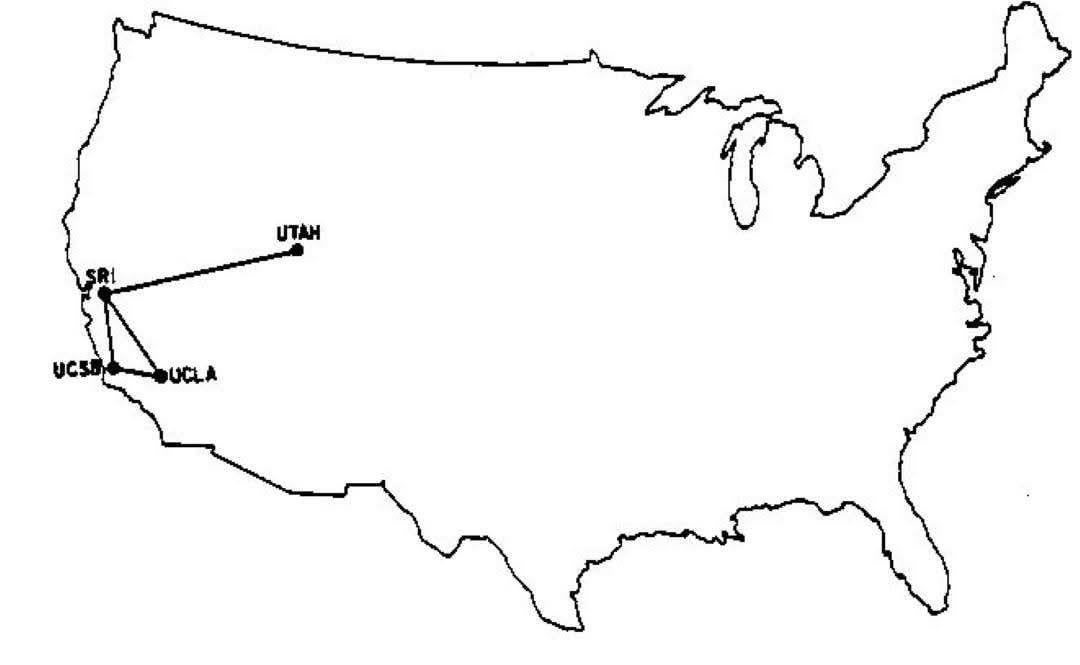
In 1969, the whole network fit on one page.
Four universities in the western United States, connected by four lines. That was the entire network.
The University of California, Los Angeles (UCLA) was the first node. Leonard Kleinrock had spent years there on the mathematics of packet switching. The basic concept is that data doesn’t need a permanent dedicated line between two points. You break it into pieces, send each one across whatever path is available, and reassemble everything at the other end. Further down the coast in Santa Barbara, the University of California (UCSB) had Glen Culler and Burton Fried working on interactive computing, specifically getting a computer to respond to a researcher in real time rather than the standard approach of submitting a job and collecting printed results the next morning. The Stanford Research Institute in Menlo Park (SRI) had Douglas Engelbart, who had already spent a decade by that point developing ideas about how people and computers could actually work together. His patent for the mouse came the following year, though his thinking in 1969 was already somewhere most of the field wouldn’t reach for years. At the University of Utah, Ivan Sutherland and David Evans ran a computer graphics program that other universities were nowhere near matching.
Four labs, each with someone building something the rest of computing would eventually need.
A 21-year-old programmer named Charley Kline was at a terminal in Los Angeles on the night of October 29, 1969, with the job of connecting to the SRI machine 350 miles (563 km) north in Menlo Park. Bill Duvall was on the phone from that end, confirming each letter as it came through. Kline typed “l,” it arrived. Typed “o,” it arrived. Typed “g” and the SRI computer crashed. The reason was almost comic: the machine in Menlo Park had been configured to receive data at ten characters per second. ARPANET was sending at five thousand. The buffer couldn’t handle it. About an hour later Duvall found the problem, adjusted the parameters, and Kline typed the full word through without incident.
Nobody outside those four buildings paid any attention.