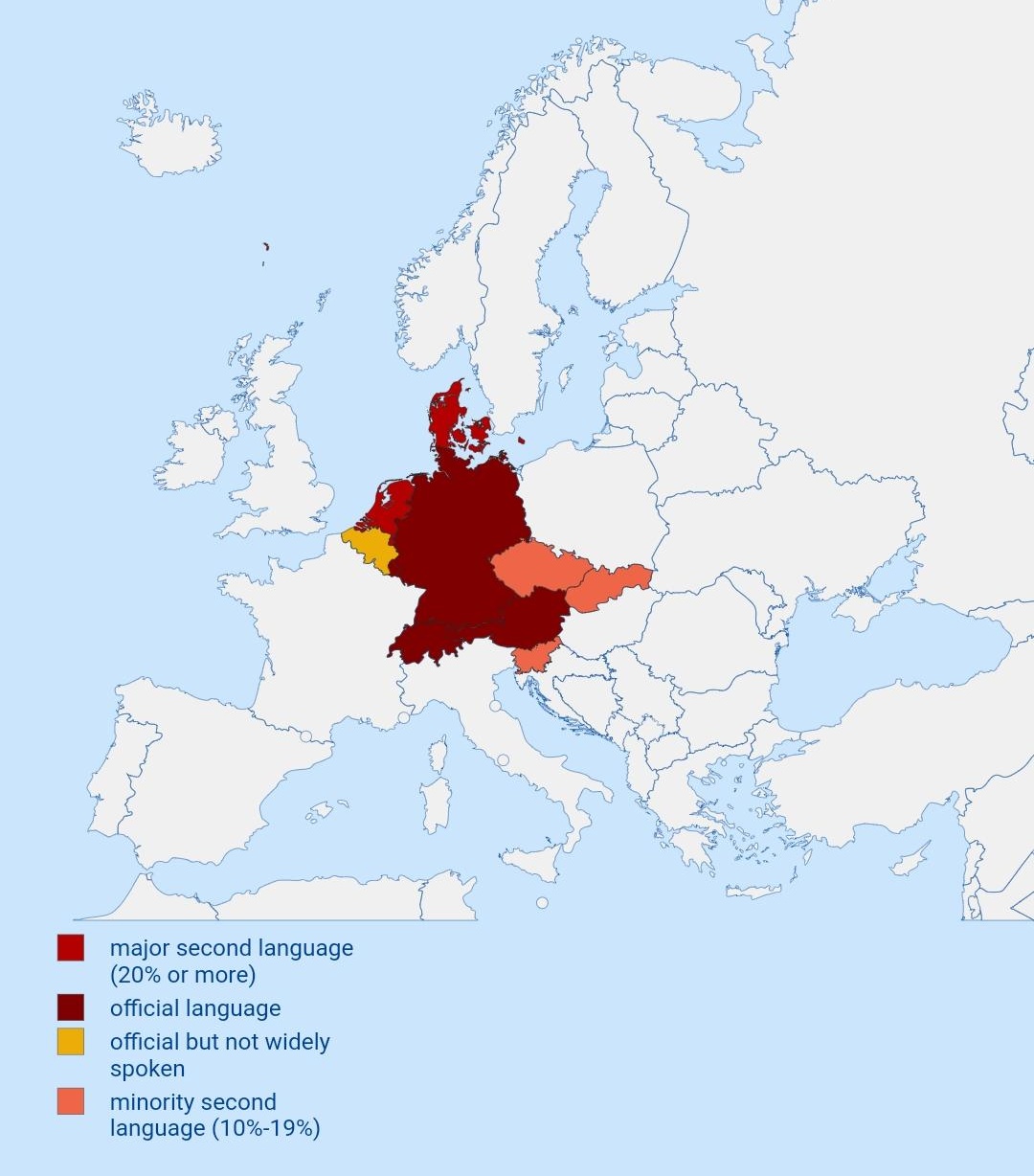
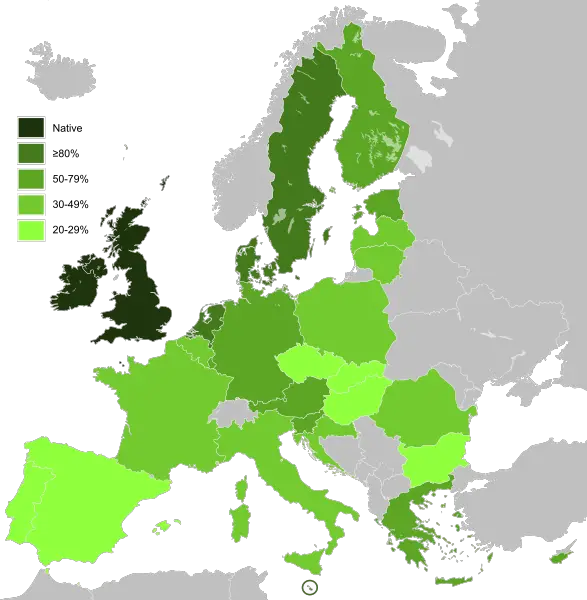
German has around 95 million native speakers across Europe, which puts it ahead of French at roughly 80 million and Italian at around 67 million as the largest native language in the EU. The Eurobarometer puts total German knowledge across all EU citizens at about 29%, second only to English. Belgium gives German co-official status and 18% of Belgians speak it. The Netherlands gives German no official status and 61% of Dutch people speak it.
Six countries give German official status. Germany and Austria together account for most of those 95 million native speakers, both at around 98%. In Switzerland about 65% of people speak German day to day, mostly in the northern and eastern cantons.
In Luxembourg, 66% of people speak German and it’s legally co-official alongside French and Luxembourgish, but walk into any government office or shop and French is what you’ll hear. In Belgium, the co-official status covers only a small community of around 78,000 people in the far east of the country, right on the German border, under 1% of the Belgian population.
The Netherlands has never given German any official status. Sixty-one percent of Dutch people speak it. Denmark is at 50%, also without formal recognition. Both have centuries of trade with Germany behind them and share a Germanic linguistic base, which accounts for those numbers more than any policy does.
For Central European countries the higher numbers go back a long way. These countries were under Habsburg administration for centuries, German was the language of government, and it stayed as the standard first foreign language in schools well into the 1990s. Slovenia is currently at 33%, Slovakia 21%, Czech Republic 20%. Sweden’s 25% is geographically harder to account for since it shares no border with Germany, but German had a firm presence in Scandinavian secondary school curricula throughout much of the 20th century and those generations are still in the survey data.
France sits at 6%, Italy at 4%. Portugal comes in at 1%, the lowest in the EU, with Romania and Spain at 3%. English took hold early in those countries as the dominant foreign language and German never got much of a footing.
Those Central and Eastern European numbers have been coming down since around 2012. Younger generations in the Czech Republic, Slovakia, and Slovenia are picking English as their first foreign language rather than German, and the shift shows clearly in the more recent Eurobarometer surveys.
Country
German Proficiency
German Status
Germany
98%
Official language
Austria
98%
Official language
Luxembourg
66%
Co-official language
Netherlands
61%
Major second language
Denmark
50%
Major second language
Slovenia
33%
Second language
Sweden
25%
Foreign language
Slovakia
21%
Second language
Czech Republic
20%
Second language
Finland
19%
Foreign language
Belgium
18%
Co-official (minor community only)
Latvia
18%
Foreign language
Croatia
15%
Foreign language
Estonia
14%
Foreign language
Hungary
13%
Foreign language
Lithuania
12%
Foreign language
Greece
7%
Foreign language
Ireland
7%
Foreign language
Cyprus
7%
Foreign language
France
6%
Foreign language
Bulgaria
5%
Foreign language
Poland
5%
Foreign language
Italy
4%
Foreign language
Malta
4%
Foreign language
Romania
3%
Foreign language
Spain
3%
Foreign language
Portugal
1%
Foreign language
Source: Eurobarometer data via Languages of the European Union, Wikipedia. Switzerland (~65%) and Liechtenstein (~95%) are not EU members and are not included in Eurobarometer figures.
Language distributions are a compressed record of trade routes, imperial administration, school curricula, and migration. German’s current reach across Europe is the result of all of those things layered on top of each other over centuries