Order a coffee in Amsterdam and the barista will likely switch to English before you finish the sentence. Try the same in Bucharest and the odds drop sharply. Language skills in Europe change at almost every border, and six maps show exactly where.
English is the most widely spoken foreign language in the European Union, with 47% of residents able to hold a conversation in it. French (11%), German (10%) and Spanish (7%) follow far behind. The Netherlands, Sweden, Denmark, Malta and Finland lead in English, while Romania, Poland and Bulgaria come last.
Key Takeaways
59% of EU residents can converse in at least one language besides their mother tongue, and 28% in at least two.
English reaches 47% as a foreign language and 50% when native speakers are counted.
German has the biggest group of native speakers in the EU at 19%, but English reaches 50% of residents once second-language speakers are counted.
Russian ranks ninth with 4%, concentrated around the Baltic states.
How many Europeans speak a foreign language?
About 59% of EU residents can hold a conversation in at least one language besides their mother tongue, up from 56% in 2012. Only 28% manage two. Among 15 to 24 year olds, 79% speak at least one.
Language
Foreign language speakers
Change since 2012
All speakers, native included
Change since 2012
English
47%
+5
50%
+6
French
11%
0
25%
0
German
10%
-2
29%
-1
Spanish
7%
0
17%
+1
Italian
3%
0
16%
-1
Russian
3%
-2
4%
-2
Which countries speak the most English?
The Netherlands (93%), Sweden (90%), Denmark (87%), Malta (86%) and Finland (81%) lead for English as a foreign language. Romania (25%), Poland (27%) and Bulgaria (29%) come last. Luxembourg is the one country where English is not the top foreign language, since French (77%) ranks first and English (68%) second.
Progress has been fast. Spain gained 16 points since 2012 and reached 38%, while Czechia and Portugal each gained 14 points and reached 41%.
Knowledge of English
Where do French, German, Spanish and Italian reach beyond their home countries?
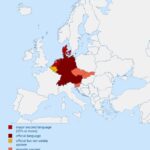
Mostly into the next country over. German is spoken by 61% of people in the Netherlands and 50% in Denmark. French reaches 27% in the Netherlands and 16% in Germany. Italian is known by 52% of Maltese respondents and 13% of Slovenes. Spanish is strongest outside Spain in Luxembourg (15%), France (14%) and Sweden (10%).
Knowledge of French
Knowledge of German
Knowledge of Italian
Knowledge of Spanish
Language
Strongest in countries where it is official
Strongest in other countries
English
Ireland 97%
Netherlands 95%, Sweden 91%, Denmark 90%
German
Germany 98%, Austria 98%
Netherlands 61%, Denmark 50%, Slovenia 33%
French
France 97%, Luxembourg 94%, Belgium 83%
Netherlands 27%, Germany 16%, Portugal 13%
Spanish
Spain 97%
Luxembourg 15%, France 14%, Sweden 10%
Italian
Italy 97%
Malta 52%, Slovenia 13%, Luxembourg 10%
Is Russian still spoken in Europe?
Russian ranks ninth among all languages in the survey at 4%, down 2 points since 2012. The Baltic states account for much of it. Russian is the mother tongue of 28% of respondents in Latvia and 25% in Estonia. Among people who speak a foreign language, 55% in Lithuania, 51% in Latvia and 39% in Estonia rate their Russian as good or very good. Bulgaria dropped 23 points to 19%.






Bulgaria is a nation of polyglots! Almost as multilingual as Nordic countries.