Mongolia is the second-largest landlocked country in the world after Kazakhstan. At 1.5 million square kilometers (0.6 sq mi) with only 3.5 million people, it’s also the world’s most sparsely populated sovereign state. Half those people live in Ulaanbaatar.
Most people assume Mongolia has one language. It has ten.
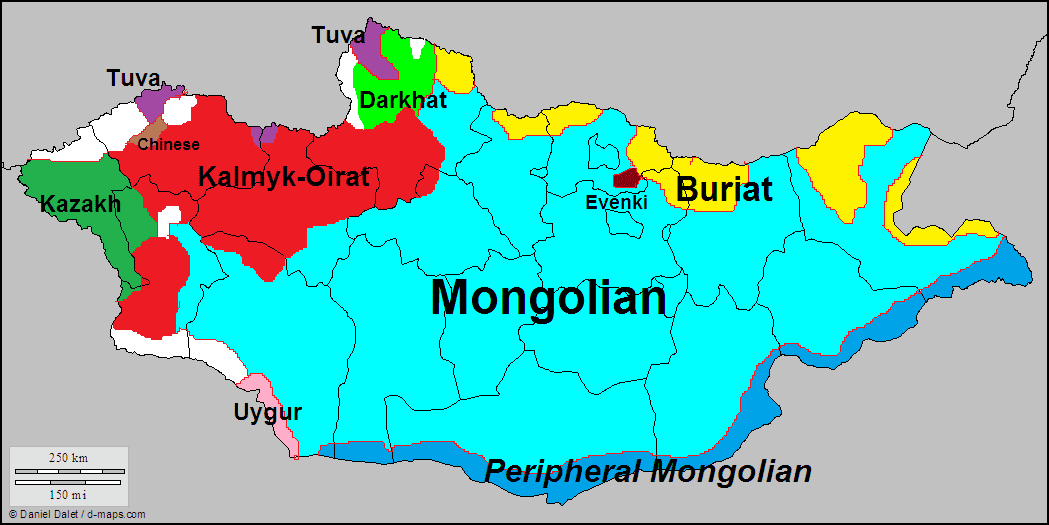
Khalkha Mongolian is the official language, about 90% of the population. Most of Mongolia’s Kazakh community, around 5% of the national total, lives in Bayan-Ölgii province in the far west. The province is majority Kazakh-speaking and Muslim. Their community has been in this part of the country since the 19th century, after Russian expansion pushed Kazakh groups east across the steppe.
Language
Estimated Speakers
Mongolian (Khalkha)
~3.3 million
Kazakh
~114,500
Buryat
~51,500
Kalmyk-Oirat
~80,000–90,000
Tuvan
~21,000
Darkhat
several thousand
Evenki
several hundred
Chinese
small urban community
Uyghur
very small minority
Peripheral Mongolian
~3.38 million (Inner Mongolia, China)
Nearby, the Dörvöd and Bayad groups speak Kalmyk-Oirat, a Mongolic language that split from Khalkha centuries ago and is now considered endangered.
About 50,000 Buryat live across Bulgan, Dornod, Khentii, and Selenge provinces near the Russian border. Mongolic in origin like Khalkha, but the two have drifted far enough apart that speakers don’t simply understand each other. Near Lake Khövsgöl, the Darkhat dialect picked up Persian loanwords through centuries of Buddhist contact, which is not something you’d expect to find in a Mongolian dialect.
The Tuvans, known locally as Uriankhai, are about 21,000 people living mostly in the Mongolian Altai. Turkic language, no Mongolian connection. Further north in the forests, a few hundred Evenki hold on to a Tungusic language closer to Manchu than to anything spoken in Ulaanbaatar. Chinese and Uyghur speakers are mostly urban, connected to trade across the southern border.
Peripheral Mongolian covers dialects spoken across the border in China’s Inner Mongolia, among them Chakhar, Ordos, Baarin, Khorchin, and Kharchin, with about 3.38 million speakers and co-official status alongside Mandarin. Inner and Outer Mongolia took separate political paths after the 17th century. Mongolia switched to Cyrillic in the 1940s. Inner Mongolia kept the traditional vertical script.
The Mongol Empire stretched from the Pacific coast to Eastern Europe. Mongolian today has about 5 to 6 million speakers. The Mongols never required the populations they conquered to learn their language. Not in China, not in Persia, not across Russia. The successor states absorbed whatever culture was already there. When they eventually fell, Mongolian had no roots left anywhere outside the plateau it came from.