Turning eighteen unlocks a lot in the United States. Voting. Signing a lease. Getting a tattoo without a parent’s signature. Marriage belongs on that list too, in most states. Not everywhere, though. Cross into California, Mississippi, or New Mexico, and no age floor appears in the statute books at all. A judge could approve a marriage at almost any age, because the law never specifies how young is too young.
Two separate numbers describe marriage age in America. Coverage often blurs them together. One is the general marriage age, the age at which someone can marry with nothing more than a valid ID. The other is the minimum age once every exception gets counted, parental consent, judicial approval, pregnancy. Strict by one measure. Permissive by the other, sometimes in the same state.
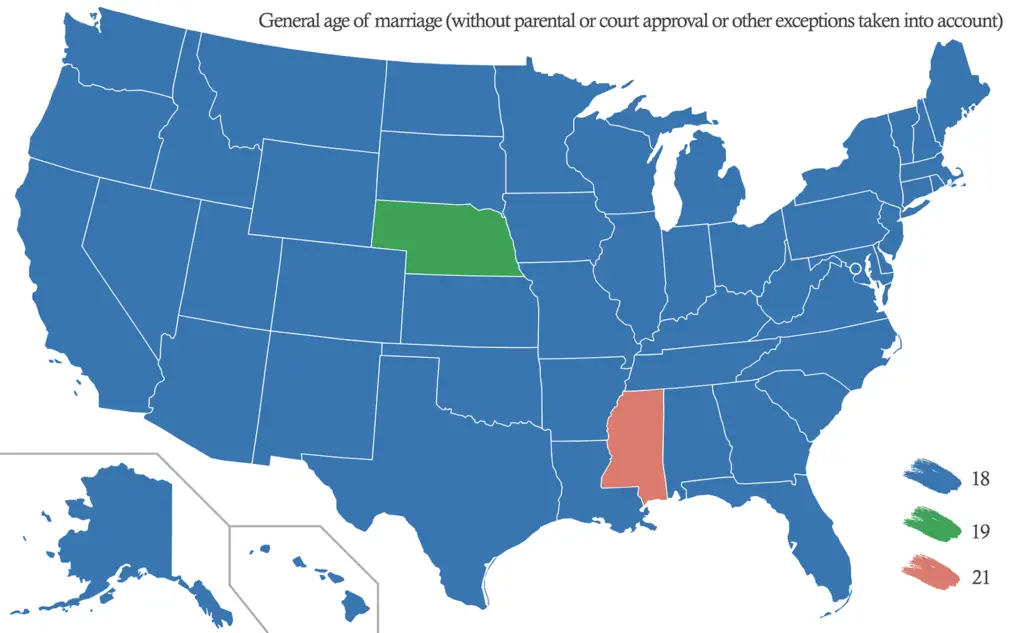
Twenty-one years old. That is Mississippi’s general marriage age, the highest of any state, tied to an age of majority that is also unusually late. Full adulthood is required for an unassisted marriage. However, once exceptions apply, Mississippi does not leave the door entirely wide open; it sets its statutory floor at 17 for males and 15 for females. Nebraska works a similar logic with a slightly higher baseline. Its general age is 19, again matching its unique age of majority. Its exception floor lands strictly at 17.
The map above covers a number that rarely comes up in practice. Most marriages happen well past any of these floors regardless. The number that actually governs underage marriage is the exception floor, the one below.
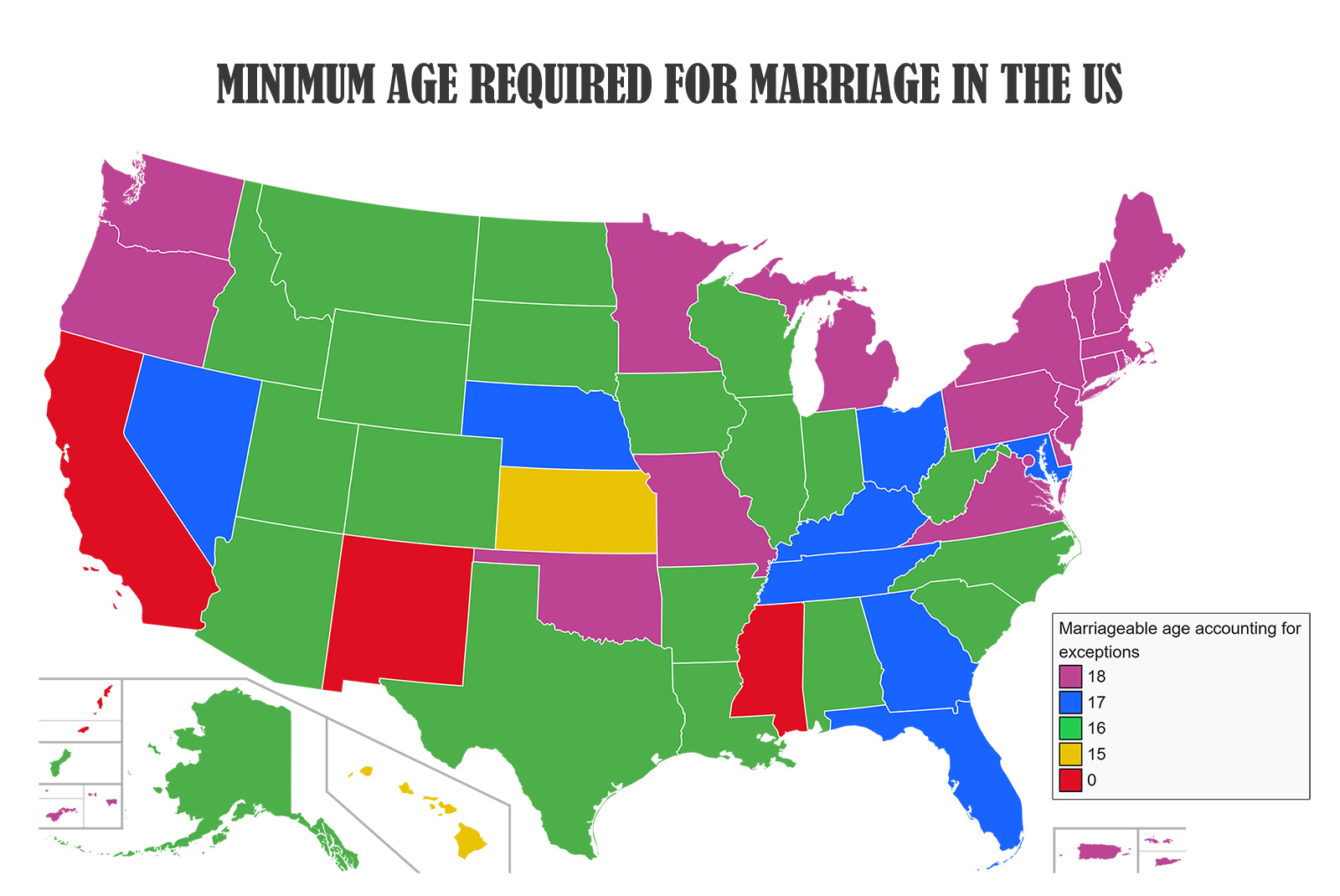
Seventeen states, most recently Oklahoma in May 2026, now bar marriage before 18 under any circumstance whatsoever. California and New Mexico fall at the opposite end, with no baseline age floor written into law at all. Everyone else lands somewhere between 15 and 17. The exact number depends on the state. A handful of jurisdictions still maintain different age standards for men and women, or carve out separate legal allowances for pregnancy.
Minimum Age (with exceptions)
States
No statutory minimum
California, New Mexico
15
Hawaii, Kansas
16
Alabama, Alaska, Arizona, Colorado, Idaho, Illinois, Indiana, Iowa, Louisiana, Montana, North Carolina, North Dakota, South Carolina, South Dakota, Texas, West Virginia, Wisconsin, Wyoming
Connecticut, Delaware, Maine, Massachusetts, Michigan, Minnesota, Missouri, New Hampshire, New Jersey, New York, Oklahoma, Oregon, Pennsylvania, Rhode Island, Vermont, Virginia, Washington
Unchained At Last has tracked marriage license data nationwide for years. The group counted nearly 315,000 minors legally married in the United States between 2000 and 2021. Eighty-six percent were girls. Most were married to adult men roughly four years older on average. Ninety-six percent were 16 or 17. The youngest recorded were 10 years old.
At least 66,415 of those marriages involved an age or an age gap that would have counted as a sex crime outside of a marriage license. Marriage functioned as a legal exemption in those cases. Closing that exemption is exactly what the seventeen zero-exception states have now done.
Rank
State
Rate per 1,000 minors
1
Nevada
6.15
2
Idaho
3.56
3
Utah
3.23
4
Kentucky
2.98
5
Wyoming
2.55
6
West Virginia
2.41
7
Alabama
2.22
8
Mississippi
1.95
9
Tennessee
1.85
10
Texas
1.74
Child Marriage Rate by State (per 1,000 minors, 2000 to 2021, ten highest)
Nevada leads the nation with over six child marriages per thousand minors, followed by Idaho and Utah, with top rates concentrated in the Mountain West and South. While states with full bans have reduced their figures to zero, legislative efforts in states like California and Kansas are advancing to eliminate remaining exceptions.