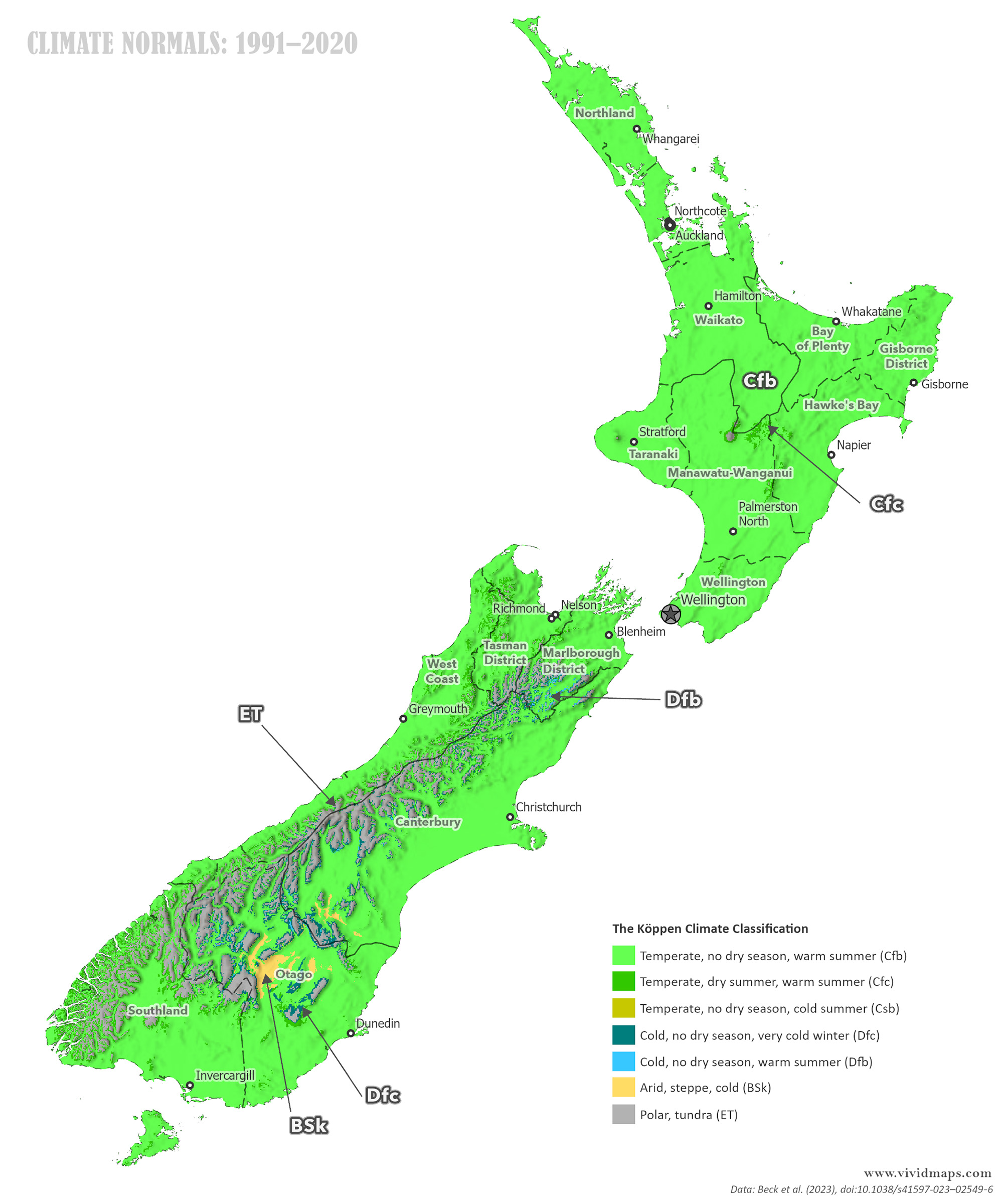
New Zealand is located in the roaring forties, where westerly winds sweep across the Southern Ocean. As a result, most of the country has an oceanic climate (Cfb), characterized by mild and wet conditions year-round. Green hills, frequent rain, moderate temperatures. It’s the climate that keeps both islands lush.
But elevation and rain shadows create exceptions. The mountains have cool-summer oceanic climate (Cfc). South Island’s Southern Alps hold patches of subarctic climate (Dfc) and even tundra (ET) on the highest peaks. Around Canterbury and into Central Otago on South Island, the mountains block enough rain to create New Zealand’s only dry zone: cold steppe (BSk). Parts of inland South Island get cold enough for humid continental climate (Dfb).
These cooler and drier zones are changing. I made maps tracking how New Zealand’s climate zones have moved since 1930 and where they’re going by 2099, using high-resolution Köppen-Geiger data from Beck et al. (2023) at 1-kilometer resolution (for climate codes and their meanings, see my earlier post on global classifications).
Current climate zones of New Zealand
Today’s map shows oceanic climate (Cfb in green) covering most of both islands. This is the mild, damp climate New Zealand is known for. In the mountains, you find cool-summer oceanic (Cfc) where elevation keeps temperatures lower. The Southern Alps on South Island hold small areas of subarctic (Dfc) and tiny patches of tundra (ET) on the highest peaks. Central Otago shows the country’s only semi-arid zone: cold steppe (BSk) where the mountains create a rain shadow. Parts of inland South Island have humid continental climate (Dfb) with colder winters than the coast.
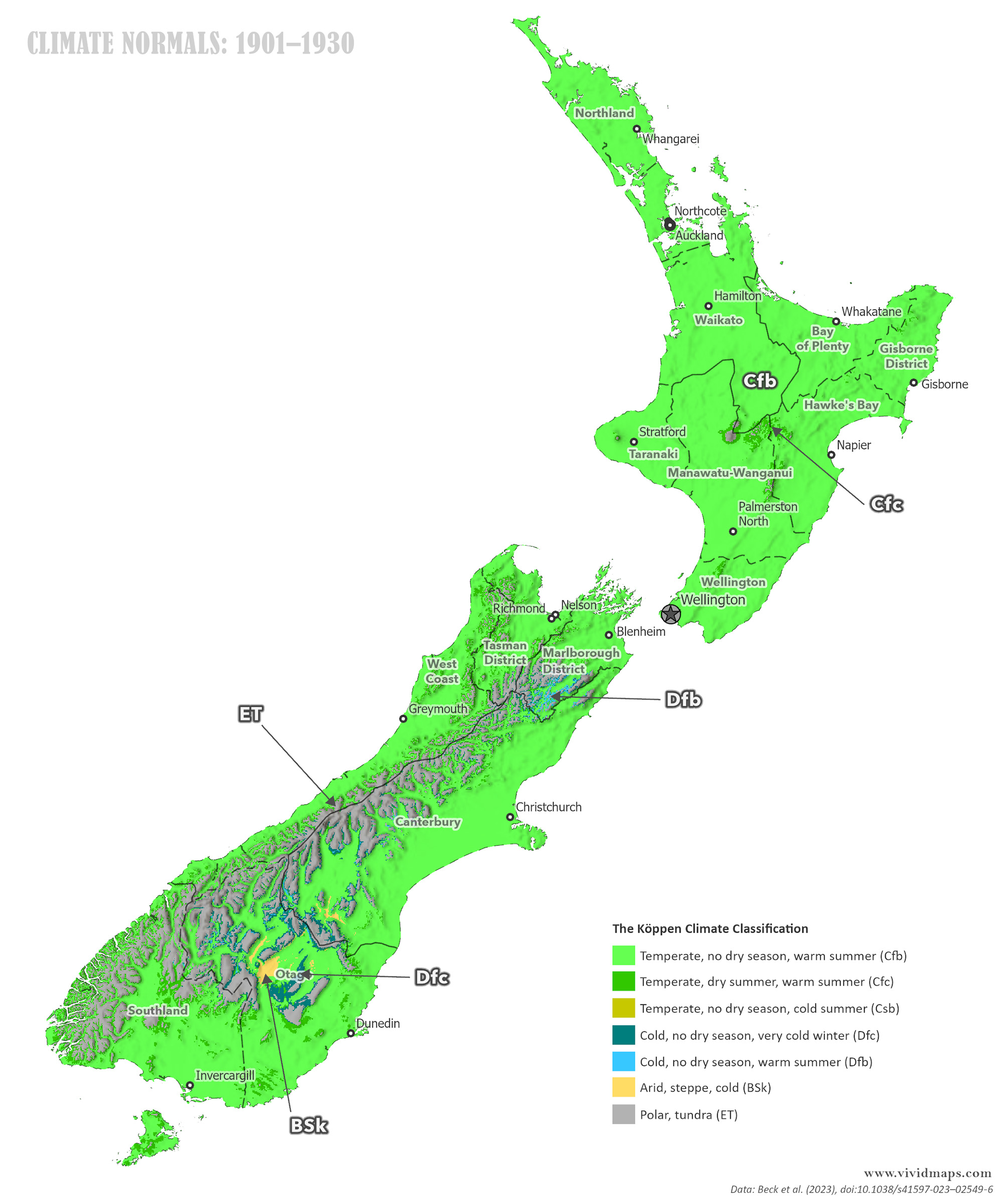
Changes Since 1930
Over the past century, the cooler and drier zones have contracted.
Since 1930, the cold steppe (BSk) in Otago has expanded and become more pronounced. But the cool climates have shrunk. Cool-summer oceanic (Cfc) has contracted in the mountains. Humid continental (Dfb) zones have gotten smaller. Subarctic (Dfc) areas have pulled back to higher elevations.
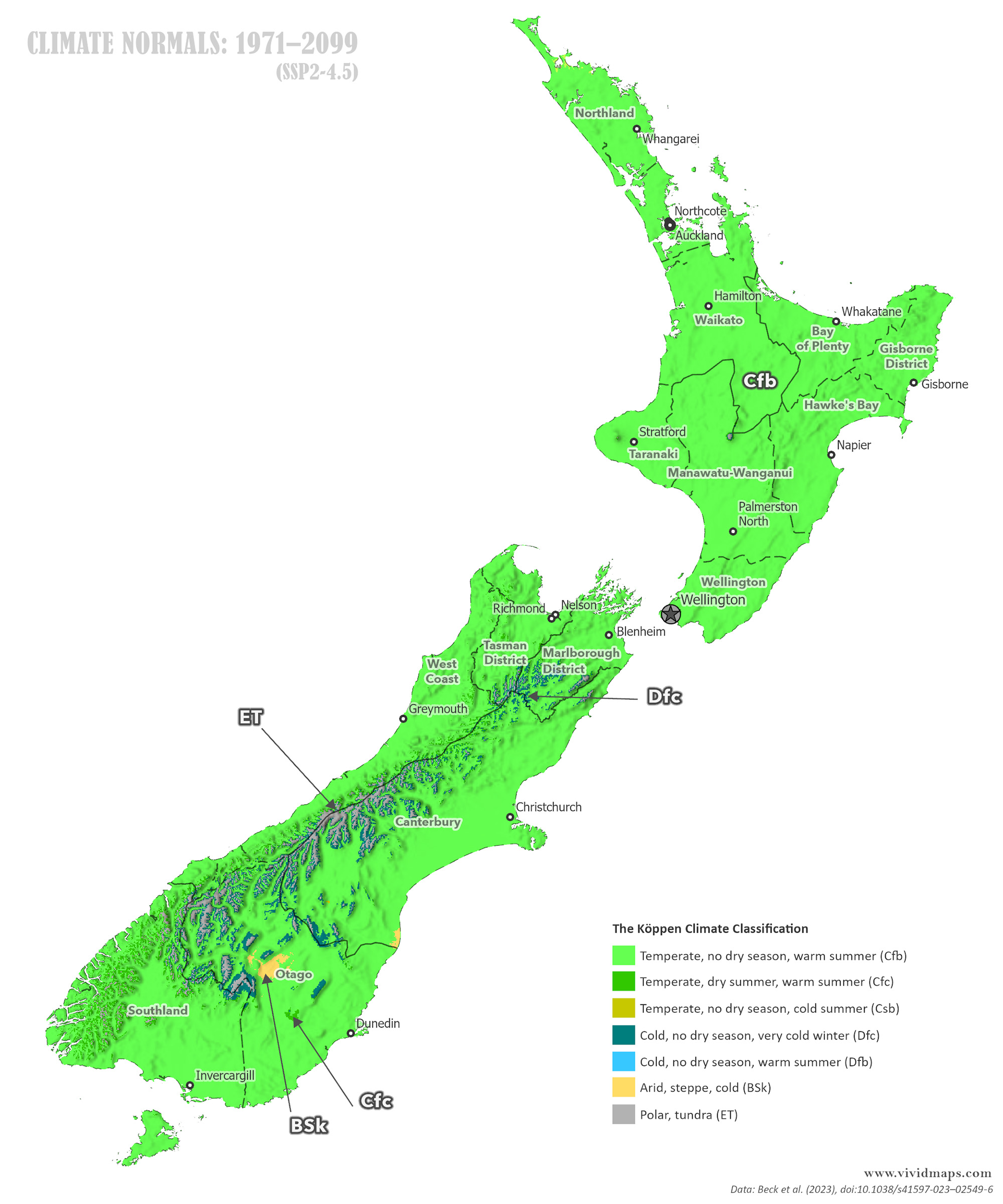
Projections to Century’s End
For future projections, I used a more realistic SSP2-4.5 scenario.
By 2099, the changes become more dramatic. Cool-summer oceanic climate (Cfc) disappears from North Island entirely. On South Island, Cfc, Dfc, and ET all shrink substantially. Even the cold steppe (BSk) in Otago contracts. The tundra patches on the highest peaks would vanish or become extremely restricted. The subarctic zones would retreat to only the very highest remaining areas.
From 1930 to 2099, New Zealand loses much of its climate diversity. The cool mountain climates that create distinct ecosystems and support unique species contract dramatically.
New Zealand’s mountain ecosystems depend on these cool climates. Alpine plants adapted to cold conditions lose habitat as zones move upslope. Snow cover decreases, affecting rivers fed by mountain snowmelt. Glaciers continue retreating.
Data and Methods: All maps use the 1 km Köppen-Geiger dataset from Beck, H.E., et al. (2023), “High-resolution (1 km) Köppen-Geiger maps for 1901–2099 based on constrained CMIP6 projections,” Scientific Data 10, 724. Available at: https://www.nature.com/articles/s41597-023-02549-6.