
North America’s Wolf Subspecies
Wolves are North America’s original top predators and can survive in almost any habitat on the continent. They live in close family groups, hunt animals much bigger than themselves, and help keep ecosystems healthy by stopping deer and elk from eating too much vegetation. Because they are so adaptable, wolves live everywhere from Alaskan permafrost and Canadian forests to the Rocky Mountains and the edge of the Sonoran Desert.
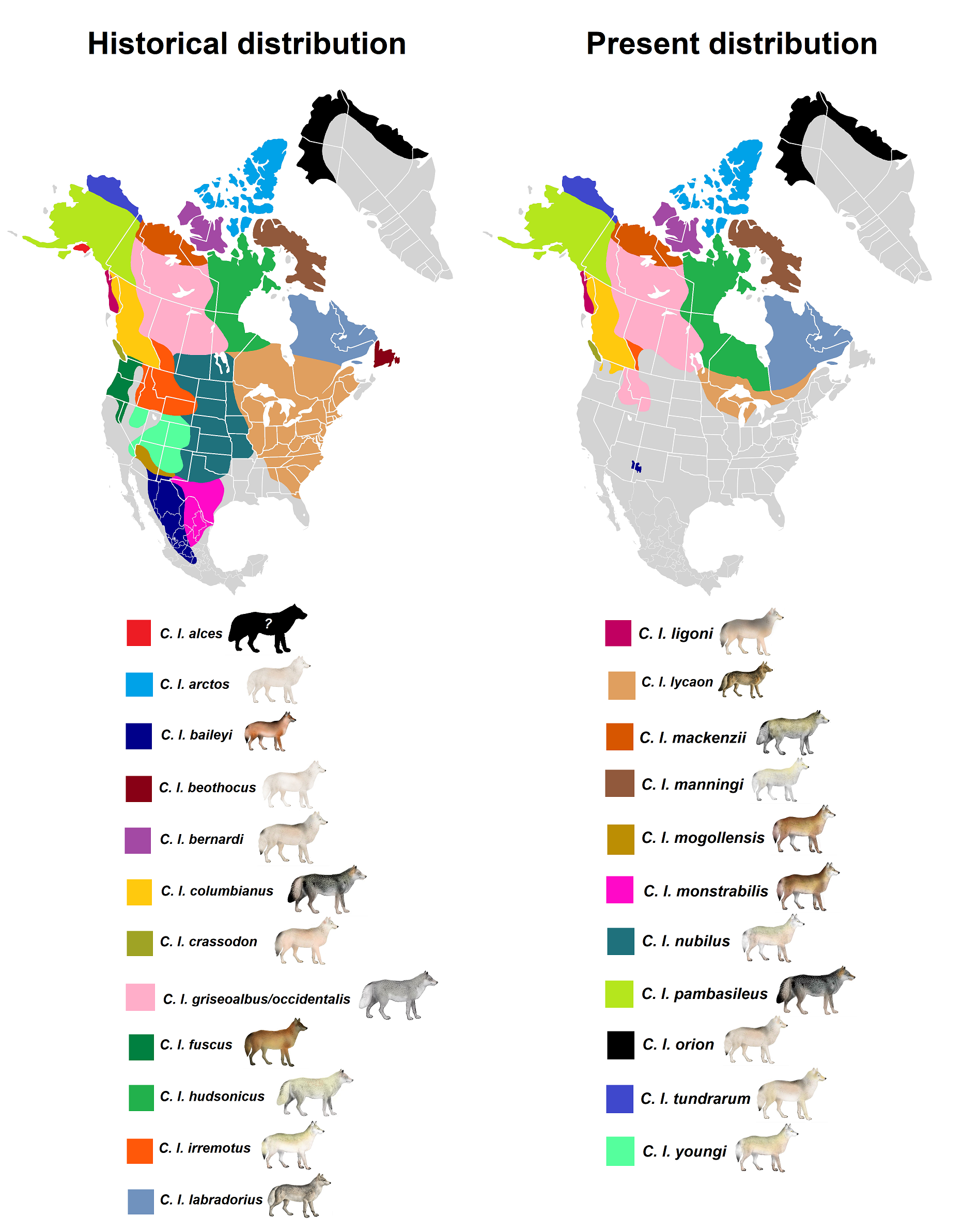
The map on the left shows where different wolf subspecies used to live. Wolves were found in the Arctic islands, along the Pacific coast, across the Great Plains, in the eastern forests, and even down into Mexico. They were almost everywhere. The map on the right shows where wolves live now. See all the gray areas? Those are places where wolves are gone. You can call it extinct or extirpated. Most of the remaining wolves are far up north, mainly in Canada and Alaska. There are some around the Great Lakes, mostly in Minnesota, where they never disappeared. There are also small reintroduced groups in the Rockies.
Between the mid-1800s and maybe the 1960s, people systematically killed wolves across most of their range. European settlement meant livestock – cattle, sheep. Wolves occasionally killed livestock. Sometimes regularly. Ranchers shot them, trapped them, poisoned them. State and federal governments actually paid bounties for dead wolves. You could make money hunting them. The effort worked. Wolves vanished from something like 95% of their range in the lower 48 states. Gone from most of the West by 1930, gone from most of the Midwest and East even earlier. Only place they held on was northeastern Minnesota and parts of Michigan’s Upper Peninsula – too remote, not enough livestock to cause problems.
Canada kept wolves longer because there was more wilderness and fewer people, but populations still dropped hard from hunting and trapping. Then in the 1990s people started thinking maybe we’d overdone it. Yellowstone got 31 wolves from Canada in 1995, more in ’96. Central Idaho got wolves around the same time. There’s been this contentious Mexican wolf reintroduction program in Arizona and New Mexico since ’98 – contentious because some ranchers hate it, wolves still get shot illegally, the population hasn’t grown much. But at least it’s something. Problem is, several subspecies were already extinct by the time anyone thought to bring wolves back.
The subspecies question is where this gets messy. Old-school taxonomists in the early 1900s named 23 or 24 different North American wolf subspecies. They measured skulls, compared fur colors, looked at body size, noted geographic ranges. Modern genetics tells a more complicated story. Turns out some of those “subspecies” were probably just local variations – wolves that looked a bit different because of their environment but weren’t genetically distinct enough to really be separate subspecies. Current science usually recognizes three to five main types.
- Arctic wolves (short, stocky, pale fur, live on the tundra and islands).
- Northwestern wolves (the big ones from Canada and Alaska – these are what got reintroduced to Yellowstone).
- Great Plains wolves (medium-sized, lived on the prairies, mostly extinct now).
- Eastern wolves around the Great Lakes (there’s an ongoing argument about whether these have coyote genes mixed in).
- Mexican wolves (smallest subspecies, adapted to desert mountains).
But maps like this one use the older classification system with 23+ subspecies because that’s how the historical data was recorded.
Current numbers?
Best estimates say 60,000 to 75,000 wolves in North America total. Canada probably has 50,000 to 60,000. Nobody’s counting every single wolf, so these are educated guesses based on surveys and modeling. Alaska has somewhere between 7,000 and 11,000. The lower 48 states have around 6,000. Minnesota alone has 2,900. Wisconsin and Michigan together have maybe 1,500. Montana, Idaho, Wyoming combined are around 2,000 to 2,500. Washington and Oregon have smaller populations that are slowly growing. Mexico’s got the smallest number – 45 wild wolves. These totals seem decent until you realize pre-1850 there were probably hundreds of thousands of wolves across the continent.
Historical Distribution of North American Wolf Subspecies
| Subspecies | Scientific Name | Historical Range |
|---|---|---|
| Kenai Peninsula wolf | Canis lupus alces | Kenai Peninsula, Alaska |
| Arctic wolf | Canis lupus arctos | Canadian Arctic islands and northern mainland, including Melville and Ellesmere Islands |
| Mexican wolf | Canis lupus baileyi | Southwestern US (Arizona, New Mexico, Texas) and northern Mexico |
| Newfoundland wolf | Canis lupus beothucus | Newfoundland, Canada |
| Banks Island wolf | Canis lupus bernardi | Banks and Victoria Islands, Northwest Territories, Canada |
| British Columbia wolf | Canis lupus columbianus | Interior and coastal British Columbia, Yukon, and Alberta, Canada |
| Vancouver Island wolf | Canis lupus crassodon | Vancouver Island, British Columbia, Canada |
| Manitoba wolf/Northwestern wolf | Canis lupus griseoalbus/occidentalis | Northern prairies in Canada (Alberta, Saskatchewan, Manitoba) and western mountains from Alaska to northwestern US |
| Cascade Mountains wolf | Canis lupus fuscus | Cascade Mountains in British Columbia, Washington, Oregon, and northern California |
| Hudson Bay wolf | Canis lupus hudsonicus | Hudson Bay region in Manitoba, Nunavut, and Northwest Territories, Canada |
| Northern Rocky Mountain wolf | Canis lupus irremotus | Northern Rocky Mountains in Idaho, Montana, Wyoming, US |
| Labrador wolf | Canis lupus labradorius | Labrador and northern Quebec, Canada; also Newfoundland |
| Alexander Archipelago wolf | Canis lupus ligoni | Southeast Alaska (Alexander Archipelago) |
| Eastern wolf | Canis lupus lycaon | Southeastern Canada (Ontario, Quebec around Great Lakes), northeastern US |
| Mackenzie River wolf | Canis lupus mackenzii | Mackenzie River Valley, southern Northwest Territories, Canada |
| Baffin Island wolf | Canis lupus manningi | Baffin Island, Nunavut, Canada |
| Mogollon Mountain wolf | Canis lupus mogollonensis | Central Arizona and New Mexico, US |
| Texas gray wolf | Canis lupus monstrabilis | Southern Texas, US and northeastern Mexico |
| Great Plains wolf | Canis lupus nubilus | Great Plains from southern Manitoba and Saskatchewan to northern Texas, US and central Canada |
| Yukon wolf | Canis lupus pambasileus | Interior Alaska and Yukon, Canada |
| Greenland wolf | Canis lupus orion | Northern Greenland and Queen Elizabeth Islands, Canada |
| Tundra wolf | Canis lupus tundrarum | Arctic tundra in Alaska and northern Canada, from Point Barrow to Hudson Bay |
| Southern Rocky Mountain wolf | Canis lupus youngi | Southern Rocky Mountains in Utah, Colorado, US |
Present Distribution of North American Wolf Subspecies
| Subspecies | Scientific Name | Present Range |
|---|---|---|
| Kenai Peninsula wolf | Canis lupus alces | Extinct |
| Arctic wolf | Canis lupus arctos | Canadian Arctic islands and northern mainland, including Melville and Ellesmere Islands (broken into islands) |
| Mexican wolf | Canis lupus baileyi | Southwestern New Mexico, southeastern Arizona, northern Mexico (reintroduced in select zones) |
| Newfoundland wolf | Canis lupus beothucus | Extinct |
| Banks Island wolf | Canis lupus bernardi | Extinct |
| British Columbia wolf | Canis lupus columbianus | Coastal British Columbia and Yukon, Canada (coastal remnants) |
| Vancouver Island wolf | Canis lupus crassodon | Vancouver Island, British Columbia, Canada |
| Manitoba wolf/Northwestern wolf | Canis lupus griseoalbus/occidentalis | Alaska, Yukon, Northwest Territories, British Columbia, Alberta, Saskatchewan, northwestern US (split by development) |
| Cascade Mountains wolf | Canis lupus fuscus | Coastal British Columbia, Washington, western Oregon (patchy groups) |
| Hudson Bay wolf | Canis lupus hudsonicus | Northern Manitoba and Nunavut, Canada (shrunken bayside) |
| Northern Rocky Mountain wolf | Canis lupus irremotus | Northern Rocky Mountains in Idaho, Montana, Wyoming, US (packs in parks and wilds) |
| Labrador wolf | Canis lupus labradorius | Labrador and northern Quebec, Canada |
| Alexander Archipelago wolf | Canis lupus ligoni | Southeast Alaska (Alexander Archipelago) |
| Eastern wolf | Canis lupus lycaon | Southeastern Canada (Ontario, Quebec around Great Lakes), parts of northeastern US like Minnesota, Wisconsin, Michigan (lake-adjacent pockets) |
| Mackenzie River wolf | Canis lupus mackenzii | Southern Northwest Territories, Canada (river corridor) |
| Baffin Island wolf | Canis lupus manningi | Baffin Island, Nunavut, Canada |
| Mogollon Mountain wolf | Canis lupus mogollonensis | Extinct |
| Texas gray wolf | Canis lupus monstrabilis | Extinct |
| Great Plains wolf | Canis lupus nubilus | Great Plains regions in US (Minnesota, Wisconsin, Michigan) and central Canada (scattered plains) |
| Yukon wolf | Canis lupus pambasileus | Interior Alaska and Yukon, Canada |
| Greenland wolf | Canis lupus orion | Northern Greenland and Queen Elizabeth Islands, Canada |
| Tundra wolf | Canis lupus tundrarum | Arctic tundra in Alaska and northern Canada |
| Southern Rocky Mountain wolf | Canis lupus youngi | Extinct |
Six of the subspecies listed in the table—mogollonensis, monstrabilis, and youngi—no longer exist; they were extinct by the mid‑1900s. Mexican wolves almost joined them. By the early 1980s they were gone from the wild. Some survived in zoos and captive breeding programs. In 1998, the U.S. Fish and Wildlife Service began releasing captive‑bred Mexican wolves in Arizona and New Mexico. The wild population there is now a little over 200 animals.




do you have an rss feed?
You can find rss feed here: https://vividmaps.com/feed/