Trans-Siberian Railway development
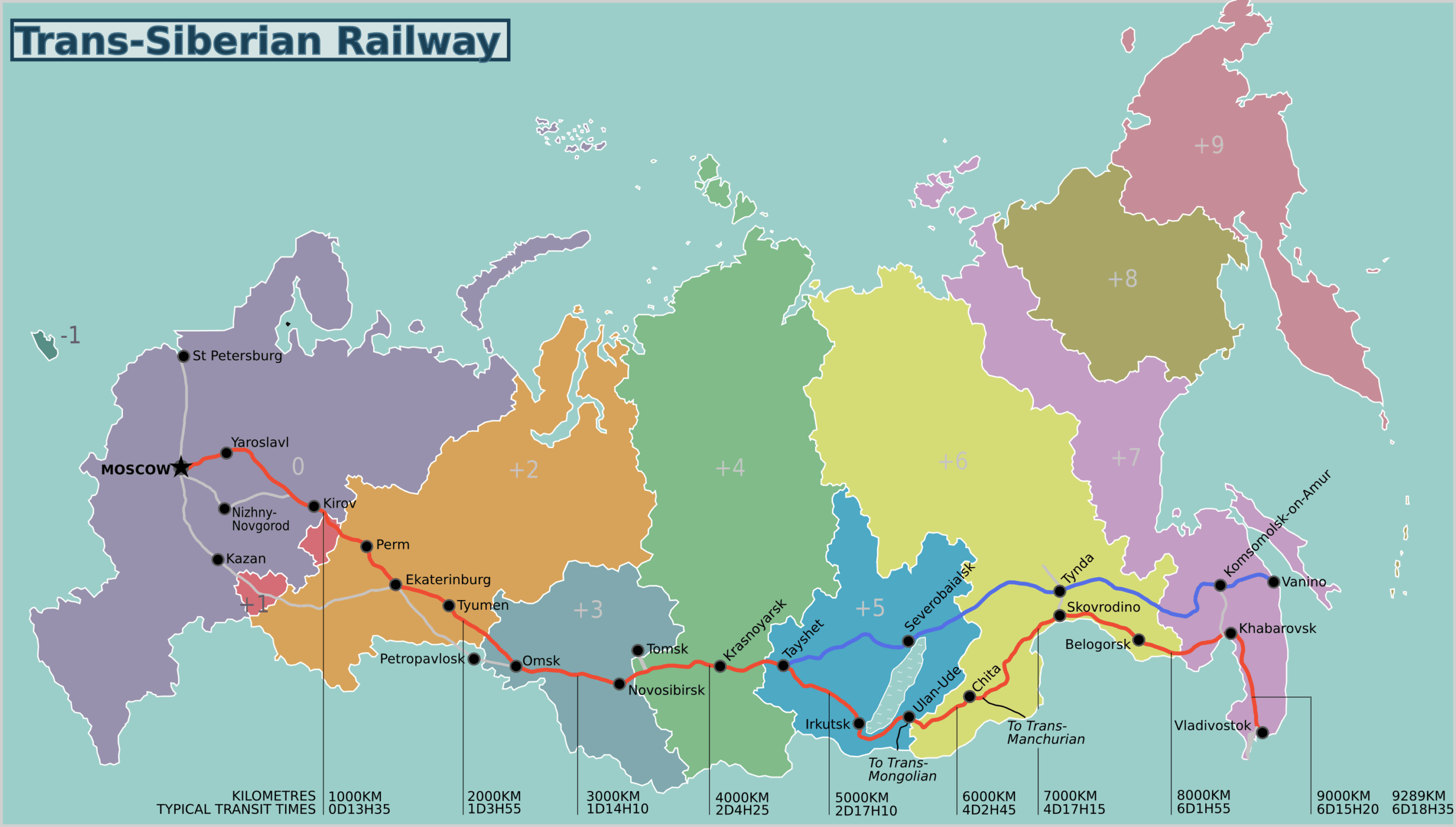
Railways first appeared in the 19th century, and even now they remain a vital part of modern transport. They still move enormous amounts of freight and carry millions of passengers every year. Among the vast railway network that spans our planet, Russia’s Trans-Siberian Railway is probably one of the most extraordinary. Despite the fact that its construction began in the 1890s and was completed around 1916, the line continues to haul huge volumes of goods and passengers across the country. Stretching about 9,289 kilometres (5,772 miles) from Moscow to Vladivostok on the Pacific, it remains one of the world’s great railway routes.
Wars interrupted construction. So did revolutions, money shortages, and the challenge of building across Siberia in winter. Why build it? Russia wanted a reliable link between its European core and the Pacific—for troops, settlers, and cargo moving across distances that are hard to fathom even today.
What does 9,289 kilometres or 5,772 miles actually feel like? Well, a through train takes six to seven days without extended stops. You pass through eight time zones, and the scenery never stops changing. You leave Moscow’s forests and fields, cross the Urals (the border between Europe and Asia), and enter the endless taiga. Siberian forests stretch for thousands of kilometres before opening into the grassland steppe. Near Irkutsk, the track skirts Lake Baikal—over 25 million years old and holding about 20% of the world’s fresh surface water. East of Baikal, the line climbs into the mountains again, then flattens out as you approach the Pacific.
The railway stops at Yaroslavl, Kirov, Perm, Yekaterinburg, Omsk, Novosibirsk, Krasnoyarsk, Irkutsk, Ulan-Ude, Chita, Khabarovsk, and Vladivostok. Many of these cities grew rapidly after the railway arrived. Novosibirsk, for example, was little more than a settlement before engineers bridged the Ob River and turned it into a transport hub. Today, it is Siberia’s largest city and the third most populous in Russia, after Moscow and Saint Petersburg.
There are branch lines too. One goes south into Mongolia—that’s the Trans-Mongolian. Another heads through Manchuria into China—the Trans-Manchurian.
Spending a week on a train? Depends on your personality. Some people love it. Others would go stir-crazy. Either way, you’re watching an entire continent roll past your window.