The white crust that forms around faucets consists of calcium carbonate, the same mineral found in limestone. This compound dissolves from rock into water as it travels through the ground over extended periods. The concentration of these dissolved minerals, mostly calcium and magnesium, is what’s called water hardness, and in the United States, it varies more dramatically between cities.
Municipal water reports measure hardness in mg/L (same as PPM). Plumbers and water softener companies use GPG, grains per gallon. One GPG is 17.1 mg/L. The USGS classifies water as soft under 60 mg/L, then moderately hard, hard, and very hard above 180 mg/L.
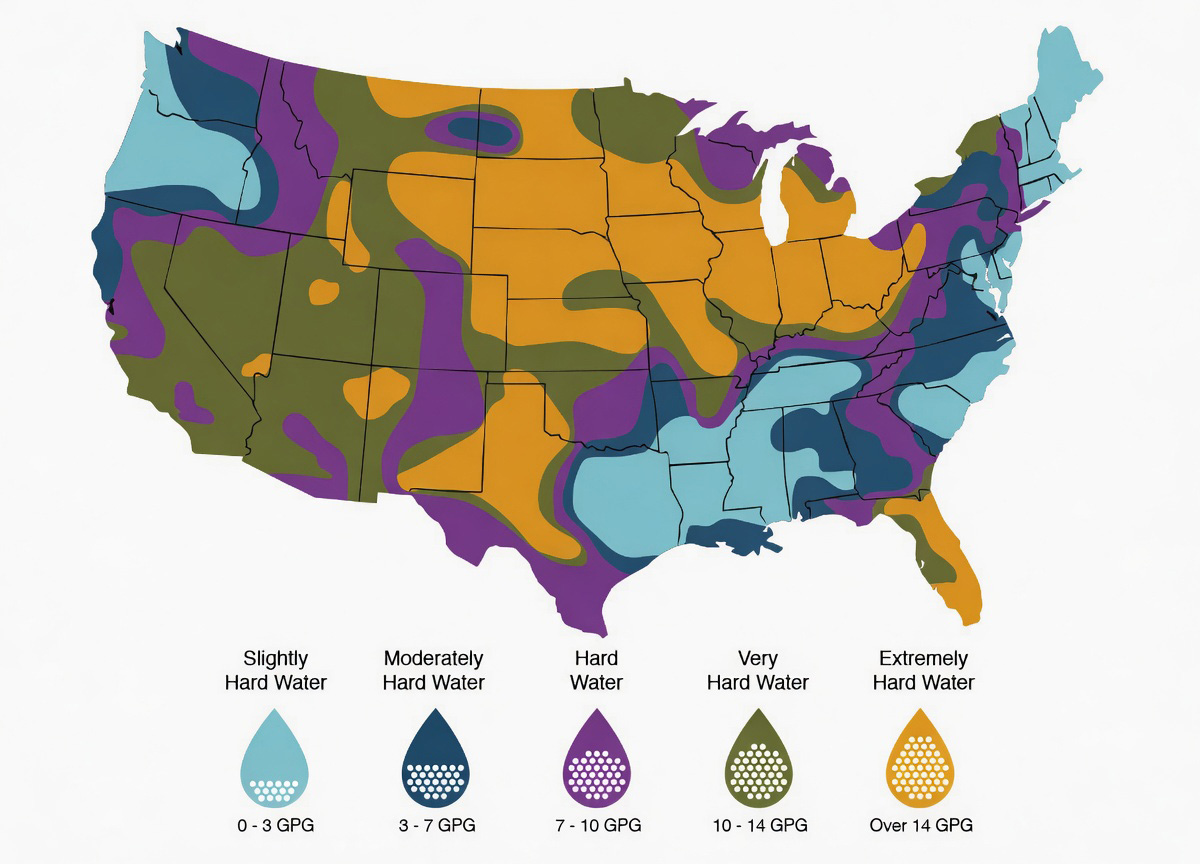
Most of the orange and dark olive covering the central and southwestern US overlies limestone and dolomite. These rocks have been releasing calcium and magnesium into groundwater for an extraordinarily long time, and in the desert Southwest the problem compounds through evaporation.
The blue zones on the Pacific coast and in the upper Northeast come from very different bedrock. The northern Pacific coast consists mainly of volcanic rock, which doesn’t dissolve into water the way limestone does, while the granite and schist across New England simply don’t give much up to water.
What hard water does over time
Hard water usually makes itself known through small things first. The showerhead needs cleaning more often. Soap won’t lather the way it used to. Glasses come out of the dishwasher spotted. By around 7 GPG (120 mg/L), most people are aware something is off even if they haven’t traced it back to the water supply. Inside the water heater, mineral scale has been quietly accumulating on the heating element for years, making it work longer and harder to reach temperature. The U.S. Department of Energy has estimatedefficiency losses of up to 48% in very hard water conditions. That doesn’t announce itself suddenly. It creeps into a decade of energy bills and eventually into an appliance that fails a few years ahead of schedule.
Hard water is not a health concern. The EPA classifies it under secondary drinking water standards, which cover taste and household nuisance rather than safety. Calcium and magnesium are minerals the body uses, and the World Health Organization has noted that hard water may contribute positively to daily mineral intake.
Soft water has its own considerations. Below about 25 mg/L (1.5 GPG), water can be mildly aggressive toward older copper pipes and may pull trace metals from original plumbing in pre-1980s buildings. In newer buildings this isn’t an issue. And if you’ve only ever lived in hard water cities and you move to somewhere like Portland or Boston, the shower will feel oddly slippery for the first few weeks. The soap is rinsing off completely. Soft water rinses more thoroughly than hard water does.
Top 10 US Cities with the Hardest Water
Rank
City
State
Hardness (mg/L)
Hardness (GPG)
1
Midland
TX
~500
~29.2
2
San Antonio
TX
~357
~20.9
3
Kansas City
MO
~305
~17.8
4
Las Vegas
NV
~285
~16.7
5
Phoenix
AZ
~285
~16.7
6
Indianapolis
IN
~275
~16.1
7
Tampa
FL
~270
~15.8
8
Minneapolis
MN
~257
~15.0
9
Riverside
CA
~240
~14.0
10
Salt Lake City
UT
~158
~9.2
Top 10 US Cities with the Softest Water
Rank
City
State
Hardness (mg/L)
Hardness (GPG)
1
Boston
MA
~8
~0.5
2
Portland
OR
~10
~0.6
3
Honolulu
HI
~17
~1.0
4
Salem
OR
~18
~1.1
5
San Francisco
CA
~18
~1.1
6
Seattle
WA
~25
~1.5
7
Charlotte
NC
~28
~1.6
8
Little Rock
AR
~28
~1.6
9
New York City
NY
~35
~2.0
10
Denver
CO
~51
~3.0
The USGS National Water Information System tracks hardness data at individual monitoring stations if city-level averages aren’t precise enough for your purposes. Most utility customer service lines will also just read you the current hardness number from their latest report if you call and ask.