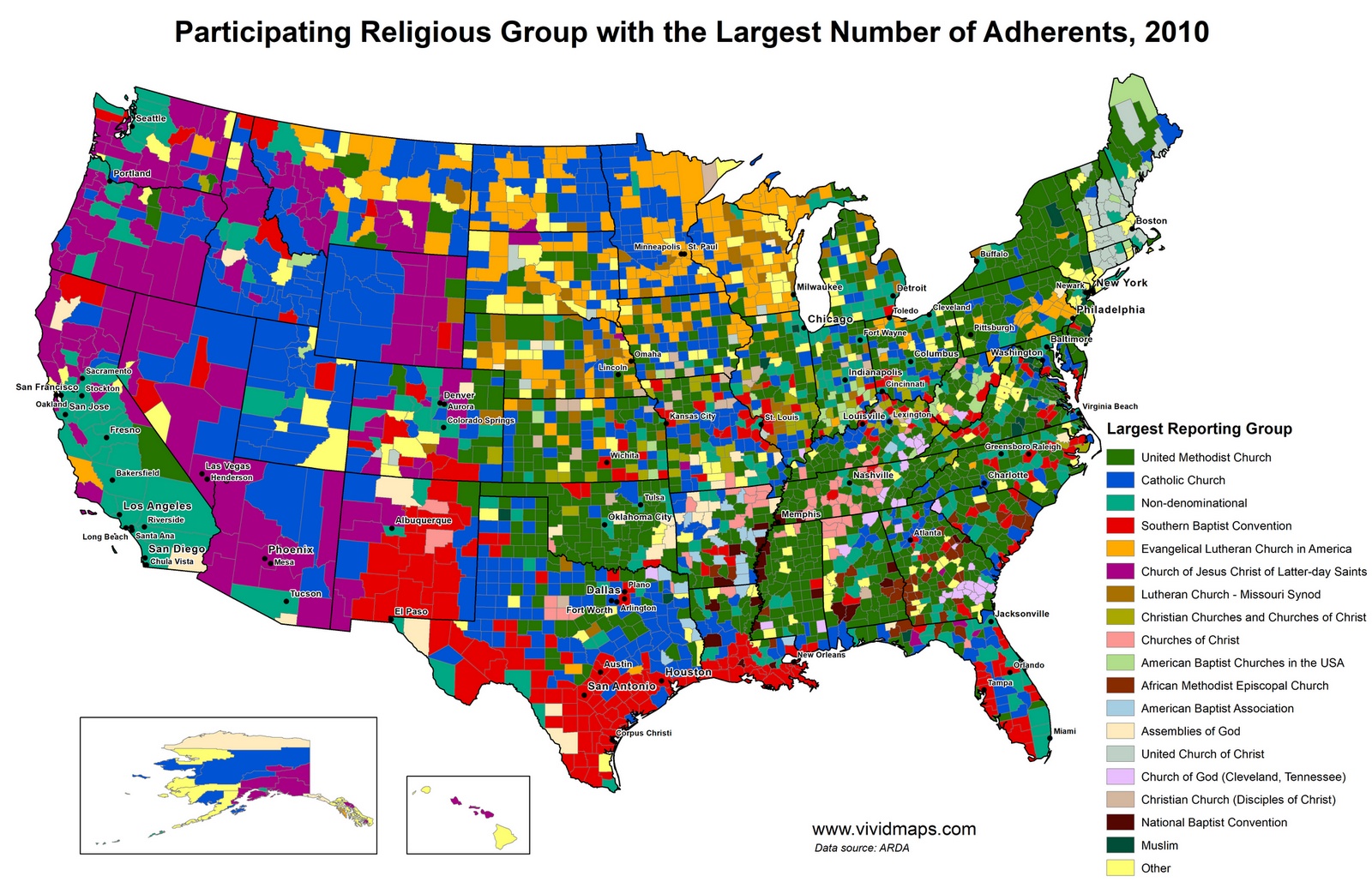
When you look at religion on a county map, the biggest group is usually easy to guess — Christian denominations take the lead almost everywhere. But once you ask who comes second, things get more interesting. The answer changes as you move across the country, following old migration routes, cultural borders, and local histories that still shape how people worship today.
In much of the Deep South, the second spot often belongs to Black Protestant churches such as the National Baptist Convention or the Church of God in Christ. Their communities grew alongside the rise of African American towns after the Civil War and later expanded during the Great Migration. If you trace the map from Mississippi to Georgia and up toward Illinois, you can almost follow that movement county by county.
Farther west, religion takes a different shape. In Utah, Idaho, and parts of Arizona, Catholic parishes tend to come second, right behind the Latter-day Saints. That’s partly the result of Mormon settlement in the 1800s — and later, waves of Catholic immigrants from Mexico, Central America, and the Philippines who built their own churches nearby. It’s a mix of two strong traditions sharing the same landscape.
In the Upper Midwest, especially Minnesota, North Dakota, and Wisconsin, you’ll find another pattern. Lutheran congregations — brought by German and Scandinavian immigrants — usually come first. But just down the road, you’ll often see Catholic or Evangelical churches ranking second. It’s the kind of quiet coexistence that defines many small towns in that region, where a church supper might draw people from both denominations.
Along the West Coast and in the country’s biggest cities — Los Angeles, New York, Chicago — the religious landscape looks more mixed. In many counties, non-denominational Protestant churches now fill the number two slot. They’ve grown fast since the 1990s, drawing younger people and those who prefer modern music, informal sermons, and fewer labels. Some counties around major cities now have more of these congregations than long-established groups like Methodists or Presbyterians.
Up in New England, things feel older. Catholic churches still lead in most counties, but mainline Protestant congregations — Episcopal, Congregational, and Methodist — remain strong in second place. Many of these buildings date back to colonial times, and even if attendance has declined, they continue to serve as landmarks and community centers in towns that haven’t changed much in generations.