The world we live in today was largely shaped by what happened in 1938. Political borders across Europe, the division between East and West that persisted for decades, the economic structures that emerged after 1945 – all of it traces back to this single year when the interwar peace finally collapsed.
March 1938 saw the Anschluss bring Austria into Germany. September brought the Munich Agreement, where Britain and France let Hitler take Czechoslovakia’s border regions. The League of Nations had become irrelevant. Appeasement wasn’t just a policy choice – it reflected which countries had the economic strength to resist aggression and which didn’t.
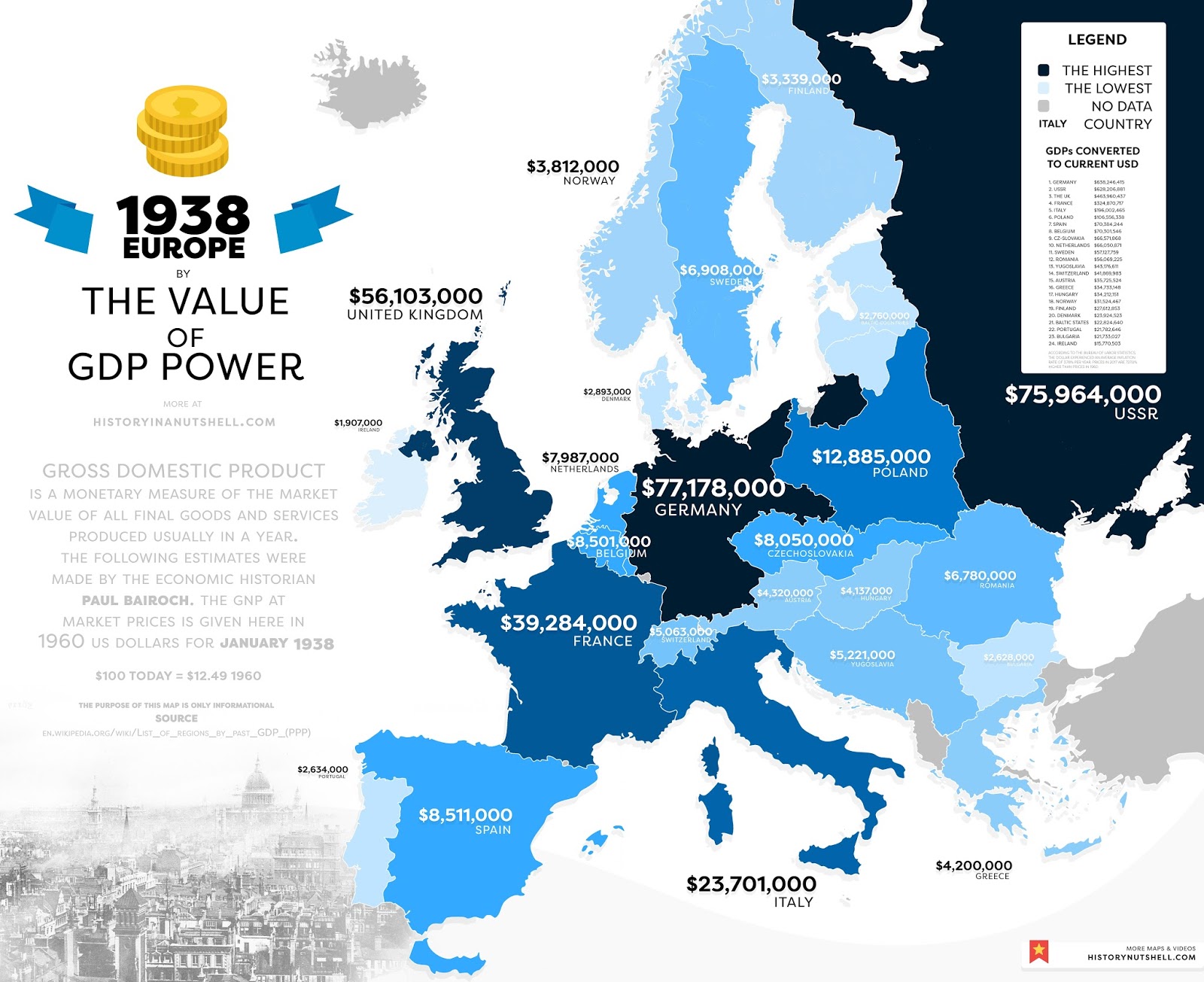
GDP data from January 1938 shows which countries could afford to go to war and which could not. While economic strength is not the only factor in war, it limits what each country can do.
Germany’s economy hit $77.2 billion in 1960 dollars. The Soviet economy measured $76 billion. Two different systems producing almost identical output. Germany got there by rebuilding from the 1923 hyperinflation crisis through exports and military spending. The USSR forced peasants onto collective farms and ran factories on quotas that ignored human costs.
Britain came in third at $56.1 billion. France had $39.3 billion but lost so many men in WWI that their economy never recovered the same vigor. Italy under Mussolini built up $23.7 billion trying for economic self-sufficiency, though importing raw materials they didn’t have made this impossible.
Look at Poland’s $12.9 billion and you see the problem. Germany had six times that. The USSR had six times that. Being stuck between them geographically meant Poland would get crushed when either one decided to move.
Czechoslovakia produced $8.1 billion, most of it from Škoda’s weapons manufacturing and Silesian coal. Estonia, Latvia, and Lithuania combined couldn’t reach $3 billion. The Soviets occupied them in 1940. With those GDP numbers, military resistance would have been brief and futile.
British colonial holdings generated more GDP than Britain proper. The Dutch East Indies exceeded the Netherlands’ domestic economy.
European Economic Data, January 1938
Country
GDP Total (1960 USD, millions)
GDP Per Capita (2022 USD)
Germany
$77,178
$10,500
USSR
$75,964
$4,500
United Kingdom
$56,103
$13,200
France
$39,284
$9,300
Italy
$23,701
$6,600
Poland
$12,885
$4,600
Spain
$8,511
$3,400
Belgium
$8,501
$10,100
Czechoslovakia
$8,050
$5,500
Netherlands
$7,987
$11,000
Sweden
$6,908
$10,300
Romania
$6,780
$3,400
Yugoslavia
$5,221
$3,400
Switzerland
$5,063
$12,700
Austria
$4,320
–
Greece
$4,200
$5,600
Hungary
$4,137
$5,500
Norway
$3,812
$9,000
Finland
$3,339
$7,500
Denmark
$2,893
$12,100
Baltic States
$2,760
$5,000
Portugal
$2,634
$3,700
Bulgaria
$2,628
$3,100
Ireland
$1,907
$6,400
Albania
–
$2,000
Turkey
–
$2,900
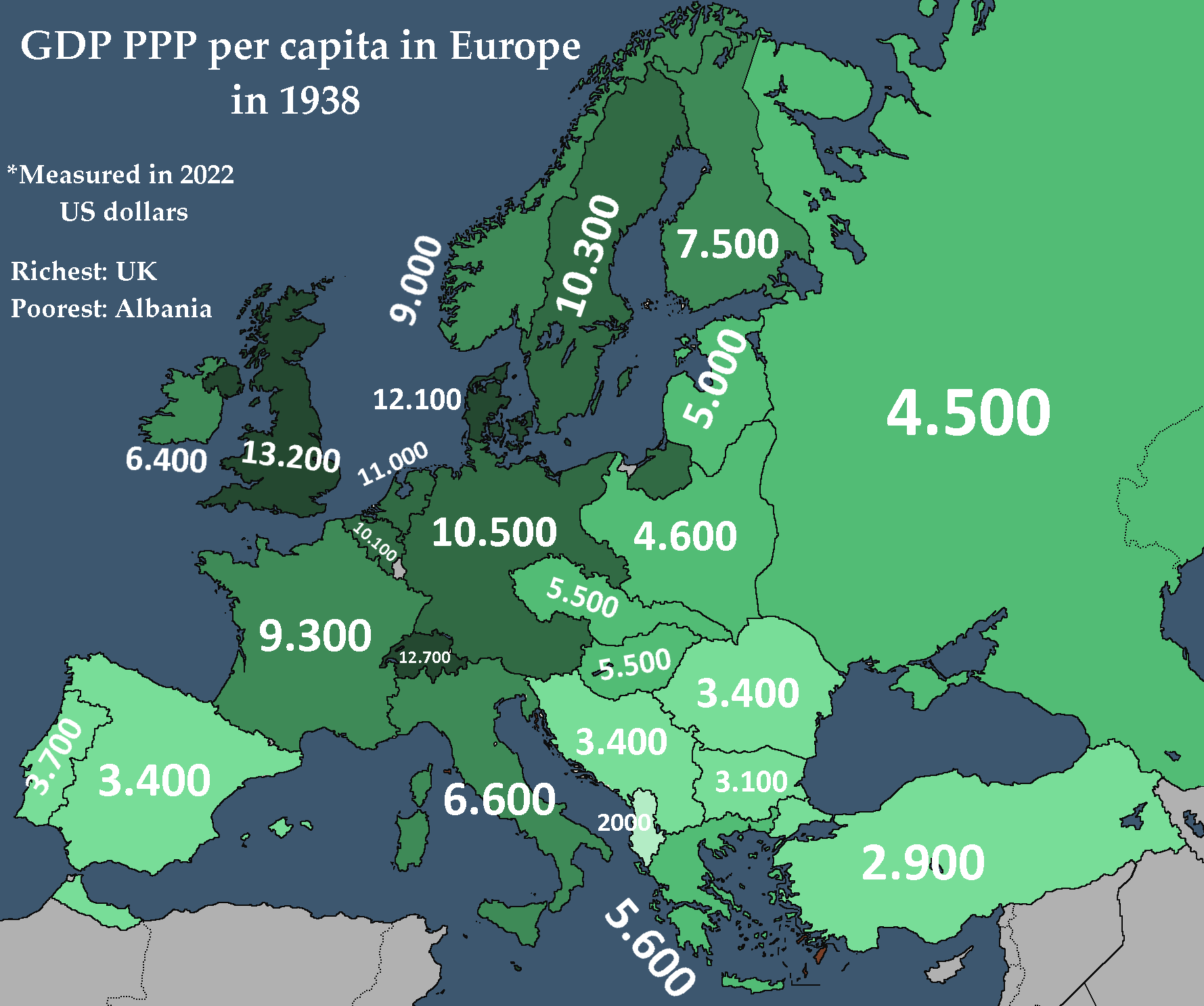
Per capita wealth shows a completely different hierarchy. Britain’s $13,200 per person put it first in Europe. Switzerland came in at $12,700, Denmark at $12,100. Germany, the Netherlands, and Belgium all exceeded $10,000 per capita.
The Soviet Union had $4,500 per person despite its enormous total economy. Poland’s per capita reached $4,600. Romania, Bulgaria, and Yugoslavia each had $3,400 per person.
Per capita wealth determined military capabilities more than total GDP. Germany’s $10,500 per person let them fund complex engineering. Messerschmitt designed sophisticated fighters. Panzer tanks got advanced optics and radio systems. The Soviets couldn’t match German per capita wealth, so their factories took a different approach. The T-34’s design was simple and robust, easy for workers to assemble quickly. Production hit 58,000 units. When you can’t win on quality, you win on volume.
Neutral countries made money throughout the war. Sweden exported iron ore to German steel mills. Swiss banks handled accounts for multiple belligerents. Switzerland’s precision manufacturing supplied various sides. Latin American countries shipped rubber, copper, and other raw materials to American factories. Staying neutral while selling resources proved lucrative.
Countries with strong economies in early 1938 could sustain long wars of attrition. Countries without money became occupied or turned into battlefields. Wealth doesn’t guarantee winning, but poverty guarantees losing.
Related Books available on Amazon
The Economic Consequences of the Peace – John Maynard Keynes Keynes went to Versailles in 1919 with the British delegation. He quit after watching them design reparations that would cripple Germany’s economy. The book he published afterwards laid out exactly why this would destabilize Europe. Within fifteen years, his predictions had come true – economic chaos fed political extremism, which fed rearmament.
The Wages of Destruction – Adam Tooze From 1933 forward, Nazi Germany operated with chronic economic problems. Shortages, monetary instability, resource constraints. Tooze shows how these economic pressures drove Hitler toward earlier military expansion than his generals wanted. Germany invaded specific countries for specific resources because their economy demanded it.
Lords of Finance – Liaquat Ahamed Four men ran the central banks of the US, Britain, France, and Germany during the 1920s. Their monetary policy decisions contributed to the Great Depression. Ahamed documents how their mistakes in one decade created the conditions for war in the next. Economic policy has political consequences, sometimes catastrophic ones.
The Great Depression: A Diary – Benjamin Roth Roth was a lawyer in Youngstown, Ohio. Between 1931 and 1941, he kept detailed daily notes about what he observed. Bank failures in his town. Unemployment spreading. Breadlines forming. The grinding slow recovery. It’s not an academic analysis, just what one professional saw happening around him during the economic collapse.