
How Much Taiwan’s Population Shifted in 337 Years
Taiwan covers about 36,197 square kilometers (13,976 square miles), making it roughly the same size as the Netherlands. Mountains cover most of the island, with peaks along the eastern half climbing past 3,000 meters (9,800 feet). As a result, most of the 23.4 million residents live on the narrower plains in the west. North is subtropical, south is tropical. The Fujian coast of mainland China lies about 180 kilometers (112 miles) away, across the Taiwan Strait. People settled the island thousands of years before Han Chinese migration began in earnest. What followed changed the population balance almost completely within three centuries.
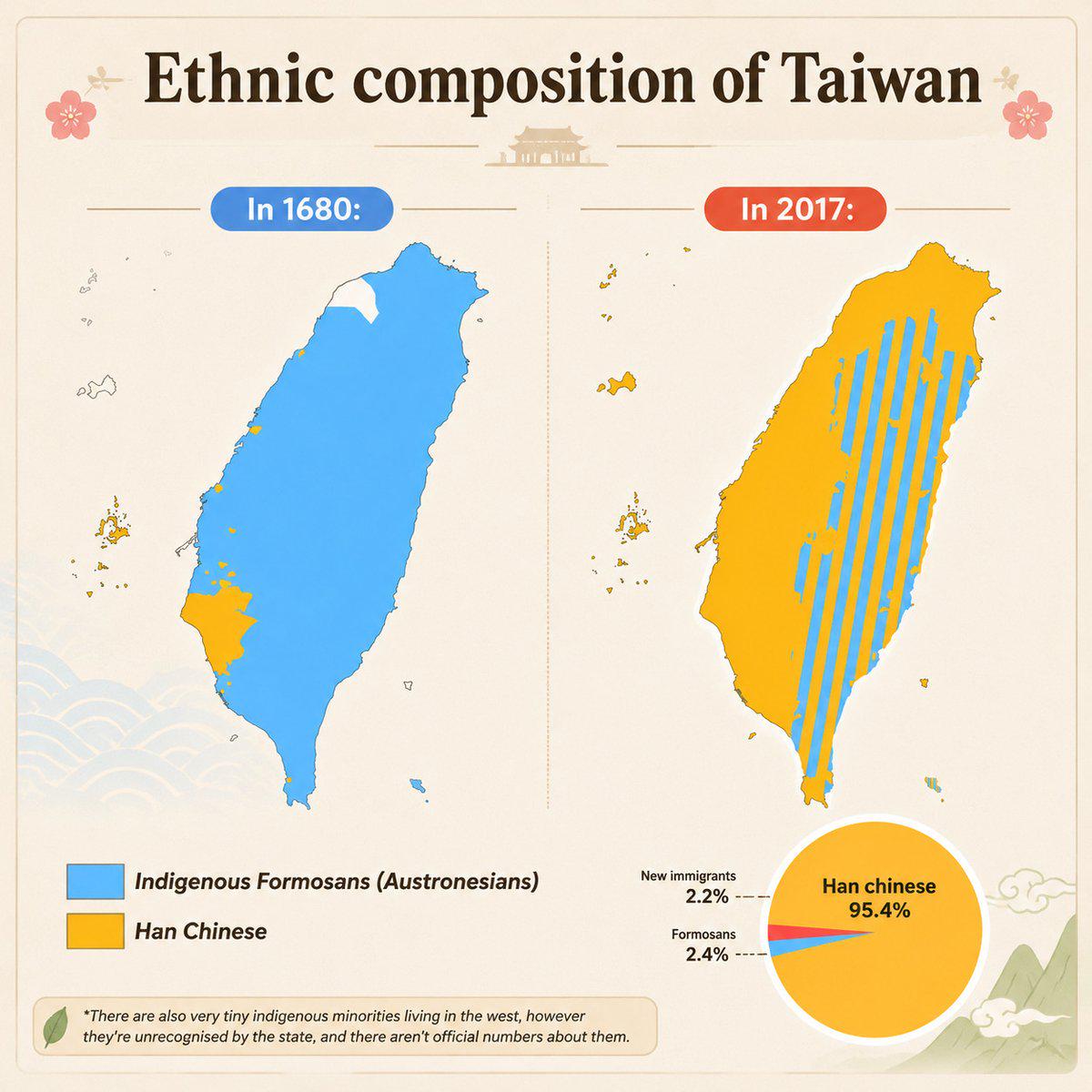
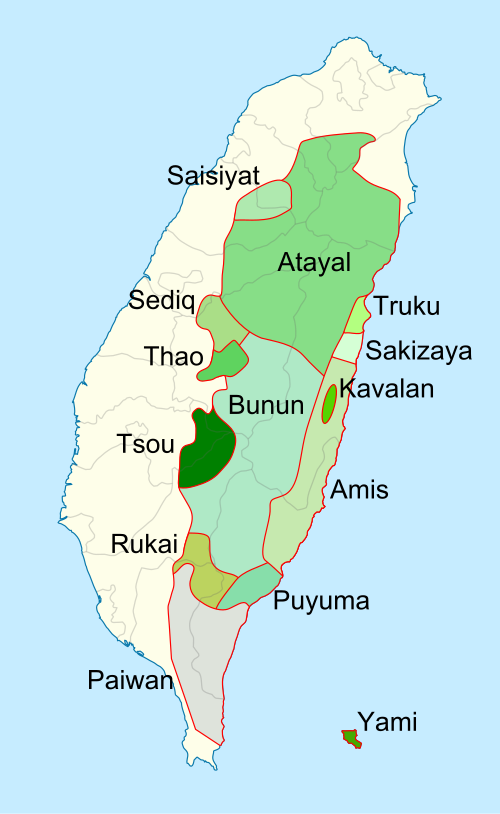
Blue covers nearly the whole 1680 map. That’s Formosan land, dozens of separate Austronesian tribes rather than one nation. Plains groups held the lowlands. Mountain groups held the interior. No one ruled the whole island (Taiwan is widely considered the homeland of the entire Austronesian language family, which eventually reached as far as Hawaii and Madagascar).
In 1683, the Qing dynasty took over the island.
Initially, there existed a strict government ban on people moving across the ocean from mainland China to the island of Taiwan. Qing rulers did not want the island to become a “hotbed for rebellion.” This was difficult to enforce because many people tried to escape Southeast China, which suffered from massive population pressure, poverty, and land shortages. Meanwhile, Taiwan had highly fertile, untouched western plains perfect for farming, so many people tried to migrate to the island anyway. Later, the migration restrictions on paper turned out to be just that—paper.
Farmers from Fujian and Guangdong kept arriving for the next two centuries. The Siraya and other lowland tribes lived closest to them. Intermarriage increased across generations, and indigenous languages and customs slowly dissolved into the Han majority. Mountain tribes, harder to reach, kept more of their own ground—in both senses of the word.
| Ethnic Group | 1683 (Qing Annexation) | 1895 (End of Qing Rule) | 2017 (Official Statistics) | 2025 (Official Count) |
|---|---|---|---|---|
| Han Chinese | 100,000 | ≈2,500,000 | ≈22,490,000 | ≈22,140,000 |
| Indigenous Formosans | N/A | 200,000+ | ≈565,700 | 629,456 |
| New Immigrants | N/A | N/A | ≈518,600 | ≈600,000 |
| Total Population | 200,000 | ≈2,700,000+ | 23,571,000 | 23,365,274 |
Today’s Han Chinese majority isn’t one monolithic block. About 70 percent are Hoklo, descended from Hokkien-speaking migrants out of southern Fujian. Starting in the 1600s, they claimed the highly fertile farmland along the western plains. Another 15 percent are Hakka, who speak a separate language that Hoklo speakers cannot understand. Arriving slightly later, they settled the hillier country bordering indigenous territory, largely because the lowlands were already taken. The remaining 10 percent trace back to the roughly 1.2 million mainlanders who arrived with the Republic of China government between 1945 and 1949. These Mandarin-speakers hailed from across China rather than a single province, and they dominated the government and military hierarchy throughout the martial law decades that followed.
On the indigenous side, just over half live in mountain townships today, the rest mostly along the eastern plains. New immigrants are the newest line on the chart, arriving mostly as spouses from Vietnam, Indonesia, and China since the late 1980s, a number that keeps creeping up year over year.



Good & informative article. Very interesting. But what’s this nonsense about Taiwan being a “small” island? It’s the world’s 35th largest island out of perhaps a million. It houses over 23 million people, with spare room for mountains, forests, and remote places. It has this long history with many different regions. It’s slightly larger than Vancouver Island – the largest island on the West Coast of the America. Are all the other islands minuscule? If Taiwan is small, what’s an average-sized island? Borneo? Calling Taiwan a small island is like saying that Argentina is a small country, just because there are a few larger ones.
You are right about Taiwan’s size. I actually can’t find where I wrote the word ‘small’ in the post—could you let me know where you saw it?
> Taiwan is a small, mountainous island off the coast of mainland China
It’s in the blurb off the main page.