Travel back a century and America looks very different. Farms and small towns covered most of the landscape in the early 1900s.
Today, the population has more than tripled and the vast majority lives in metropolitan areas. Simple growth doesn’t fully explain this transformation. Millions of people physically relocated. They left rural communities, moved across state lines, and settled where work was available, where new highways were being built, and where economic activity was booming along the coasts.
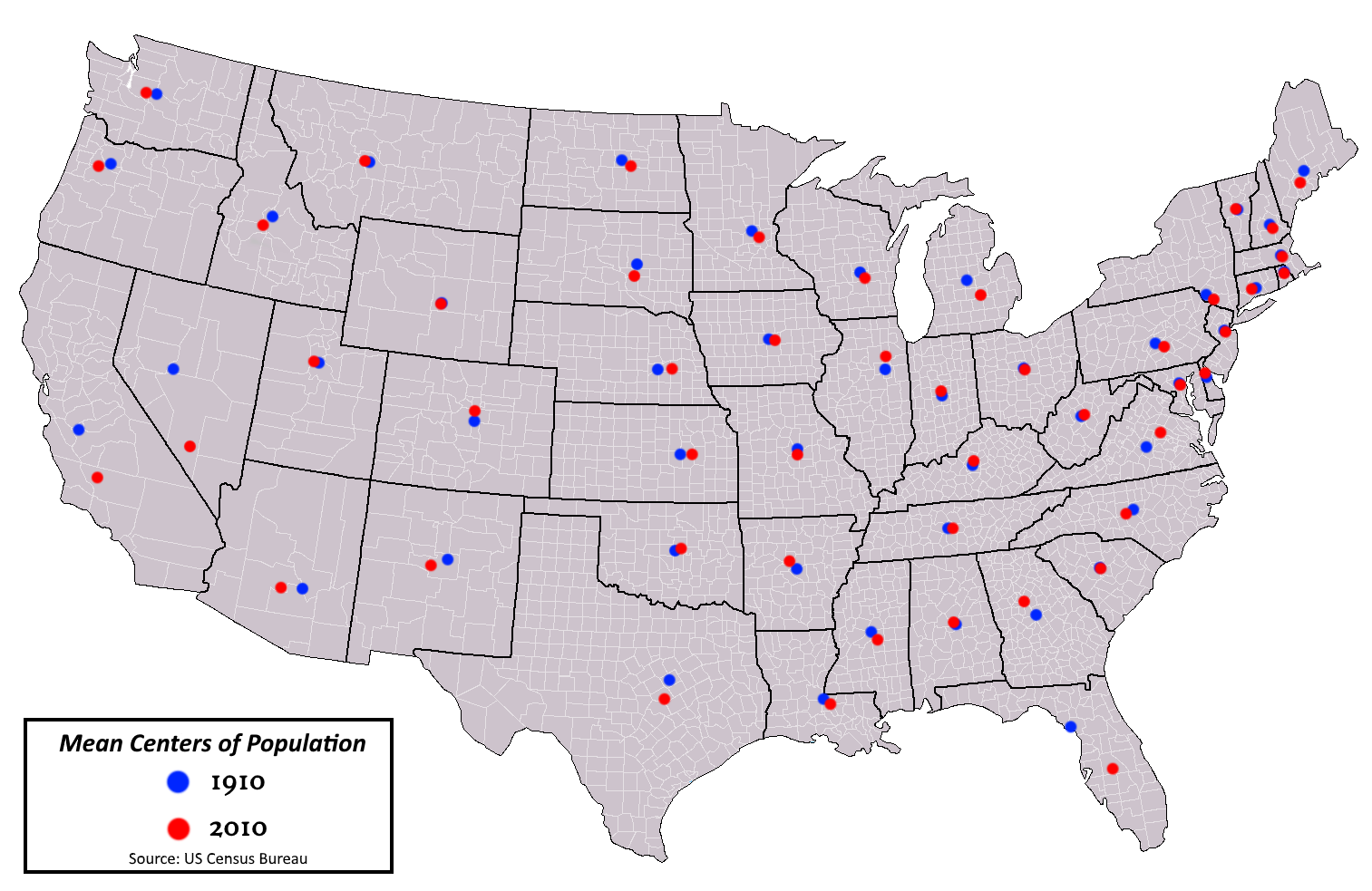
The map below shows where each state’s population center has moved over the past hundred years.
@ProjectFailure
Blue dots represent where the population balanced out in the early 1900s. Red dots show where that center sits now.
Look at the western states and you’ll notice the red markers have crept toward the Pacific. California’s center has moved closer to Los Angeles and the Bay Area. What were once separate cities eventually grew into one sprawling urban belt. Arizona’s dot leans toward Phoenix. New Mexico’s has shifted toward Albuquerque. Both cities boomed after World War II. Jobs drew people in. So did the climate and cheap land that made development almost inevitable.
Texas is similar but bigger in every way. The I-35 corridor and Gulf Coast became magnets for migration. Dallas, Fort Worth, Houston, Austin, San Antonio all boomed during the same period, and the state’s center of gravity drifted southeast as a result.
In Florida, the population center slid southward down the peninsula. Orlando, Tampa, and Miami became huge. Yes, the sunshine helped, but the real story was jobs in new industries, housing that didn’t break the bank, and a way of life that pulled in retirees from up north and immigrants from Latin America and the Caribbean.
The Midwest shifted more subtly. In Kansas and Nebraska, the centers moved east. Their eastern counties got railroads and highways earlier, which gave them a development advantage. Wyoming, Vermont, and Rhode Island barely moved. These states were already fairly urban for their size.
When you look at the whole map, one thing becomes clear. Cities pull people in like gravity wells. Manufacturing needed workers. Service sectors expanded. People wanted reliable paychecks. So generation after generation moved toward urban areas. These individual decisions accumulated and fundamentally altered the demographic makeup of entire states.