The twelve were the men closest to Jesus during his time in Judea. The Gospels describe him choosing ordinary working people, mostly fishermen and a tax collector, to travel with him and learn his teaching. After Jesus died they kept preaching and helped the movement spread beyond its local origins.
Can we prove every detail in those stories? A few names stand on firmer ground. Peter, John and James, the brother of Jesus, are the best attested. The historian Josephus refers to James in a passage usually dated to about 93 AD. For most of the others, outside evidence is thin. What is clear is that Christianity spread quickly across the Mediterranean in the first century, and the maps below collect the places later tradition assigns to each apostle.
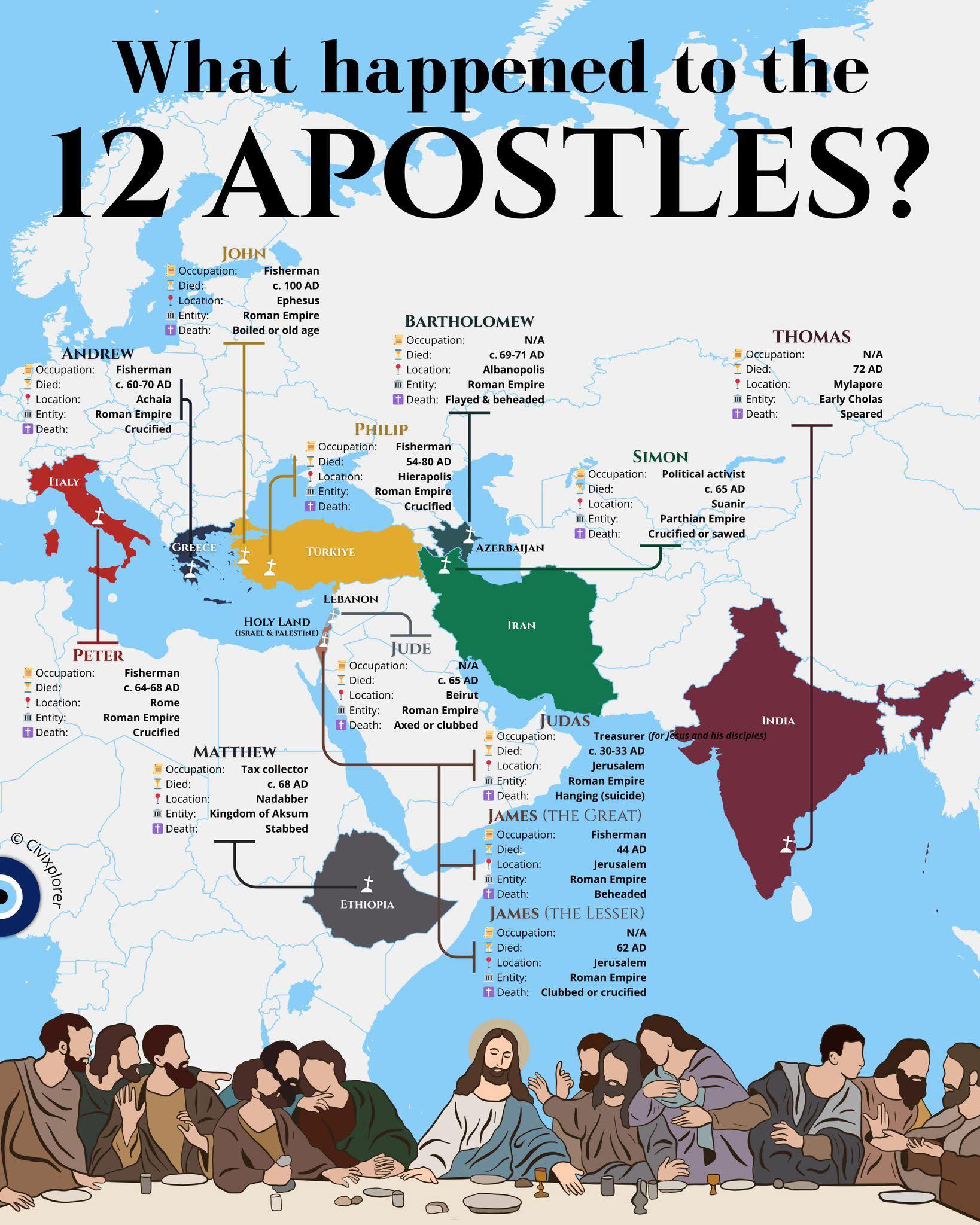
The first map created by @Civixplorer shows where each apostle is said to have died, according to church tradition.
Apostle
Occupation
Death date
Location of death
Political entity
Manner of death
Peter
Fisherman
c. 64–68 AD
Rome
Roman Empire
Crucified, tradition says upside down
Andrew
Fisherman
c. 60–70 AD
Achaia
Roman Empire
Crucified
James the Great
Fisherman
44 AD
Jerusalem
Roman Empire
Beheaded
John
Fisherman
c. 100 AD
Ephesus
Roman Empire
Natural causes, old age
Philip
Fisherman
54–80 AD
Hierapolis
Roman Empire
Crucified
Bartholomew
—
c. 69–71 AD
Albanopolis
Roman Empire
Flayed and beheaded
Matthew
Tax collector
c. 68 AD
Nadabber
Kingdom of Aksum
Stabbed
Thomas
—
72 AD
Mylapore
Early Cholas
Speared
James the Less
—
62 AD
Jerusalem
Roman Empire
Clubbed or crucified
Jude (Thaddaeus)
—
c. 65 AD
Beirut
Roman Empire
Axed or clubbed
Simon (the Zealot)
Political activist
c. 65 AD
Suanir
Parthian Empire
Crucified or sawed
Judas Iscariot
Treasurer
c. 30–33 AD
Jerusalem
Roman Empire
Hanging, recorded as suicide
Most of this information wasn’t recorded until decades or centuries after it happened.
Paul is not one of the original Twelve, but his letters are a different kind of evidence. They date from the 50s and 60s AD and describe real communities and the problems they faced. Those letters help us place early Christian groups in cities across Asia Minor and Greece. Modern scholars estimate Paul travelled thousands of miles on routes that linked towns such as Antioch, Ephesus and Corinth; he was eventually arrested and executed in Rome in the 60s AD.
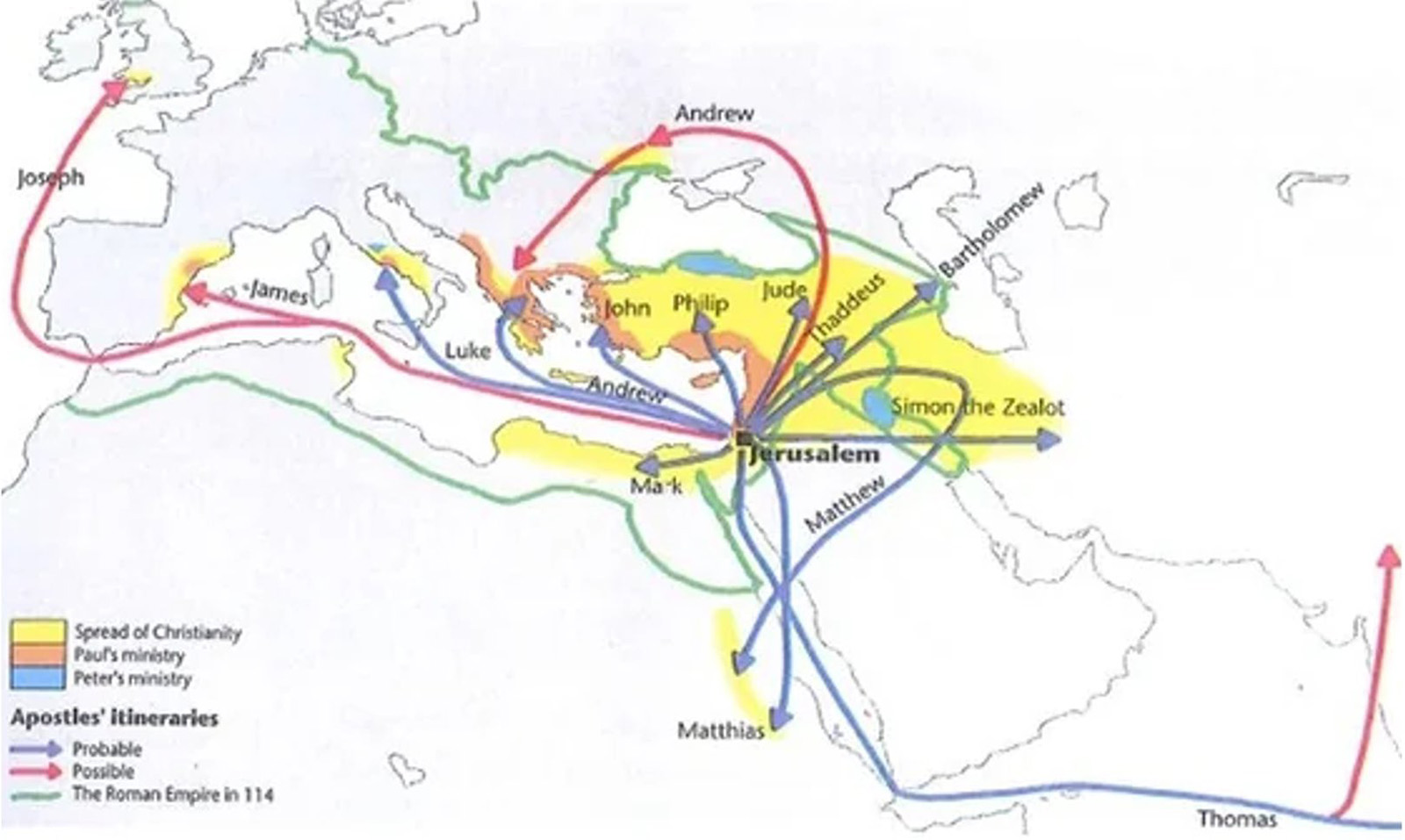
The second map traces the routes tied to each apostle. Purple arrows indicate routes with stronger support and red arrows mark paths where the evidence is weaker. Green shows the Roman border around 114 AD and yellow highlights areas where Christianity had spread by the early second century.
Tradition places Simon the Zealot in Parthian lands where several accounts say he suffered a violent death. Jude, often called Thaddaeus, appears in stories centered on the Levant and Beirut. Philip’s tradition centers on Hierapolis and describes his martyrdom.
Some of the traditional journeys cover great distances. Thomas is credited with travelling to southern India and dying at Mylapore, and Christian communities in Kerala still trace their origins to him even though written records appear later. Matthew is linked by tradition with Aksum and said to have been killed there. Bartholomew appears in Armenian accounts with a brutal end. These reports vary by source and many cannot be independently verified, but when the traditions are placed onto a map they follow routes that were feasible in the ancient world.