The Most Valuable Soil on Earth
Soil forms the base of our food supply. All the crops we grow rely on healthy soil.
Chernozems (a subset of “Black Soils”) are among the most fertile types of soil. In Russia, they are called chernaya zemlya, or “black earth,” because they are very dark, sometimes almost pitch black. This rich color originates from organic material that has accumulated over thousands of years, often reaching 5 to 15 percent.
How do soils like this even form? It’s from being under huge grasslands for ages, with winters that are freezing, hot summers, and rain that’s balanced just right. If there’s too much water, nutrients get flushed deep underground. Not enough, and the vegetation can’t produce enough organic matter to enrich the soil. So what happens is these dense grasses shoot up annually, wither away, and decomposing into the soil.
Those grass roots reach deep and keep dumping in more organics season after season, slowly building these thick layers full of humus. Nowadays, we’ve got roughly 230 million hectares of chernozems, mostly scattered across the Eurasian steppes and the prairies in North America—places where the weather and vegetation have lined up similarly for eons.
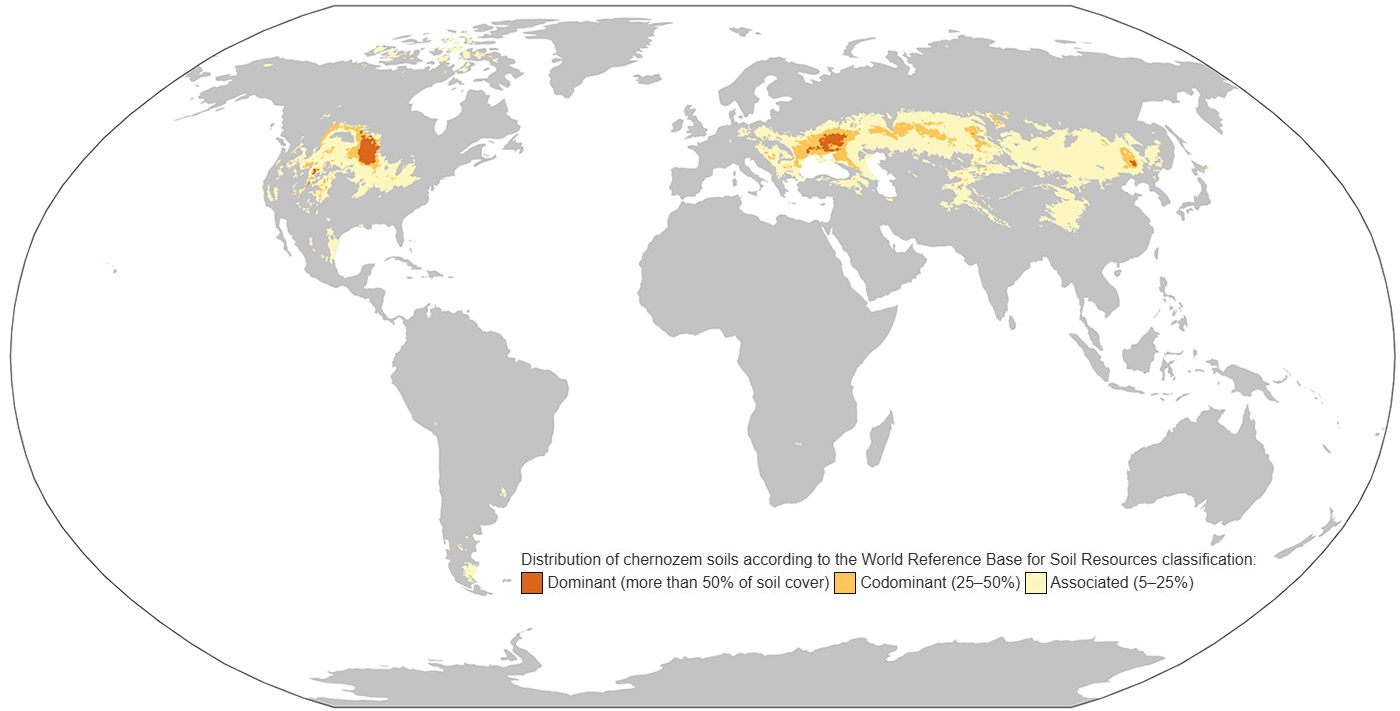
The global distribution shows these soils are incredibly concentrated geographically.
The Distribution
Russia has a whopping 1.2 million square kilometers of chernozem, which is 52% of the global total.
Ukraine is next up with 340,000 square kilometers (15%), and Kazakhstan has 300,000 square kilometers (13%). Those three countries alone account for 80% of it all.
| Rank | Country | Estimated Area (km²) | Estimated Area (mi²) | Global Share (%) |
| 1 | Russia | ~1,200,000 | ~463,300 | 52.2% |
| 2 | Ukraine | ~340,000 | ~131,200 | 14.8% |
| 3 | Kazakhstan | ~300,000 | ~115,800 | 13.0% |
| 4 | United States | ~230,000 | ~88,800 | 10.0% |
| 5 | Canada | ~90,000 | ~34,700 | 3.9% |
| 6 | China | ~80,000 | ~30,900 | 3.5% |
| 7 | Others | ~60,000 | ~23,200 | 2.6% |
| Total | World | ~2,300,000 | ~888,000 | 100% |
Over in North America, they stretch across the Great Plains. The U.S. and Canada together have about 14%.
Sure, those areas are huge for farming there, but they pale next to the massive Eurasian zones where everything just clicked over a way bigger landscape.
If you check the map, there’s this long, mostly unbroken stretch from Ukraine heading east through Russia right into Kazakhstan.
Kastanozems and Phaeozems
Over here on the second map, we’re looking closer at Eurasia and including two other soil types that usually show up around the edges of chernozem areas.
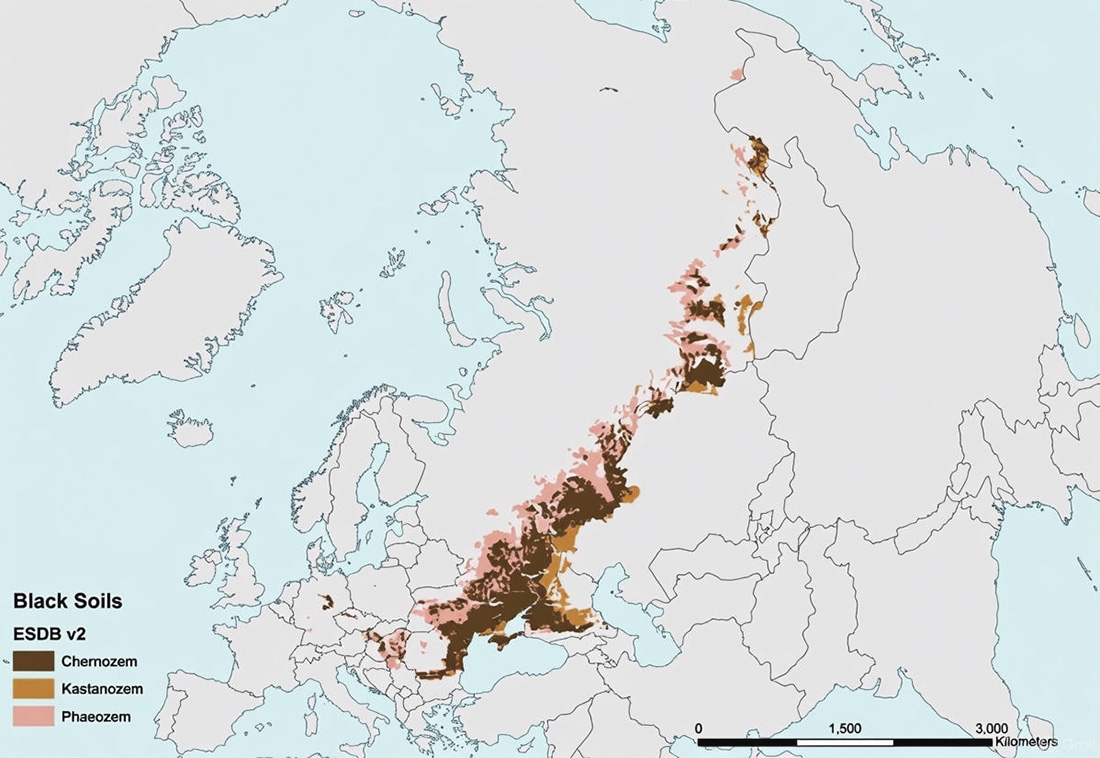
Kastanozems are more of a chestnut color, not as dark. They form in drier spots, typically south of the chernozem core, so their organic buildup isn’t as thick. You’ll find big areas of them in southern Russia and Kazakhstan.
Phaeozems come about in wetter spots than chernozems. A good chunk of the North American prairies are actually phaeozems, not the full-on chernozems. The extra water shifts how plants grow and things decompose, but they’re still top-notch for growing stuff.
All three soil types support major crop production. Wheat dominates in many areas, along with sunflowers and corn.
Why These Soils Matter for Farming
It’s no wonder Russia, Ukraine, and Kazakhstan lead the way in grain exports—they’ve got the bulk of these super-fertile soils.