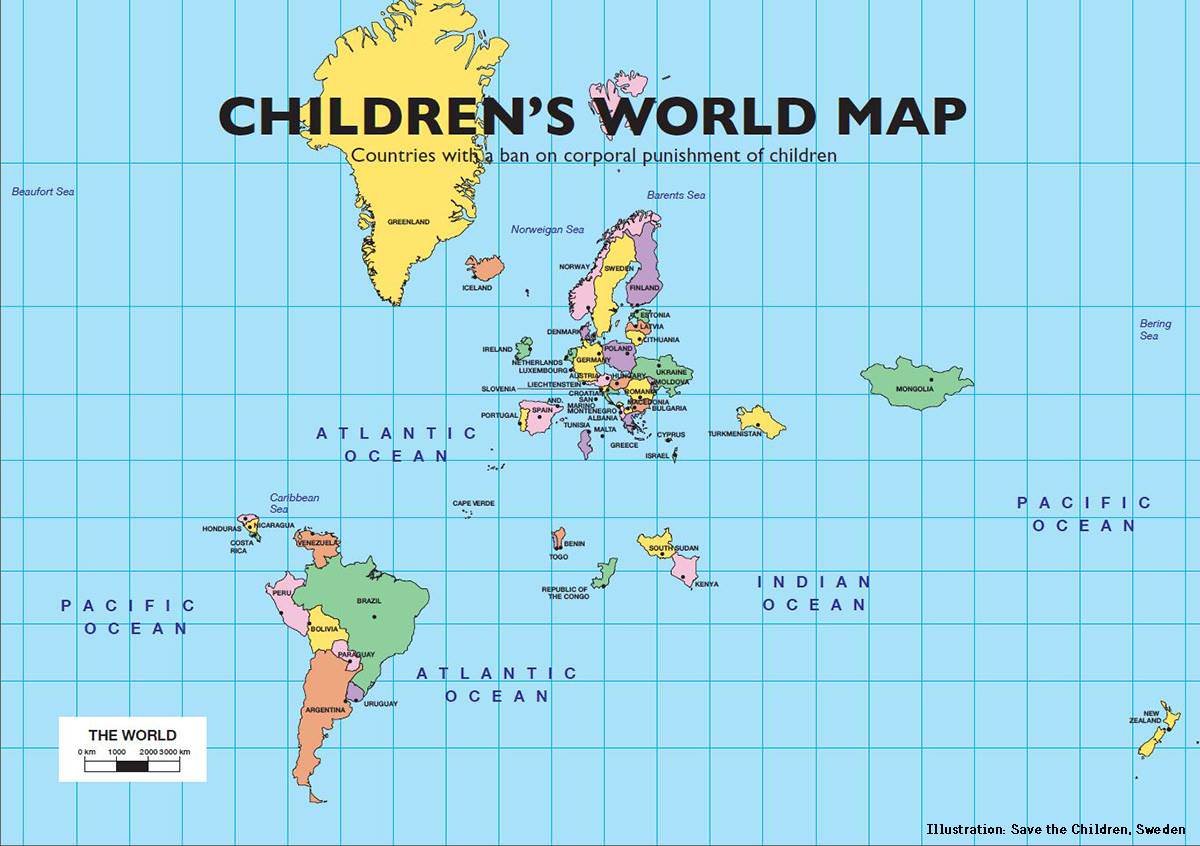
Switzerland’s Parliament voted for a ban in September 2025, and the Global Initiative to End All Corporal Punishment of Children counts it as the 70th state to outlaw all corporal punishment of children. Sweden went first. Its law dates to 1979, and adult support for corporal punishment there fell from 53% in 1965 to 7% in 2006. The world map below, credited to Reddit user Wolfinton, catches the idea partway through its spread.
As of October 2026, 70 states ban all corporal punishment of children in every setting, home included. Europe and South America do lead, with 39 of 54 states in Europe and Central Asia and 8 of 12 in South America. The map appears to predate 2015, so it misses 25 states that came later.
Key takeaways
70 states have a full ban, covering about 347 million children, or roughly 15% of the world’s child population.
Bans peaked from 2010 to 2014, with 17 states, and have slowed to a little over two a year since 2015.
Bans go with less youth fighting in an 88-country study, yet WHO says laws alone are not enough.
How many countries have banned corporal punishment of children?
Seventy, by the Global Initiative’s count, which credits a state only when the law covers every setting, home included. Another 25 have promised to follow. Plenty of websites still quote 53, the right number in 2017.
The busiest stretch was 2010 to 2014, with 17 states and eight of them in 2014 alone. From 2015 onward the pace settled at a little over two a year. The newest three are Thailand (March 2025), the Czech Republic (law in force from January 1, 2026) and Switzerland.
States with a full ban, by year of enactment
Year
States
2025
Thailand, Czech Republic, Switzerland
2024
Tajikistan
2023
Lao PDR
2022
Zambia, Mauritius
2021
South Korea, Colombia
2020
Japan, Seychelles, Guinea
2019
Georgia, South Africa, France, Kosovo
2018
Nepal
2017
Lithuania
2016
Mongolia, Montenegro, Paraguay, Slovenia
2015
Benin, Ireland, Peru
2014
Andorra, Estonia, Nicaragua, San Marino, Argentina, Bolivia, Brazil, Malta
2013
Cabo Verde, Honduras, North Macedonia
2011
South Sudan
2010
Albania, Republic of the Congo, Kenya, Tunisia, Poland
2008
Liechtenstein, Luxembourg, Moldova, Costa Rica
2007
Togo, Spain, Venezuela, Uruguay, Portugal, New Zealand, Netherlands
2006
Greece
2005
Hungary
2004
Romania, Ukraine
2003
Iceland
2002
Turkmenistan
2000
Germany, Israel, Bulgaria
1999
Croatia
1998
Latvia
1997
Denmark
1994
Cyprus
1989
Austria
1987
Norway
1983
Finland
1979
Sweden
Total
Which large countries are not on the list?
The United States, Canada, Australia and China. The United Kingdom as a whole is absent too, although Scotland and Wales ban it under their own laws and are listed separately. US state laws confirm parents’ right to use physical punishment, and 15 states still allow it in public schools.
Being off the list does not mean legal everywhere. In 62 states corporal punishment is not yet fully banned in schools, so the rest have school bans even where homes are not covered.
Do bans change anything?
Some evidence says yes, with caveats. A 2018 BMJ Open study of 403,604 adolescents in 88 countries found that males in the 30 full-ban countries had 69% of the rate of fighting seen in the 20 countries with no ban. The lead author called it a correlation. Sweden’s own numbers fell steeply, yet researcher Joan Durrant noted that no direct causal link between the law and the trends can be drawn.
Laws leave gaps. WHO estimates 1.2 billion children aged 0 to 18 face corporal punishment at home every year, and 77% of parents in Togo, which has had a full ban since 2007, reported using it in the past month on a child aged 2 to 14. WHO calls bans necessary but not enough and asks for parent support and awareness campaigns beside them.
The count changes a few times a year, and this post gets updated when the Global Initiative adds a 71st state.
If you’d like to use maps as educational tools in your space, these world maps on Amazon can spark good conversations.