Continental Runoff and River Discharge
Key Takeaways
- Amazon discharge: 209,000 to 224,000 m³/s (7.4 to 7.9 million ft³/s)
- Water flowing through the Amazon’s mouth each second would fill 88 Olympic pools
- South America: 29% of global runoff, 12% of Earth’s land
- Europe: just two rivers in the world’s top 30 by discharge
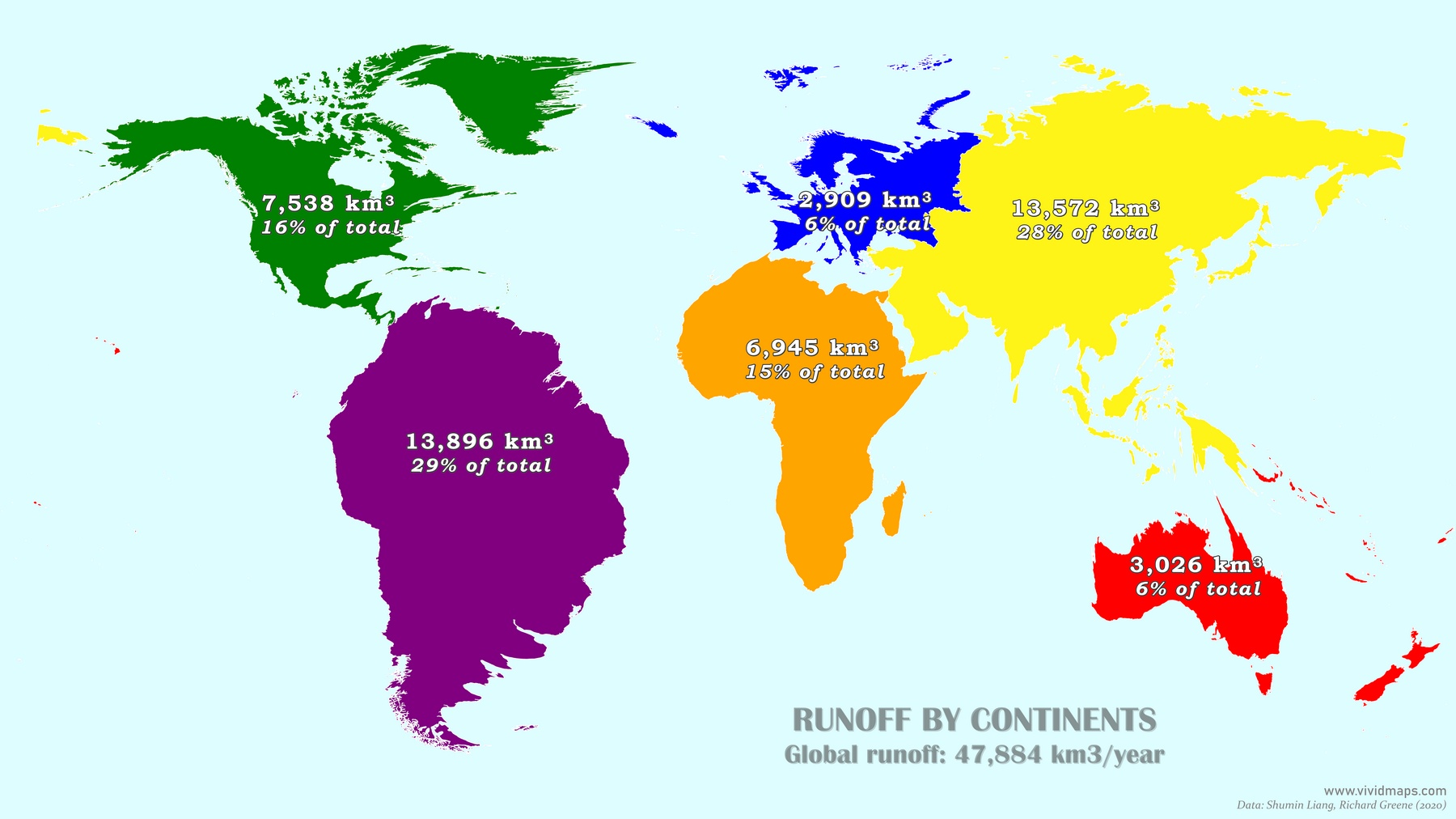
Water resources don’t distribute evenly across the planet. South America generates nearly 30% of global runoff while covering just 12% of Earth’s land surface. Europe produces only 6% of the world’s runoff despite its numerous rivers and relatively wet climate. Some regions have far more water than they need. Others don’t have enough.
A cartogram reshapes continents according to their annual runoff volume. South America swells. Europe and Australia shrink.
Runoff by Continent
The world generates 47,884 km³ of runoff per year (11,488 mi³). Distribution across continents:
| Continent | Annual Runoff (km³) | Annual Runoff (mi³) | Percentage |
| South America | 13,896 | 3,333 | 29% |
| Asia | 13,571 | 3,255 | 28% |
| North America | 7,538 | 1,808 | 16% |
| Africa | 6,944 | 1,666 | 14% |
| Oceania | 3,026 | 726 | 6% |
| Europe | 2,909 | 698 | 6% |
South America and Asia produce similar amounts. But Asia covers more than twice the land and holds 60% of the world’s population. South America? Only 6% of global population on 29% of the water.
Brazil experiences water shortages in its northeast even though the country sits on massive freshwater resources. Northern China imports water despite Asia generating seemingly adequate runoff. The issue isn’t total volume but where water actually flows. The visualization below, created by VisualCapitalist, shows the average discharge of the world’s most powerful rivers, the continents on which they are located, and the countries through which they flow.
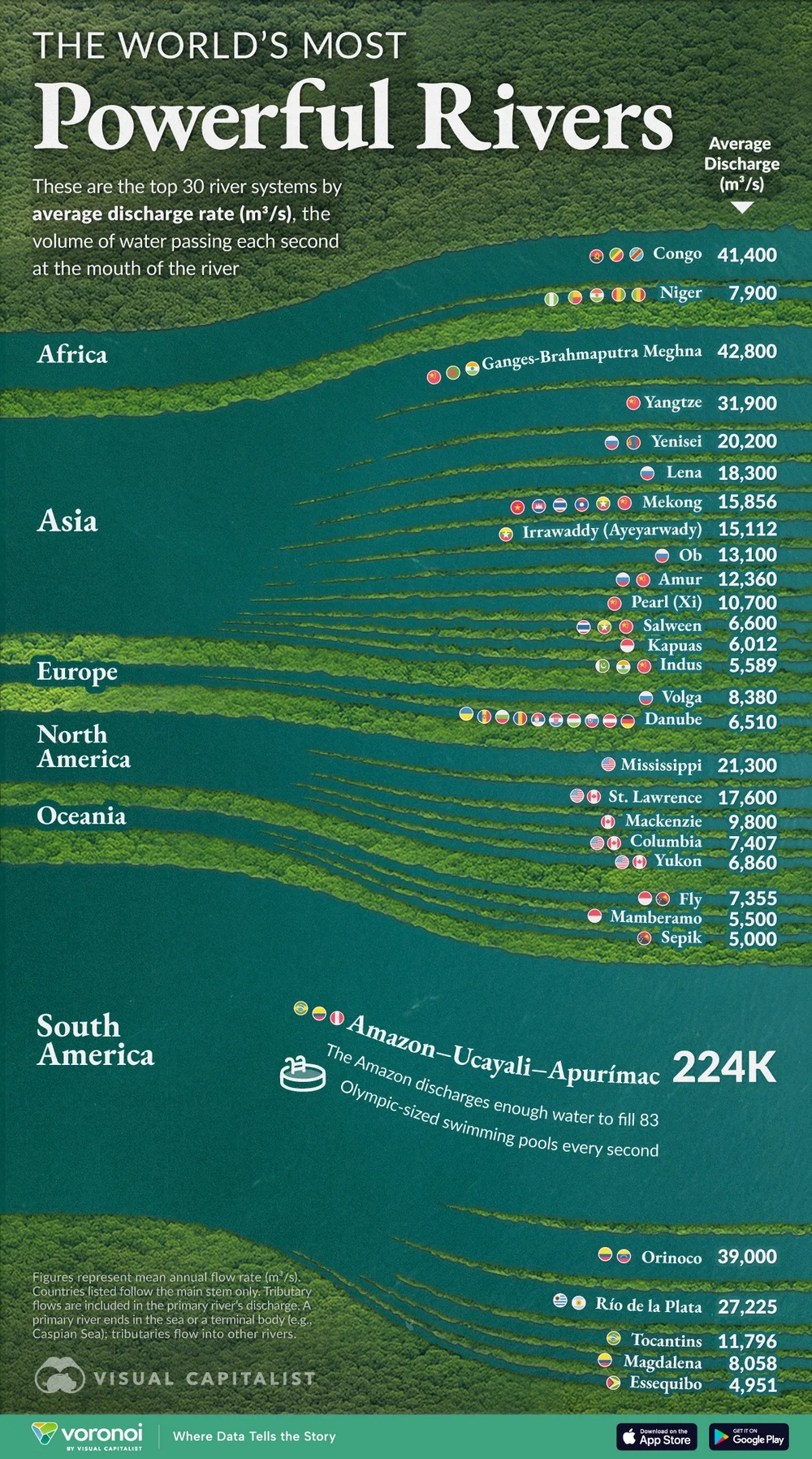
Top 30 Rivers
The Amazon discharges 209,000 to 224,000 m³/s depending on season (7.4 to 7.9 million ft³/s). The Ganges-Brahmaputra-Meghna, Congo, Orinoco, Yangtze, Río de la Plata, Mississippi, and Yenisei are the next seven largest rivers. Combined, they nearly match the Amazon by itself. One river moving about 20% of all freshwater into the oceans!
| Rank | River System | Region | Discharge (m³/s) | Discharge (ft³/s) |
| 1 | Amazon–Ucayali–Apurímac | South America | 224,000 | 7,910,000 |
| 2 | Ganges-Brahmaputra-Meghna | Asia | 42,800 | 1,511,000 |
| 3 | Congo | Africa | 41,400 | 1,462,000 |
| 4 | Orinoco | South America | 39,000 | 1,377,000 |
| 5 | Yangtze | Asia | 31,900 | 1,126,000 |
| 6 | Río de la Plata | South America | 27,225 | 961,000 |
| 7 | Mississippi | North America | 21,300 | 752,000 |
| 8 | Yenisei | Asia | 20,200 | 713,000 |
| 9 | Lena | Asia | 18,300 | 646,000 |
| 10 | St. Lawrence | North America | 17,600 | 621,000 |
| 11 | Mekong | Asia | 15,856 | 560,000 |
| 12 | Irrawaddy | Asia | 15,112 | 534,000 |
| 13 | Ob | Asia | 13,100 | 463,000 |
| 14 | Amur | Asia | 12,360 | 436,000 |
| 15 | Tocantins | South America | 11,796 | 416,000 |
| 16 | Pearl (Xi) | Asia | 10,700 | 378,000 |
| 17 | Mackenzie | North America | 9,800 | 346,000 |
| 18 | Volga | Europe | 8,380 | 296,000 |
| 19 | Magdalena | South America | 8,058 | 285,000 |
| 20 | Niger | Africa | 7,900 | 279,000 |
| 21 | Columbia | North America | 7,407 | 262,000 |
| 22 | Fly | Oceania | 7,355 | 260,000 |
| 23 | Yukon | North America | 6,860 | 242,000 |
| 24 | Salween | Asia | 6,600 | 233,000 |
| 25 | Danube | Europe | 6,510 | 230,000 |
| 26 | Kapuas | Asia | 6,012 | 212,000 |
| 27 | Indus | Asia | 5,589 | 197,000 |
| 28 | Mamberamo | Oceania | 5,500 | 194,000 |
| 29 | Sepik | Oceania | 5,000 | 177,000 |
| 30 | Essequibo | South America | 4,951 | 175,000 |
The Ganges-Brahmaputra-Meghna sits at number two with 42,800 m³/s (1.5 million ft³/s). Still under 20% of the Amazon. Hundreds of millions across India and Bangladesh rely on this system draining the Himalayas.
The Congo ranks third at 41,400 m³/s (1.5 million ft³/s). It crosses the equator twice. Different basin sections hit wet season at different times, keeping flow more consistent year-round than most tropical rivers.
Six South American rivers appear in the top 20. Asia places seven across a continent three times larger. Africa has two. The Volga ranks 18th at 8,380 m³/s (296,000 ft³/s). The Danube sits at 25th with 6,510 m³/s (230,000 ft³/s).
The Nile doesn’t make this list. Africa’s longest river discharges around 3,075 m³/s (109,000 ft³/s). The Sahara evaporates most of its water before the Mediterranean. Length and discharge don’t correlate.
South America controls nearly a third of global runoff using one-eighth of the land. The Amazon in one year moves what most rivers move in a decade.