Fly over the Congo Basin, the Amazon, or Siberia’s vast taiga and green stretches to every horizon. Those unbroken canopies feel infinite from above. Zoom out to the scale of the whole planet, though, and forest covers a smaller share of Earth’s surface than most people assume, just under a third, according to the newest global assessment. That share has been shrinking for decades, though the pace has slowed considerably. And the number looks completely different depending on which country you are looking at.
Key Takeaways
Forests cover 4.14 billion hectares of Earth right now, 41.4 million square kilometers or about 16 million square miles, which works out to 32 percent of all land on the planet
Net forest loss is still happening every year, but it has slowed sharply, down from 10.7 million hectares a year in the 1990s to 4.12 million hectares a year between 2015 and 2025
Five countries, Russia, Brazil, Canada, the United States, and China, hold 54 percent of all forest on the planet
Forest cover as a share of land ranges from zero in a handful of desert nations to 94.5 percent in Suriname, the most forested country on Earth by that measure
How Much Forest Covers the Planet
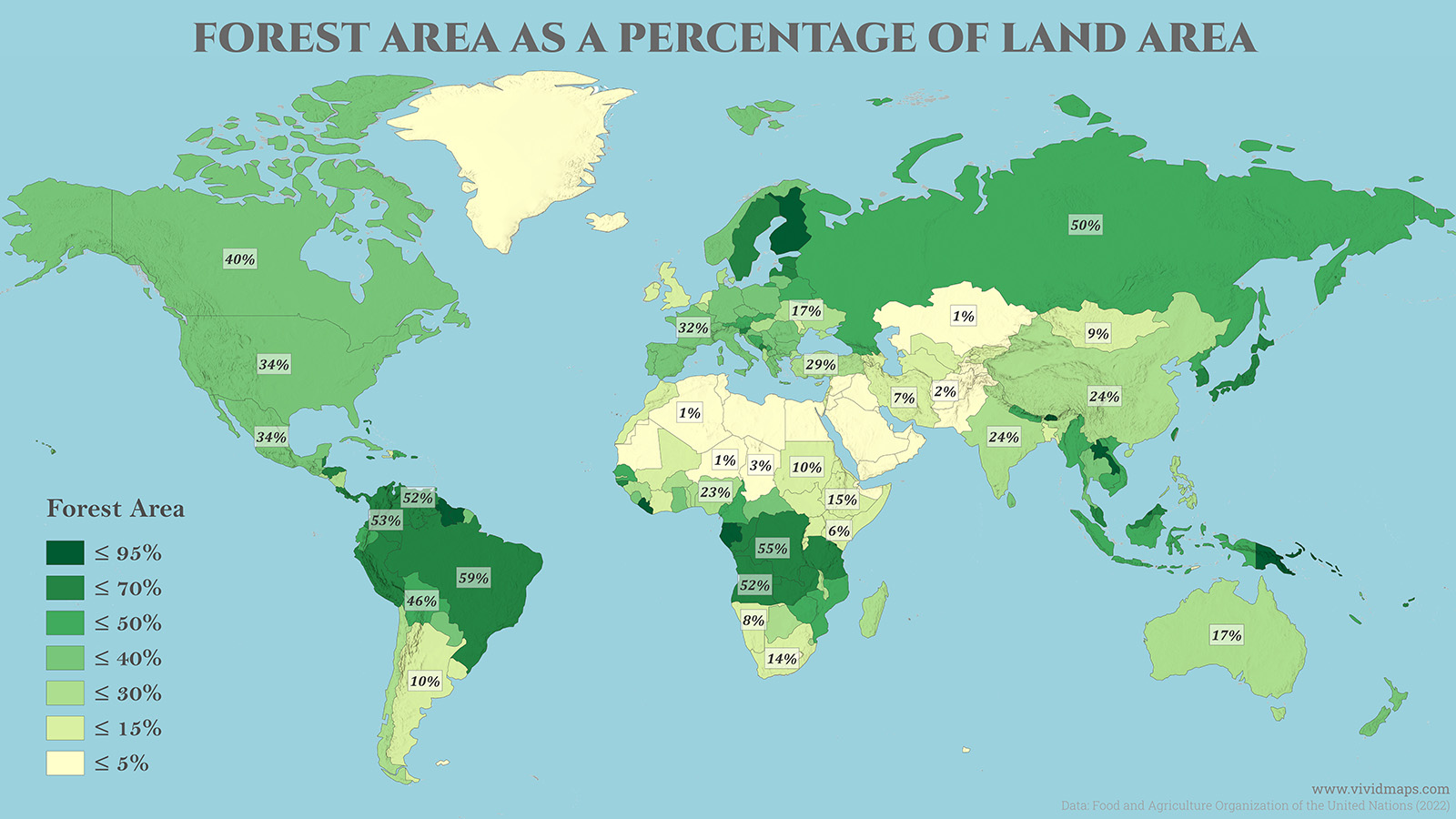
Forest still covers close to a third of Earth’s land overall, but that average hides huge swings between countries. The Food and Agriculture Organization’s newest global assessment reports a total forest area of 4.14 billion hectares, 41.4 million square kilometers or about 16 million square miles, which comes out to 32 percent of the planet’s land area. Nearly half of that total is tropical forest, with the rest split across boreal, temperate, and subtropical zones.
The map below breaks that 32 percent down country by country.
Rank
Country
Land Area
Forest Area
Forest Cover
1
Suriname
160,508 km2 (61,972 mi2)
151,718 km2 (58,579 mi2)
94.5%
2
Guyana
196,850 km2 (76,004 mi2)
183,969 km2 (71,031 mi2)
93.5%
3
Gabon
257,670 km2 (99,487 mi2)
235,068 km2 (90,760 mi2)
91.2%
4
Solomon Islands
27,990 km2 (10,807 mi2)
25,215 km2 (9,736 mi2)
90.1%
5
Equatorial Guinea
28,050 km2 (10,830 mi2)
24,317 km2 (9,389 mi2)
86.7%
6
Papua New Guinea
452,860 km2 (174,850 mi2)
357,887 km2 (138,181 mi2)
79.0%
7
Liberia
96,320 km2 (37,189 mi2)
75,569 km2 (29,177 mi2)
78.5%
8
Finland
303,948 km2 (117,355 mi2)
224,090 km2 (86,522 mi2)
73.7%
9
Brunei
5,270 km2 (2,035 mi2)
3,800 km2 (1,467 mi2)
72.1%
10
Laos
230,800 km2 (89,112 mi2)
165,265 km2 (63,809 mi2)
71.6%
11
Bhutan
38,140 km2 (14,726 mi2)
27,290 km2 (10,537 mi2)
71.6%
12
Guinea-Bissau
28,120 km2 (10,857 mi2)
19,631 km2 (7,580 mi2)
69.8%
13
Sweden
407,280 km2 (157,252 mi2)
279,800 km2 (108,031 mi2)
68.7%
14
Japan
364,500 km2 (140,734 mi2)
249,350 km2 (96,275 mi2)
68.4%
15
South Korea
97,600 km2 (37,684 mi2)
62,670 km2 (24,197 mi2)
64.2%
Five small, heavily forested nations dominate the top of that list, several of them countries most people could not place on a blank map. Naturally, none of them appear anywhere near the top when the measurement shifts from the percentage of land to total forest area.
That global share has been falling for a long time, though not at a steady pace. FAO tracks forest loss by decade, and the trend is more encouraging than most environmental headlines suggest.
Period
Deforestation, average per year
Net forest loss, average per year
1990 to 2000
17.6 million ha, 176,000 km2 (68,000 mi2)
10.7 million ha, 107,000 km2 (41,300 mi2)
2015 to 2025
10.9 million ha, 109,000 km2 (42,100 mi2)
4.12 million ha, 41,200 km2 (15,900 mi2)
Deforestation cut down more than 17 million hectares a year through the 1990s. By 2015 to 2025 that had fallen to under 11 million hectares a year, and after accounting for regrowth and new planting, net loss shrank from 10.7 million hectares annually to 4.12 million. Losses are still concentrated in Africa and South America, especially the Amazon and Congo Basin, while Europe has been gaining forest back through natural regrowth and new planting.
Which Countries Hold Most of the World’s Forest
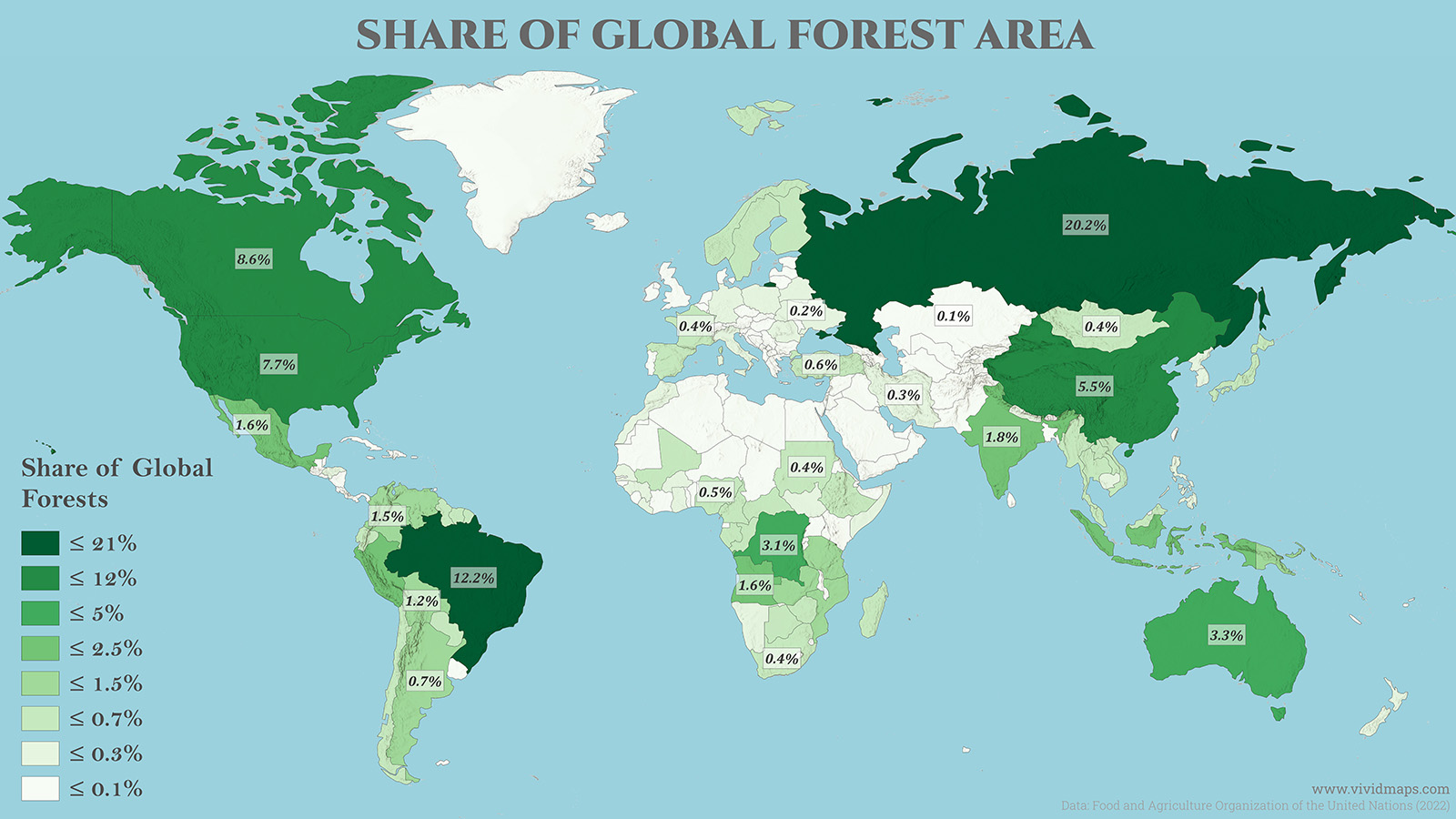
Obviously, being the largest country, Russia holds more forest than any other nation. Brazil, Canada, the United States, and China round out the top five. Together, those five countries account for 54 percent of all forest on the planet.
Rank
Country
Forest Area
Forest Cover
Share of World Forest
1
Russia
8,153,116 km2 (3,147,934 mi2)
49.8%
20.18%
2
Brazil
4,941,960 km2 (1,908,101 mi2)
59.1%
12.23%
3
Canada
3,468,541 km2 (1,339,211 mi2)
39.5%
8.59%
4
United States
3,097,950 km2 (1,196,125 mi2)
33.9%
7.67%
5
China
2,237,373 km2 (863,854 mi2)
23.8%
5.54%
6
Australia
1,340,051 km2 (517,396 mi2)
17.4%
3.32%
7
Democratic Republic of the Congo
1,239,525 km2 (478,583 mi2)
54.7%
3.07%
8
Indonesia
909,221 km2 (351,052 mi2)
48.0%
2.25%
9
India
726,928 km2 (280,668 mi2)
24.4%
1.80%
10
Peru
719,847 km2 (277,934 mi2)
56.2%
1.78%
11
Angola
654,973 km2 (252,886 mi2)
52.5%
1.62%
12
Mexico
654,365 km2 (252,652 mi2)
33.7%
1.62%
13
Colombia
587,433 km2 (226,809 mi2)
52.9%
1.45%
14
Bolivia
504,164 km2 (194,659 mi2)
46.5%
1.25%
15
Venezuela
461,268 km2 (178,096 mi2)
52.3%
1.14%
Compare Every Country’s Forest Cover
The interactive map below carries the same two measurements, forest share of land and share of the global total, for every country and territory on Earth. Click any country and it turns red, opening a full profile with its rank, land area, forest area, forest percentage, and share of world forest.