Roughly 300 million people get their New Year underway in March as the spring equinox shows up, passing right over that January 1 date. The word Nowruz comes from Persian, and it basically stands for a brand new day.
You can trace its origins back over 3,000 years to Zoroastrian practices in ancient Persia. UNESCO added Nowruz to their Intangible Cultural Heritage list in 2009, and the UN designated March 21 as International Nowruz Day the following year.
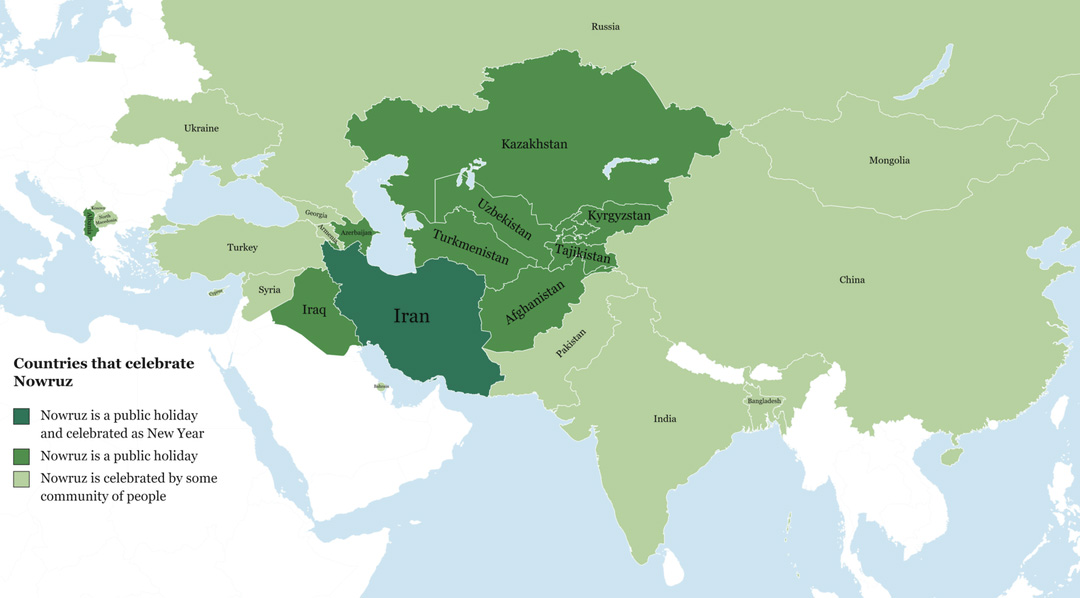
Here are the countries where Nowruz is an official public holiday:
Country
Holiday Length
Afghanistan
Public holiday
Albania
Public holiday (since 1996)
Azerbaijan
5 days
Iran
13 days (New Year)
Iraq
Public holiday (Kurdish areas)
Kazakhstan
3-4 days
Kyrgyzstan
Public holiday
Tajikistan
4 days
Turkmenistan
2 days
Uzbekistan
Public holiday
Iran celebrates Nowruz for 13 days straight, and the country essentially comes to a standstill during this time.
Today, countries like Kazakhstan, Kyrgyzstan, Tajikistan, Turkmenistan, and Uzbekistan all celebrate Nowruz as a public holiday. Before the Soviet Union collapsed, only Iran and Afghanistan marked it openly. The Soviets tried to suppress the holiday, but families continued their traditions quietly at home. After gaining independence in the 1990s, these countries quickly brought Nowruz back into public life.
I was a bit surprised to see Albania included. They have celebrated Nevruz, which is their spelling, as a holiday since 1996. Bektashi Sufis (Muslim Sufi Order in Albania) introduced it during Ottoman rule. The holiday marks both the start of spring and Ali ibn Abi Talib’s birthday.
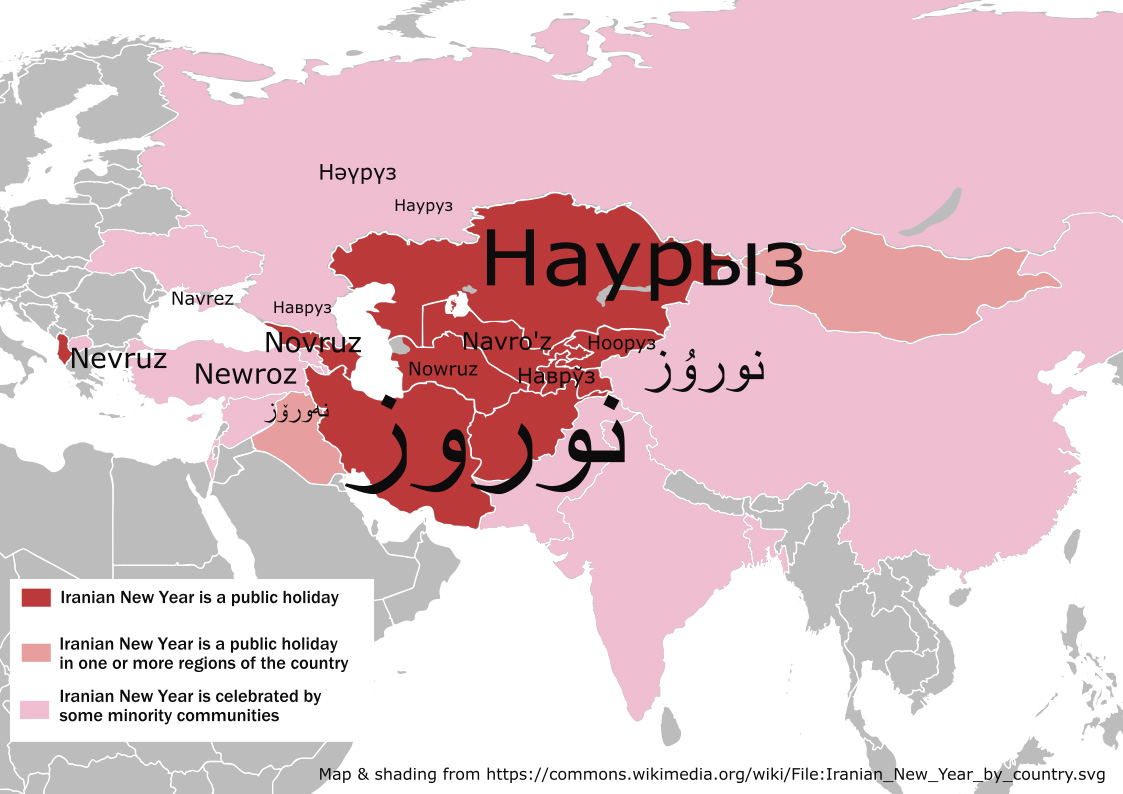
Lots of people celebrate Nowruz even if it’s not official. Kurdish people throughout Iran, Iraq, Syria, and Turkey. Parsis and Zoroastrians in India and Pakistan. And in Xinjiang, China, groups like Uyghurs, Tajiks, Salars, Kyrgyz, and Kazakhs stick with the tradition.
The term shifts a bit wherever you go. Iranians say Nowruz. Azerbaijan has it as Novruz. Kazakhstan calls it Nauryz. In Kyrgyzstan, Nooruz. Albania uses Nevruz. However you say or spell it, the core is always “new day.”
How People Celebrate
People start preparing before the holiday even begins. Iranians take on khane tekani, or literally “shaking the house”, and that means scrubbing down every last spot. New clothes get bought, and they add tulips and hyacinths around the home to make it feel lively.
Chaharshanbe Suri, which occurs on the last Wednesday before Nowruz, is one of the most visually impressive parts. People light bonfires in the streets and jump over them. As they’re jumping, they chant a request for the fire to take their sickness and give them warmth and energy back. If you’ve never seen an entire neighborhood doing this at once, it’s quite a sight.
A lot of Iranian families prepare what’s called a Haft Seen table (“Haft Seen” translates to “seven S’s”). You pick seven items that all start with the Persian letter seen (س).
Sabzeh (wheat or lentil sprouts)
Samanu (a sweet pudding)
Senjed (dried oleaster fruit)
Seer (garlic)
Seeb (apples)
Somāq (sumac berries)
Serkeh (vinegar)
Most families don’t stop there. They’ll add goldfish in a bowl, painted eggs, a mirror, candles. Often there’s a Quran or a book of Hafez’s poetry on the table too.
The food you see depends on the spot. Iranians could put together sabzi polo ba mahi with rice full of herbs served next to fish, or kookoo sabzi that’s a solid frittata packed with greens, and ash reshteh that combines noodles, beans, and herbs for a filling soup. Kazakhs assemble nauryz koje from seven specific items. Plov shows up a lot in Central Asia, that rice dish with meat and vegetables, and people from each spot insist theirs is unbeatable.
Day 13 comes as Sizdah Bedar. The idea is to picnic outdoors, because staying indoors is considered unlucky. Parks get absolutely packed with families eating, playing games, and throwing away the wheat sprouts from their Haft Seen tables—that’s meant to get rid of any bad luck that built up.
A Persistent Tradition
Nowruz has survived a lot. When Muslim armies conquered Persia back in the 7th century, the tradition kept going. It made it through Mongol invasions. When Soviet authorities spent decades trying to stamp it out in Central Asia, families just celebrated quietly in their homes. The moment those countries got their independence, Nowruz came right back into the open.
The celebration crosses religious lines pretty easily. Zoroastrians treat Nowruz as sacred. Shia Muslims celebrate it. So do Sunni Muslims. Secular people join in too.
The tradition is even expanding into new places. California has a huge Iranian population, and Nowruz has become a major event there. In 2024, Governor Gavin Newsom issued a proclamation recognizing March 19 as Nowruz Day.
Come the March equinox, balancing light and dark, hundreds of millions of people light fires, set tables, visit relatives, and mark a new beginning. The languages differ. Local customs vary. But the core idea stays the same: spring’s arrival means renewal.
In Iran, about 60% of the population is ethnically Persian, and large Kurdish and Turkic communities also celebrate Nowruz, so calling it only a ‘Turk’ holiday is inaccurate.





Novruz the holiday of TURK people , thats why the 300.000 millions !
In Iran, about 60% of the population is ethnically Persian, and large Kurdish and Turkic communities also celebrate Nowruz, so calling it only a ‘Turk’ holiday is inaccurate.