Medieval Oslo ended in a fire on 17 August 1624. King Christian IV had a new city built beside Akershus Fortress and named it Christiania. The old Oslo shrank to a suburb, kept its name for three centuries, and in 1925 the whole capital took it back.
The maps below follow that route, from a saga-era trading place to a capital with its original name restored.
Oslo was a town by about 1000 AD and Norway’s capital by around 1300. The 1624 fire destroyed it, and Christian IV rebuilt it west of the Bjørvika bay as Christiania. The old name survived on a suburb until 1 January 1925, when the entire city became Oslo again.
Key Takeaways
Archaeology places the first town at about 1000 AD, roughly half a century before the saga date of 1048.
Christiania was founded on 27 September 1624, about six weeks after the fire.
The city covered 16.9 km² (6.5 sq mi) until 1948, then 453.4 km² (175.1 sq mi) after merging with Aker.
Year
Event
Name in use
c. 1000
First urban settlement found by archaeologists
Áslo or Óslo
1048
Saga date for Harald Hardrada’s trading town
Áslo or Óslo
1314
Royal seal handed to the provost of St Mary’s, formal capital move
Oslo
1624
Fire on 17 August, Christiania founded on 27 September
Christiania
1859
Nearby suburbs, including old Oslo, join the city
Christiania
1877 and 1897
Spelling Kristiania adopted by the state, then by the city
Kristiania
1925
Whole city renamed, old suburb becomes Gamlebyen
Oslo
When was Oslo founded, 1048 or around 1000 AD?
The sagas credit King Harald Hardrada. Snorri Sturluson wrote that he had a market town built on the east side of Oslo, and the historian Peter Andreas Munch dated that to 1048.
Excavations moved the date back. Urban settlement shows up from about 1000 AD, and burials found by archaeologists predate the year 1000, which is why the city celebrated its 1,000th anniversary in 2000.
The name is Old Norse, Áslo or Óslo. Linguists read it as either the meadow below the hill or the meadow of the gods.
When did Oslo become the capital of Norway?
Magnus the Law-mender’s town law of 1276 set the limits of medieval Oslo. His son Håkon V became king in 1299, lived in Oslo and began building Akershus around 1300, so historians credit him with taking the capital role from Bergen.
Local history sources date the formal switch to 1314, when Håkon gave the royal seal to the provost of St Mary’s Church.
Why was Oslo rebuilt in a different place in 1624?
Most of the city burned from 17 August 1624, and the medieval town was practically wiped out. Christian IV ordered it rebuilt on the west side of the Bjørvika bay, close to Akershus. A fire in 1567 had produced the same decision, but nobody carried it out.
This time the king followed through. Christiania was founded on 27 September 1624 with straight streets in a grid, still visible today in the district Kvadraturen. New buildings were to be masonry instead of timber to limit fire risk (lokalhistoriewiki).
The old site kept the name Oslo as an area outside the city. Residents who owned plots there rebuilt anyway, whatever the king had said.
How fast did the city grow from 1859 to 1948?
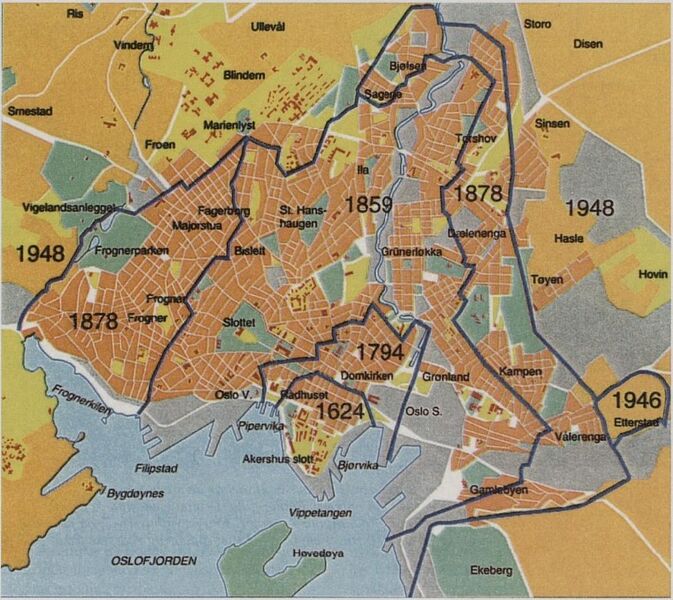
Early growth came in small steps. The merchant district’s boundary was first adjusted in 1784, and the largest of the early additions covered 347 dekar, about 0.35 km² (0.13 sq mi).
The 1859 expansion took in nearby suburbs, among them old Oslo, Grünerløkka and Sagene. In 1878 Frogner, Majorstuen, Torshov, Kampen and Vålerengen followed. Population climbed from under 10,000 in 1801 to nearly a quarter of a million by 1900.
The biggest jump came after the maps end. On 1 January 1948 the city merged with Aker, the municipality that surrounded it, and grew about 27 times larger. Aker alone covered 436 km² (168.3 sq mi) and had 130,976 residents.
Year
What changed
Area (km²)
Area (sq mi)
1859
Suburbs including old Oslo added
9.8
3.8
1878
Western and northern suburbs added
16.3
6.3
1947
Before the Aker merger
16.9
6.5
1948
After the Aker merger
453.4
175.1
Today
Municipal area
454.1
175.3
When did Christiania become Oslo again?
The spelling changed first. The state adopted Kristiania in 1877, and the city followed in 1897.
Meanwhile the old Oslo district had been inside the city since 1859. A law of 11 July 1924 gave the whole city the name Oslo from 1 January 1925. The change had been proposed in 1918 by 29 civil servants and caused plenty of debate. The old suburb became Gamlebyen, the Old Town.
Sixty-six years passed between the suburb joining the city and the city taking its name.