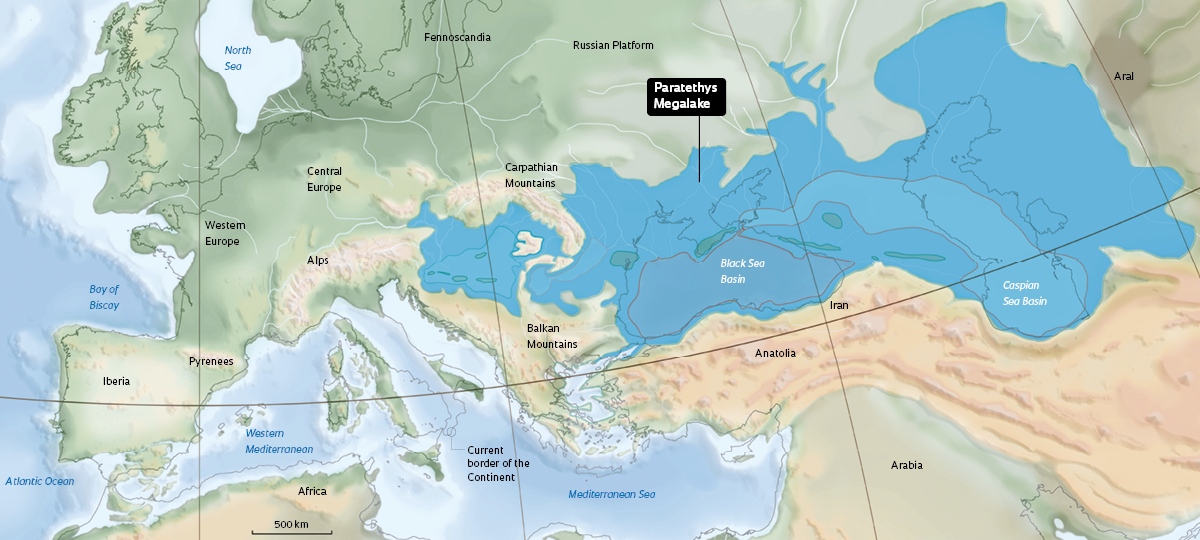
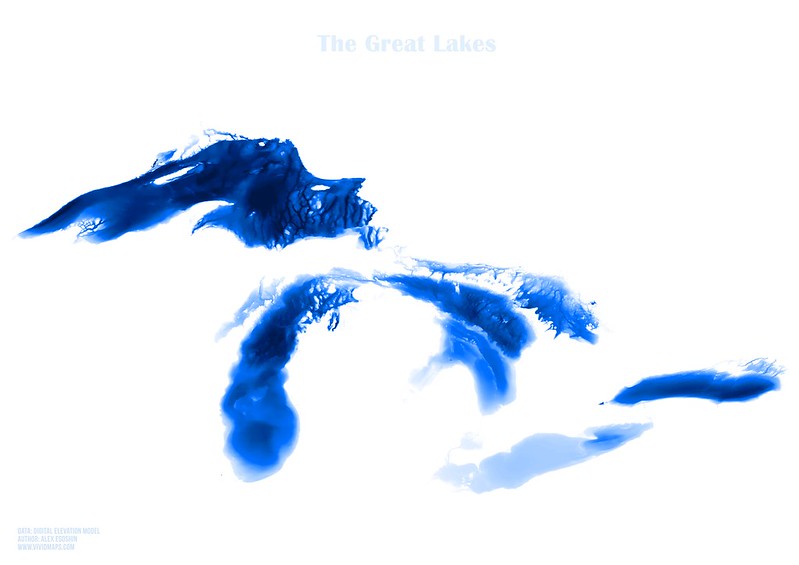
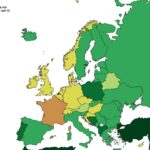
The Caspian Sea, at 386,000 square kilometers (149,000 square miles), is the largest lake on Earth today. Lake Paratethys, which existed twelve million years ago in the region between what is now the eastern Alps and Kazakhstan, covered 2.8 million square kilometers (1.08 million square miles). More than seven times larger. The Mediterranean today covers an area of roughly 2.5 million square kilometers (965,000 square miles), and the Paratethys was even larger. The water it held came to 1.77 million cubic kilometers (approximately 425,000 cubic miles), more than ten times the amount held by every lake on Earth combined. Paratethys had grown from the ancient Tethys Ocean before tectonic movement spent millions of years shutting off its connections to the sea, one passage at a time, until the whole thing became a landlocked basin with no parallel anywhere on Earth today. France, Spain, Germany, Sweden, Finland, Norway, Poland, Italy, the UK, Romania, Greece, Hungary, Portugal, Czechia, and Austria placed inside it at the same time would still not fill it.
Palcu, D.V. et al., “Late Miocene megalake regressions in Eurasia,” Scientific Reports, June 1, 2021.
Lake
Area (km²)
Area (mi²)
Paratethys (ancient, ~12 Ma)
2,800,000
1,081,000
Caspian Sea
386,000
149,000
Lake Superior
82,100
31,700
Lake Victoria
68,800
26,560
Lake Huron
59,570
23,000
Lake Michigan
57,757
22,300
Paratethys had a whale. Cetotherium riabinini, 3 meters (10 feet) long, living entirely in landlocked brackish water far from any ocean. The lineage this animal belonged to would eventually produce some of the largest creatures that ever lived — but not here. This branch had been isolated for millions of years and had its own trajectory. Seals shared the water with it. On the surrounding wetlands and shoreline, Deinotherium giganteum moved through the vegetation, a prehistoric elephant larger than anything alive today, its tusks pointing downward rather than forward.
Around 9.6 million years ago a dry period set in, stayed for an exceptionally long time, and pulled water levels down 150 meters (490 feet). The lake split. The central basin, roughly where the Black Sea sits now, turned hypersaline as the water concentrated. The outer zones swung toward fresh water. These animals had spent millions of years shaped by Paratethys’s specific chemistry, and the lake they now lived in had become something foreign to them. Most didn’t make it through. Eventually wetter years returned, the water came back, and whatever had scraped through spread back out. Then another dry period hit. Then a third.
That played out three times across roughly two million years. Each time the lake recovered it recovered a bit less completely. Then between 7.9 and 7.65 million years ago came the worst of them. Water dropped 250 meters (820 feet), whatever was left turned hypersaline and toxic, and most of what had scraped through the earlier crashes didn’t get through this one. Wout Krijgsman of Utrecht University, one of the co-authors, reached for a film reference when describing what that landscape must have looked like: “a postapocalyptic prehistoric world, an aquatic version of the wastelands from Mad Max.”
After a wetter period around 6.7 million years ago opened a connection through the Aegean Sea, Paratethys drained away into what we now call the Caspian, the Black Sea, and the Aral Sea. Palcu’s team found that the worst periods in Paratethys’s history coincided with droughts in Arabia and forests disappearing from Spain.
Some of Paratethys’s mollusks survived everything the lake went through and were still living around the Caspian when Soviet engineers connected the Volga and Don rivers by canal in the 1950s. They caught rides on ships, eventually reaching the Great Lakes of North America, where native species have largely been pushed out. An ancient lake collapse, a Soviet canal, a biological crisis in Canada. Twelve million years apart, but connected.