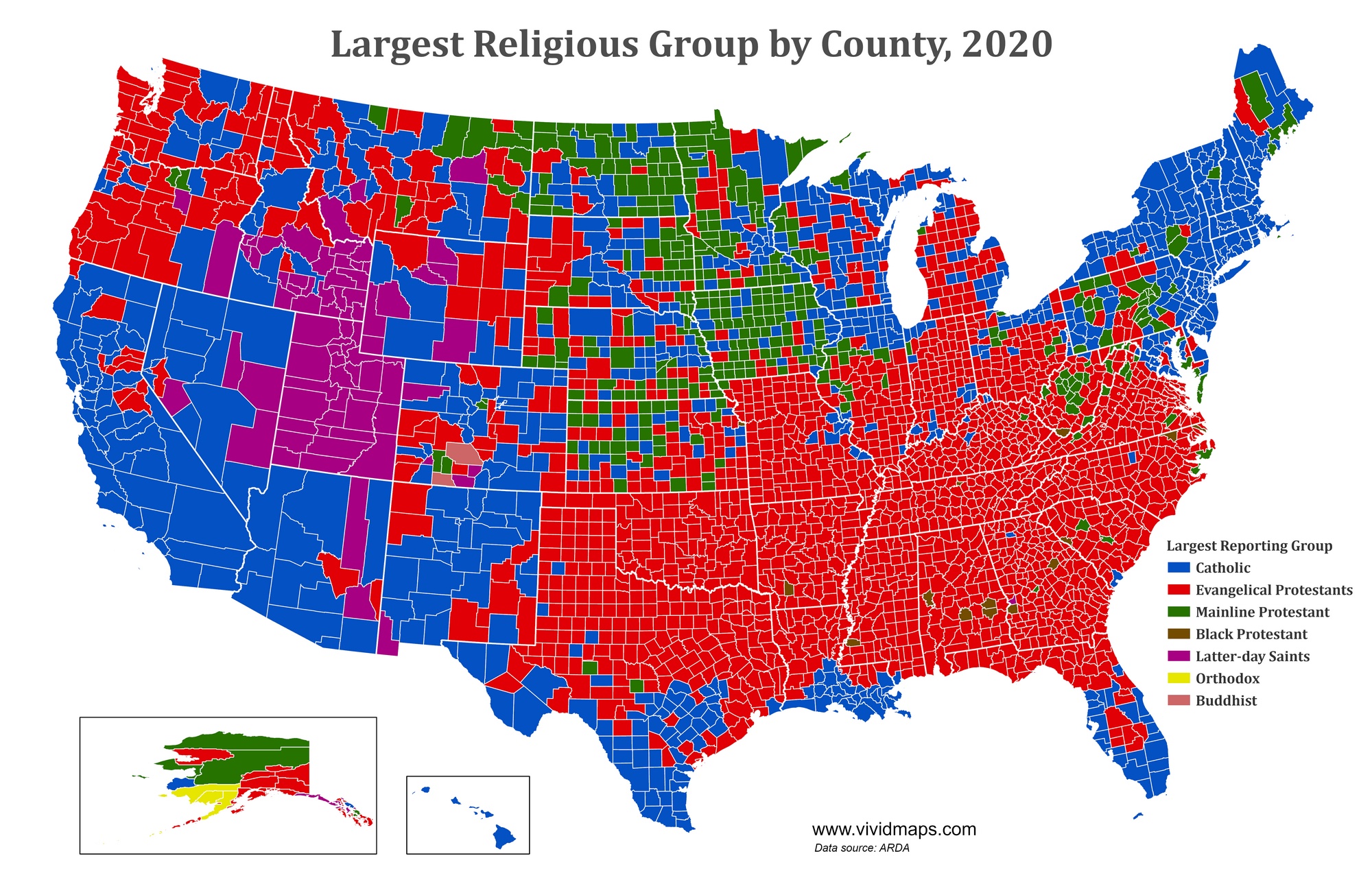
According to the Association of Religion Data Archives, around 2,000 US counties have Evangelical Protestants as their single largest religious group. Another 786 go to Catholics, 345 to Mainline Protestants, and 83 to Latter-day Saints.
Catholic strongholds stretch across the Northeast, much of the Southwest, and southern Louisiana. Spanish missionaries and French settlers were there first, and then came successive immigration waves from Ireland, Italy, Poland, and eventually Latin America, most of them landing in regions where Catholic communities already existed and where work was available nearby.
The South went Baptist through waves of evangelical revivals in the 1700s and 1800s. Rural communities built local congregations around personal faith, those congregations became central to everyday life, and not much has shifted since.
Utah stands apart from everything else on the map. Members of the Church of Jesus Christ of Latter-day Saints moved there in 1847 after repeated hostility further east, settled the land deliberately and communally, and built a religious culture that has remained remarkably concentrated ever since.
Lutheran concentrations in the Upper Midwest are a direct reflection of who farmed that land in the 1800s. German and Scandinavian families arrived, brought their congregations with them, and passed them on. Methodists ended up more spread out — traveling preachers covered enormous territory and reached frontier communities before most other denominations had any organized presence there.
Denomination / Group
% of U.S. Adults
Approx. Adherents
Evangelical Protestants
23%
~60 million
Catholics
19%
~50 million
Mainline Protestants
11%
~29 million
Historically Black Protestants
5%
~13 million
LDS (Mormons)
2%
~5 million
Other Christians (Orthodox, etc.)
1%
~3 million
At the national level, 62 percent of American adults still identify as Christian.