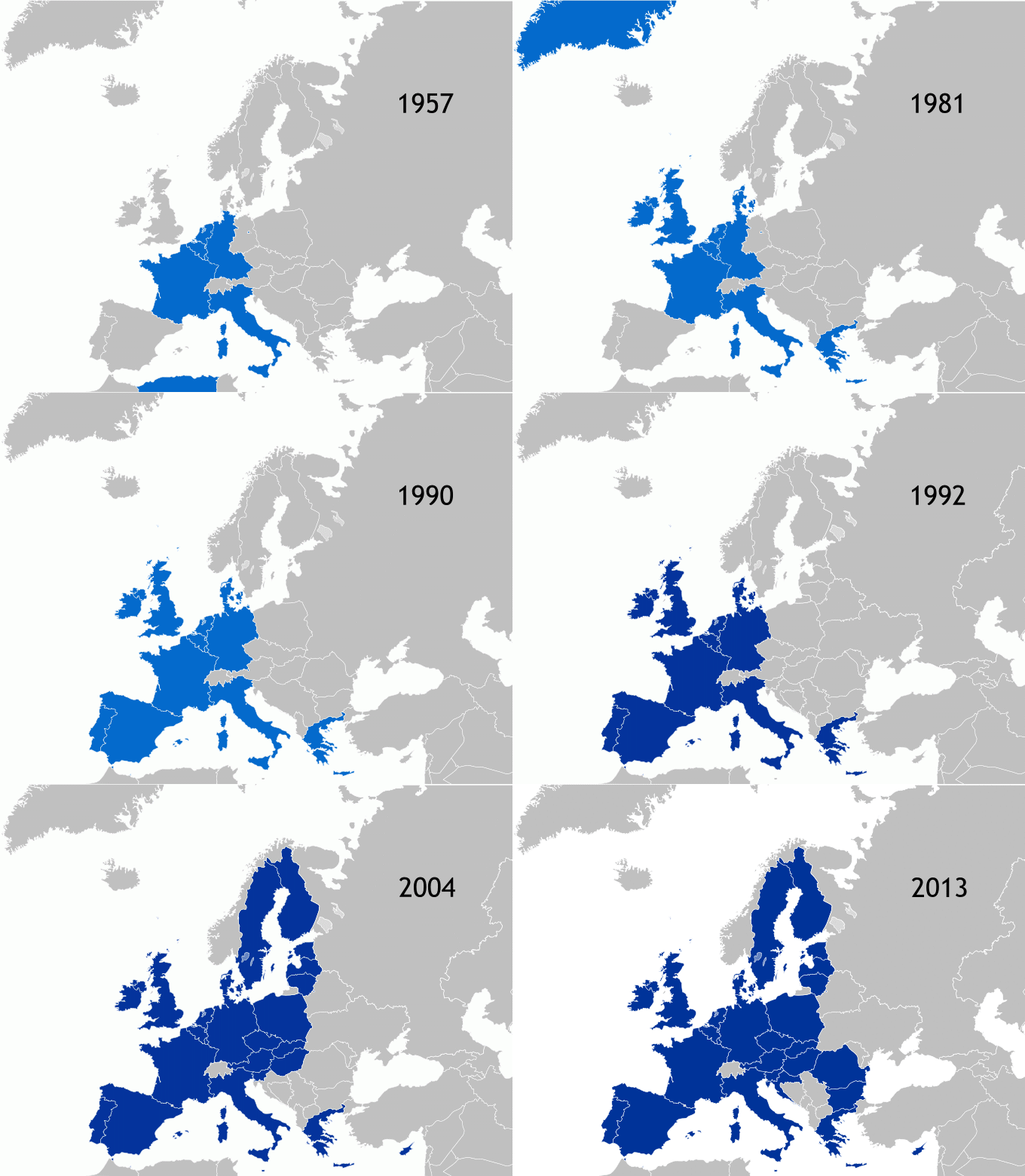
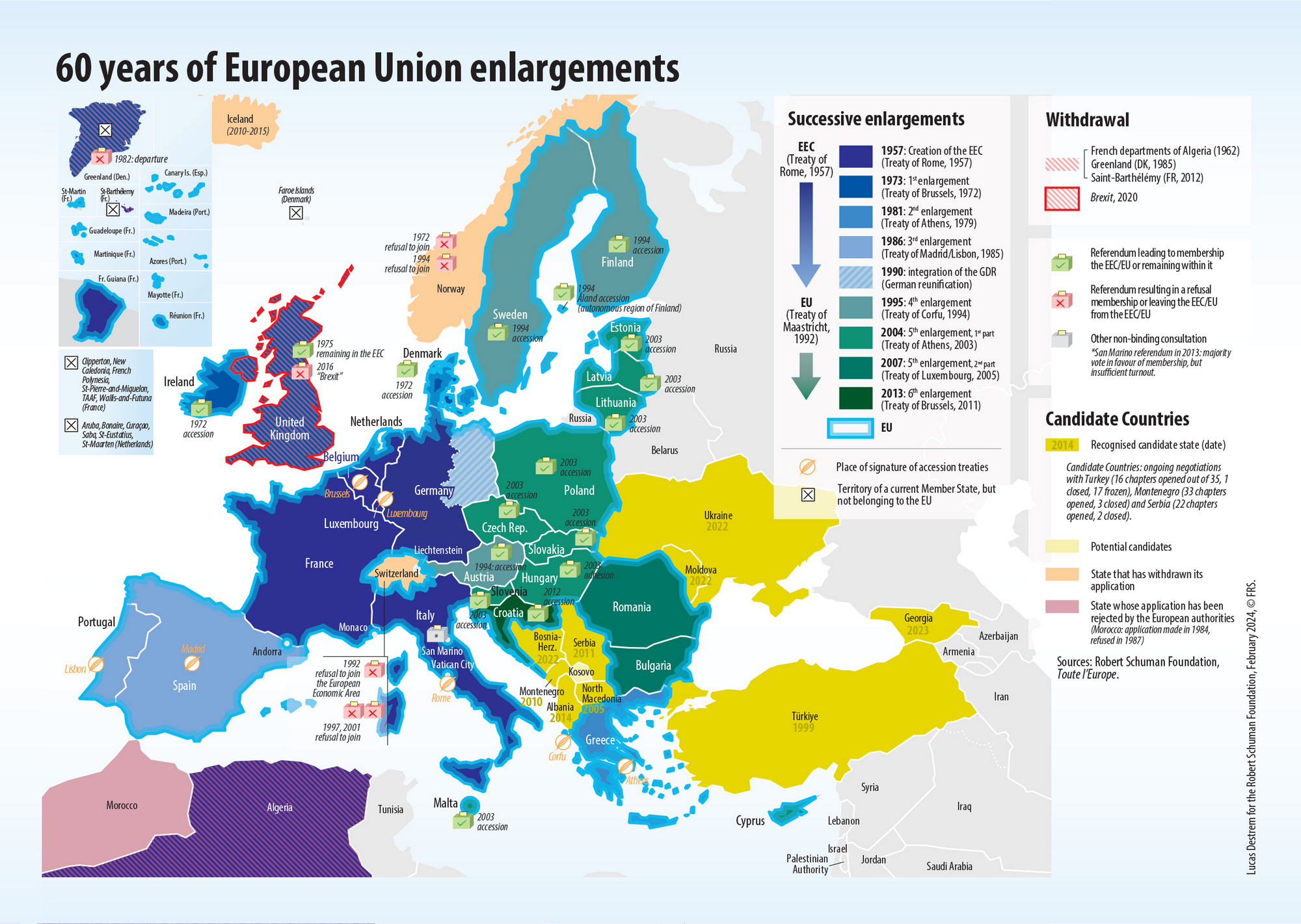
Anyone under the age of 40 has always known the EU to be a part of their lives. A borderless region for most member nations, a unified currency used throughout a large part of the continent, and the freedom to reside and be employed anywhere within a union of 450 million individuals. That wasn’t around 65 years ago.
Since 1870, France and Germany have engaged in warfare on three occasions. Robert Schuman’s proposal in May 1950 came just five years after the last one. Pool French and West German coal and steel under joint management, and the raw materials of modern warfare would be shared between potential enemies. In his declaration, conflict between them would become “not merely unthinkable, but materially impossible”. Italy, Belgium, Luxembourg, and the Netherlands joined in. The ECSC was up and running by 1952. Five years later the Treaty of Rome broadened the arrangement into a full common market. The EEC opened on 1 January 1958.
For 15 years nothing changed on the membership map, mostly because of Charles de Gaulle. He vetoed UK membership in 1963 and again in 1967, his reasoning laid out at a press conference in January 1963. British entry would eventually produce “a colossal Atlantic Community under American dependence and leadership, which would completely swallow up the European Community”. He resigned on 28 April 1969 after losing a domestic referendum he had personally staked his presidency on. Pompidou replaced him, a more pragmatic Gaullist who had not tied his prestige to the British membership issue. Denmark, Ireland, and the United Kingdom joined in January 1973.
Greece was the tenth to join, in 1981. Spain and Portugal followed five years later. For all three, membership wasn’t only about trade. Greece had come out of a military junta in 1974, Portugal out of the Estado Novo that same year, Spain two years past Franco’s death. EEC membership arrived partly as an anchor for democracies still on uncertain ground. The economics followed. Portugal averaged around 4.6% annual growth in the first two decades, doubling GDP in real terms. In 1986, the average Portuguese person’s purchasing power was nearly 55% of the EEC average. Today, it’s close to 75%. Spain has drawn over €185 billion in EU structural funds since joining, money spent on motorways, agricultural modernisation, and employment programs.
When Germany reunified in October 1990, the former GDR came inside the Community the same day. No membership application, no accession process. Maastricht in 1993 converted the EEC into the EU. Austria, Finland, and Sweden joined two years later.
On 1 May 2004, ten countries joined the same day. Cyprus, the Czech Republic, Estonia, Hungary, Latvia, Lithuania, Malta, Poland, Slovakia, and Slovenia. Nothing before or since has come close in scale, either by population or by number of countries. Bulgaria and Romania joined in January 2007. Croatia came last, in July 2013.
Poland’s unemployment was 19% when it joined. By 2024 it was around 3%, with real GDP doubled and exports up sixfold. The Polish Economic Institute ran a counterfactual to separate what membership contributed from general post-communist growth trends, finding Poland’s GDP per capita 39.6% higher by 2022 than it would have been outside the EU. Lithuania’s premium was even larger, at 60.3%. In 2004 Lithuania’s purchasing power was roughly half the EU average. By 2024 that figure was 87.5%. The Czech Republic was about 30% below the EU average in 2004. By 2024, 91%.
Country
Year Joined
Enlargement
Treaty
Belgium
1958
Founding Member (EEC)
Treaty of Rome (1957)
France
1958
Founding Member (EEC)
Treaty of Rome (1957)
West Germany
1958
Founding Member (EEC)
Treaty of Rome (1957)
Italy
1958
Founding Member (EEC)
Treaty of Rome (1957)
Luxembourg
1958
Founding Member (EEC)
Treaty of Rome (1957)
Netherlands
1958
Founding Member (EEC)
Treaty of Rome (1957)
Denmark
1973
1st Enlargement
Treaty of Brussels (1972)
Ireland
1973
1st Enlargement
Treaty of Brussels (1972)
United Kingdom*
1973
1st Enlargement
Treaty of Brussels (1972)
Greece
1981
2nd Enlargement
Treaty of Athens (1979)
Portugal
1986
3rd Enlargement
Treaty of Madrid/Lisbon (1985)
Spain
1986
3rd Enlargement
Treaty of Madrid/Lisbon (1985)
East Germany (GDR)
1990
German Reunification
Reunification Treaty (1990)
Austria
1995
4th Enlargement
Treaty of Corfu (1994)
Finland
1995
4th Enlargement
Treaty of Corfu (1994)
Sweden
1995
4th Enlargement
Treaty of Corfu (1994)
Cyprus
2004
5th Enlargement, Part 1
Treaty of Athens (2003)
Czech Republic
2004
5th Enlargement, Part 1
Treaty of Athens (2003)
Estonia
2004
5th Enlargement, Part 1
Treaty of Athens (2003)
Hungary
2004
5th Enlargement, Part 1
Treaty of Athens (2003)
Latvia
2004
5th Enlargement, Part 1
Treaty of Athens (2003)
Lithuania
2004
5th Enlargement, Part 1
Treaty of Athens (2003)
Malta
2004
5th Enlargement, Part 1
Treaty of Athens (2003)
Poland
2004
5th Enlargement, Part 1
Treaty of Athens (2003)
Slovakia
2004
5th Enlargement, Part 1
Treaty of Athens (2003)
Slovenia
2004
5th Enlargement, Part 1
Treaty of Athens (2003)
Bulgaria
2007
5th Enlargement, Part 2
Treaty of Luxembourg (2005)
Romania
2007
5th Enlargement, Part 2
Treaty of Luxembourg (2005)
Croatia
2013
6th Enlargement
Treaty of Brussels (2011)
*The United Kingdom left the EU on 31 January 2020.
The UK left in January 2020. North Macedonia and Bosnia and Herzegovina have been in accession talks since 2022 and 2024 respectively, with Ukraine and Moldova in the process too. When any of them actually join is anyone’s guess.