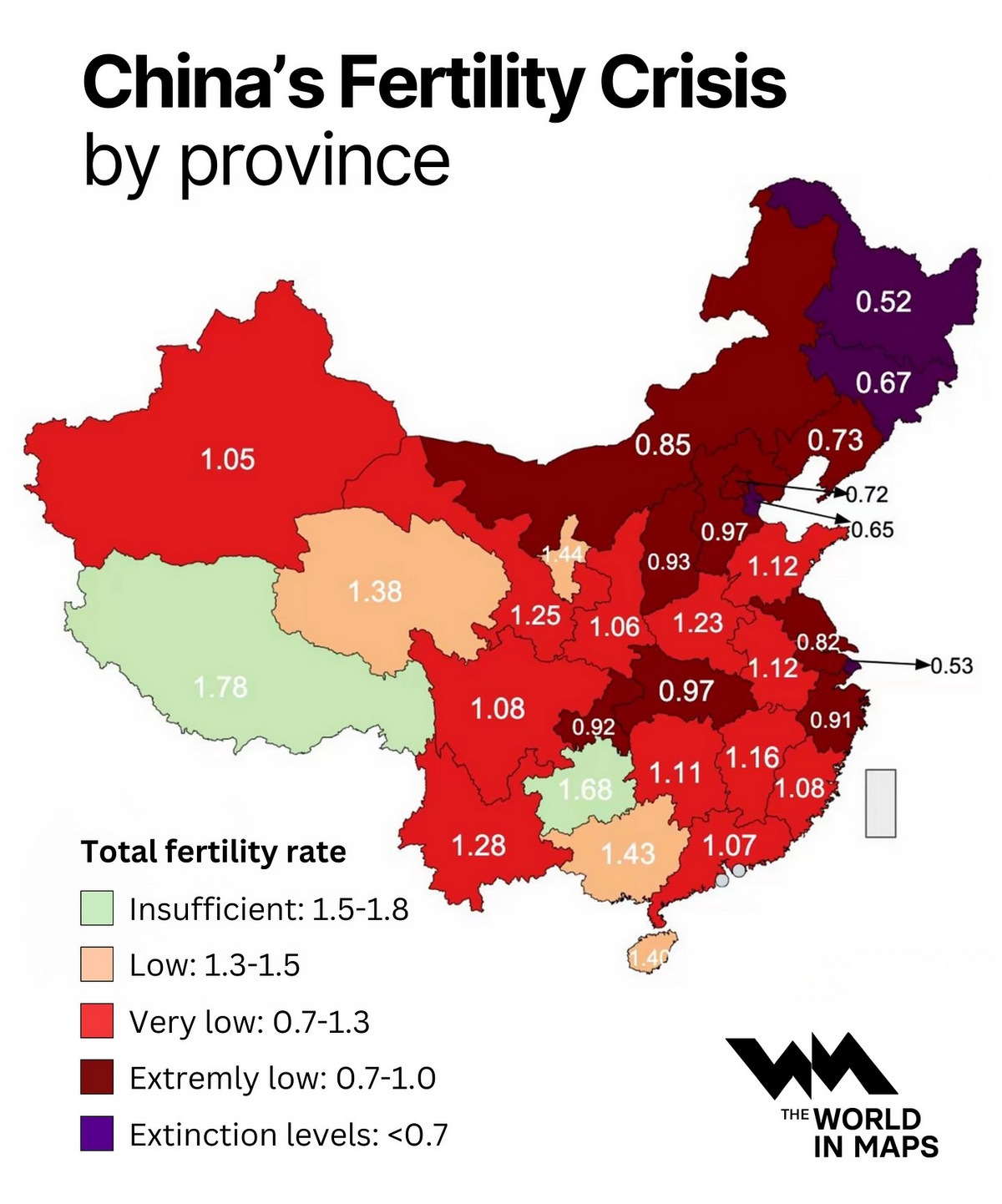
China was the world’s most populous country for generations. That changed in April 2023 when India took over. The distance between them keeps growing. China’s population has now fallen for four straight years.
How low has fertility gone? Try 1.0 child per woman in 2023. You need 2.1 just to maintain current numbers. Do the math and you’ll see each generation is replacing itself at less than half the necessary rate.
Look at the map and you’ll notice the crisis isn’t hitting everywhere equally. Guizhou province? 1.68 children per woman. Heilongjiang in the northeast? Just 0.52. Shanghai sits at 0.53. Demographers use the term “extinction-level fertility” to describe these numbers. Without massive immigration, populations at these levels eventually disappear.
The one-child policy ran from 1979 to 2015. Most people assume that’s the main reason fertility collapsed. Actually, the policy accounts for only 38% of the decline. The remaining 62%? Those are economic pressures that stuck around after the policy ended.
Take housing. Property prices in cities and coastal regions have made it nearly impossible for young couples to afford starting families. When your rent or mortgage eats up most of your income, having children becomes a financial impossibility. Childcare costs, food prices, everything connected to housing has climbed too.
Education is another huge factor. A decade ago, one in twenty young people went to college. Now it’s one in three. That expansion created intense competition for university spots. Parents spend enormous sums on tutoring and test preparation. Many feel they can only afford to invest in one child’s educational future.
Then there’s the cultural transformation. Work demands have intensified for young people. Women especially struggle with the career-family balance. A lot of couples now think one child is plenty. Some skip having kids altogether. The government has rolled out better maternity benefits and cheaper childcare programs. Young couples aren’t buying it.
The 2024 UN World Population Prospects report has China’s population dropping to 1.3 billion by 2050, then 633 million by 2100. The UN notes China “will likely experience the largest absolute population loss between 2024 and 2054” of any country.
Here’s something interesting. Compare China to the United States. America’s fertility rate sits around 1.6, also below replacement level. But America’s population grows through immigration while China experiences net emigration. Check out these projections:
Year
China
United States
2025
1.41 billion
347 million
2050
1.21 billion
389 million
2100
633 million
421 million
Right now China has about four times the US population. By 2100? Just 1.5 times as many people. In three generations, the demographic relationship between these countries will flip.
India currently has 1.45 billion people. The country will grow to about 1.7 billion by the early 2060s, then fall back to roughly 1.5 billion by 2100.
What happens to China with all these demographic changes? Pension systems will strain under fewer workers supporting more retirees. Healthcare systems face similar pressures. Economic growth gets harder. The northeastern provinces show what’s ahead. Their cities are shrinking, schools have shut down, and the elderly outnumber working-age residents by growing margins.
Government attempts to boost births haven’t worked. Better maternity leave? Doesn’t help. Lower education costs? Not enough. Improved childcare? Still not working. The problem isn’t benefits. It’s that housing prices remain astronomical. Kids cost money that young families simply don’t have.