The Arctic remained largely unexplored for centuries because traveling there meant risking death. The North Pole sits roughly 800 kilometres, 497 miles, from the nearest shore and it rests on a shifting skin of ice above a basin more than four kilometres deep (13,123 feet). Robert Peary finally reached it in 1909 after losing half his toes to frostbite. Frederick Cook’s group nearly starved.
Technology opened things up first with submarines and icebreakers and satellites. At the same time the climate warmed and the calendar of ice shortened. Satellites have watched summer ice shrink since 1979, losing on average about 12 percent every decade. Routes that used to be blocked for months at a time are now open longer. Russia already moves cargo along the Northern Sea Route for much of the year. Some climate models still point to summers with almost no ice by 2030.
Why the scramble? Treasure and transit. According to the U.S. Geological Survey, the Arctic seabed holds tens of billions of barrels of oil and over a thousand trillion cubic feet of gas. Greenland is also believed to have about 1.5 million tonnes of rare earths, which are important for batteries and electronics. Shipping through the Arctic can cut almost three weeks off the journey from Asia to Europe compared to using the Suez Canal. When time is money, those savings add up fast.
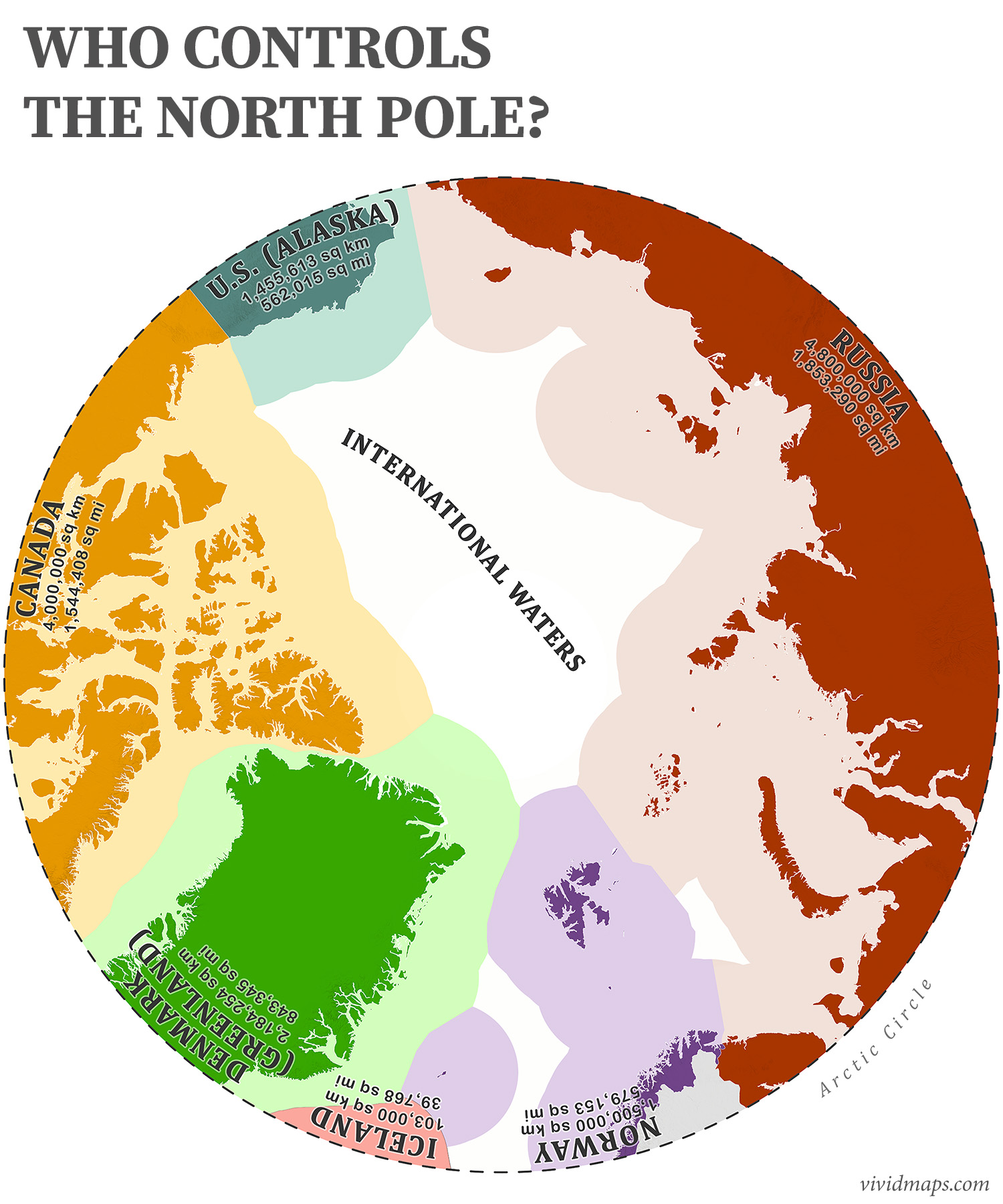
Six countries have drawn territorial claims.
Country
Area (Approx. sq km)
Area (Approx. sq mi)
Russia
4,800,000
1,853,290
Canada
4,000,000
1,544,408
Denmark (Greenland)
2,184,254
843,345
Norway
1,500,000
579,153
United States
1,455,613
562,015
Iceland
103,000
39,768
Russia reopened over 50 military bases since 2014. Thirteen airfields, 10 radar stations. They’ve got eight nuclear icebreakers running. Everyone else combined? Three, maybe. Year-round Arctic access while others can’t.
Canada says the Northwest Passage is theirs. The U.S. calls it international waters. Both run military drills there now.
Greenland matters because China makes 60% of the world’s rare earths. Denmark filed their Arctic claim in December 2014. It overlaps with Russia’s claim.
The map shows 90°N falls outside everyone’s 200-mile zones. International law says that’s open ocean. Countries keep filing claims anyway, saying underwater ridges connect to their land.
Russia filed for the Lomonosov Ridge in February 2023. It’s an 1,800-kilometer (1,118-mile) underwater mountain range. They say it extends from Siberia. Canada filed in December 2022 saying it’s connected to North America. Denmark sided with Canada. The U.N. checks the geology but won’t pick sides. Countries have to negotiate directly. That takes decades.
Norway approved Arctic drilling for 2025. Sweden’s LKAB found 1+ million tons of rare earth oxides near Kiruna in 2023. Norway found bigger deposits at Fen Carbonatite. China built polar icebreakers and calls itself “near-Arctic” despite being nowhere close.
Russia’s icebreakers run all year. Their bases cover the whole Arctic coast. The U.S. talks expansion but hasn’t built the ships. Finland and Sweden joining NATO added northern territory, but Russia already had their infrastructure up.
Who controls the Arctic? Whoever can operate ships and bases up there. Russia’s got that now. Trump wants Greenland’s rare earths and location. China’s building icebreakers anyway. Trillions in resources guarantee this keeps going.



Here is an interesting map created by Al Jazeera that shows military bases in the Arctic.